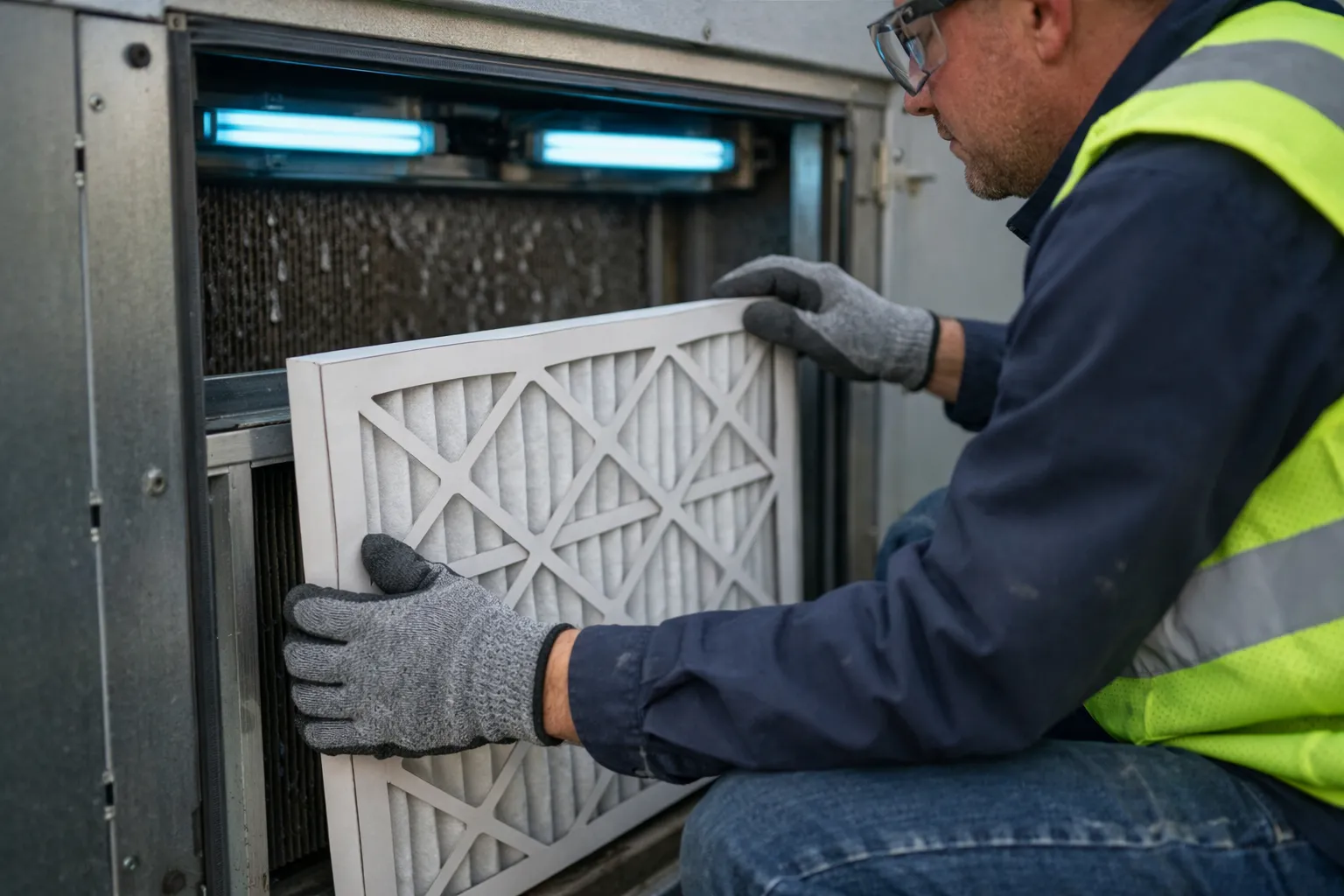
Building owners and facilities teams continue to balance two competing goals: improving indoor air quality (IAQ) to reduce airborne disease risk and maintaining low energy and operating costs. Since 2020, many office portfolios implemented continuous MERV‑13 filtration and coil UV‑C as default upgrades. Between 2023 and mid‑2026, a growing body of modeling studies, vendor performance reports, and field notes has clarified the real tradeoffs. This article synthesizes that evidence into practical metrics and retrofit strategies HVAC enthusiasts can use to evaluate or specify MERV‑13 plus UV‑C upgrades.
What MERV‑13 + UV‑C actually changes
Upgrading an air handling unit (AHU) from typical MERV‑8 to continuous MERV‑13 filtration plus adding UV‑C aimed at coil disinfection affects three main areas:
- Particle removal and infection risk: MERV‑13 removes a higher fraction of sub‑micron and 1–3 µm particles than MERV‑8, lowering occupant exposure to aerosols and, by proxy, some airborne pathogens.
- Fan energy and pressure drop: Higher‑efficiency media typically introduces greater initial and loaded pressure drop. If the fan is operated to maintain design flow, electrical power rises.
- Coil performance and maintenance: UV‑C reduces biological growth on coils and drip pans, helping maintain heat‑exchange efficiency and reducing manual cleaning frequency, at the cost of additional lamp electrical load and lamp replacement cycles.
Quantifying the energy penalty: typical ranges and why they vary
Two numbers drive fan energy: the change in total external static pressure (ESP) across the airside system, and how the fan is controlled. The effect of a filter upgrade depends on initial filter type, filter positioning (preheat or after cooling coil), duct losses, and how close the fan is to its design point.
- Observed initial filter pressure drops for packaged AHUs: typical MERV‑8 pleated media ≈ 0.06–0.12 in. w.g.; MERV‑13 pleats ≈ 0.10–0.25 in. w.g. (ranges depend on manufacturer and pleat depth).
- When upgrading without other changes, modeled and supplier test data commonly indicate an additional 0.05–0.15 in. w.g. of ESP.
- Fan energy impact: with VAV systems or VFDs that increase fan speed to preserve flow, a 0.05–0.15 in. w.g. ESP increase typically translates to roughly a 3–12% increase in fan motor energy for systems already near design pressure. Systems operating at low baseline ESP or with spare fan capacity will see smaller increases; older or near‑stall fans can see higher penalties.
Key takeaway: energy penalty is sensitive to the baseline system. Before specifying MERV‑13 across a portfolio, measure baseline ESP and fan headroom.
UV‑C on coils: small steady load, outsized maintenance upside
UV‑C systems for coils are electrically modest but operationally impactful:
- Typical installed lamp power per AHU coil bank ranges from ~30 W (small split systems) to 150–300 W (large commercial coils) depending on coil length and number of lamp banks.
- Annual energy consumption per AHU is therefore often in the 30–2,500 kWh range depending on size and run hours. For 24/7 operation in an office AHU, expect on the order of 100–700 kWh/year for mid‑sized systems.
- UV‑C can restore heat exchanger effectiveness lost to biofilms and keep fin spacing cleaner between scheduled coil cleanings. Vendors and several facility studies report reduced pressure drop across coils and improved heating/cooling capacity after installation—operational savings that partially offset lamp energy and replacement costs.
UV‑C lamp replacement cycles and safety controls (interlocks, irradiance shields, worker training) are essential budget and operational considerations.
IAQ benefits: particles, not CO2
MERV‑13 upgrades primarily reduce aerosol particles. They do not reduce occupant‑generated CO2, and therefore cannot replace outdoor air requirements for dilution. Specific benefits include:
- Particle removal: MERV‑13 captures a higher fraction of 0.3–3 µm particles. In steady‑state filtration models, equipping central filtration with continuously operated MERV‑13 (versus MERV‑8) often cuts steady‑state airborne particle concentration by 30–70%, depending on air change rate, recirculation fraction and indoor particle sources.
- Infection risk: Using simple Wells‑Riley style calculations, the reduced aerosol concentration from better filtration yields proportional reductions in airborne infection risk for a given exposure time—effective when pathogen transmission is primarily aerosol mediated.
- No direct effect on VOCs or CO2: source control and ventilation strategy remain primary levers for gases.
Lifecycle cost comparison—what to budget
When evaluating an upgrade, consider four cost buckets:
- Capital and installation: filter frames, filter racks (deep‑pleat vs bag), UV‑C fixtures, wiring and controls. Retrofitting UV‑C into cramped AHUs can be labor‑intensive.
- Incremental energy: increased fan energy plus UV‑C lamp consumption.
- Filter and lamp replacement: MERV‑13 media and bag filters cost more per change; UV‑C lamps typically need replacement every 9–18 months depending on hours and irradiance.
- Maintenance savings: reduced coil cleaning, fewer microbial remediation episodes, potential HVAC performance recovery.
In many mid‑sized office scenarios, payback on energy and maintenance alone is often multi‑year. The non‑energy benefit—reduced illness absenteeism or tenant confidence—can justify the upgrade in competitive markets even where direct energy payback is slow.
Practical retrofit and specification guidance
To get the IAQ benefits while minimizing energy surprises, use these practical steps:
- Measure baseline ESP and fan curves: before specifying MERV‑13, record current filter DP, coil DP, and fan speed capability.
- Prefer pleated MERV‑13 with lower initial DP: deep‑pleat or extended surface filters deliver high efficiency with lower incremental pressure drop than some compact box media.
- Stage filtration and fan control: use delta‑P monitoring and VFDs so the fan can trim speed rather than run at rigid setpoints; sequence higher filtration when occupancy is highest.
- Combine with HVAC tuning: where feasible, re‑balance ducts and clean coils before upgrade to avoid magnifying fan penalties from clogged downstream restrictions.
- UV‑C placement and controls: install lamps on the coil face for maximum microbiological impact; interlock lamps with access doors and include control monitoring for lamp life and irradiance when possible.
- Monitor outcomes: install particle counters, differential pressure sensors, and track energy and cleaning intervals post‑upgrade to build an evidence base for portfolio decisions.
When to consider alternatives or complements
MERV‑13 + UV‑C is not always the optimal first step. Consider:
- In buildings with limited fan headroom: using a staged approach—prefilters, increased OA, or upgrading to a different fan with higher capacity—may be necessary.
- When gas‑phase contaminants are dominant: add sorbent filtration or source controls; MERV‑13 is ineffective for VOCs.
- For targeted infection control: portable HEPA units or upper‑room UVGI can supplement rather than replace central upgrades, especially in rooms with high occupant density.
Bottom line for HVAC enthusiasts
Continuous MERV‑13 filtration plus coil UV‑C delivers meaningful particle removal and real operational benefits—especially in portfolios where tenant health perception or disease mitigation is a priority. However, these gains come with measurable fan energy penalties and ongoing lamp/filter expenses. The smartest implementations are not blanket upgrades but measured, instrumented projects: baseline measurements, staged retrofits, VFD and control tuning, and performance monitoring. That approach preserves IAQ benefits while controlling energy and lifecycle costs.