
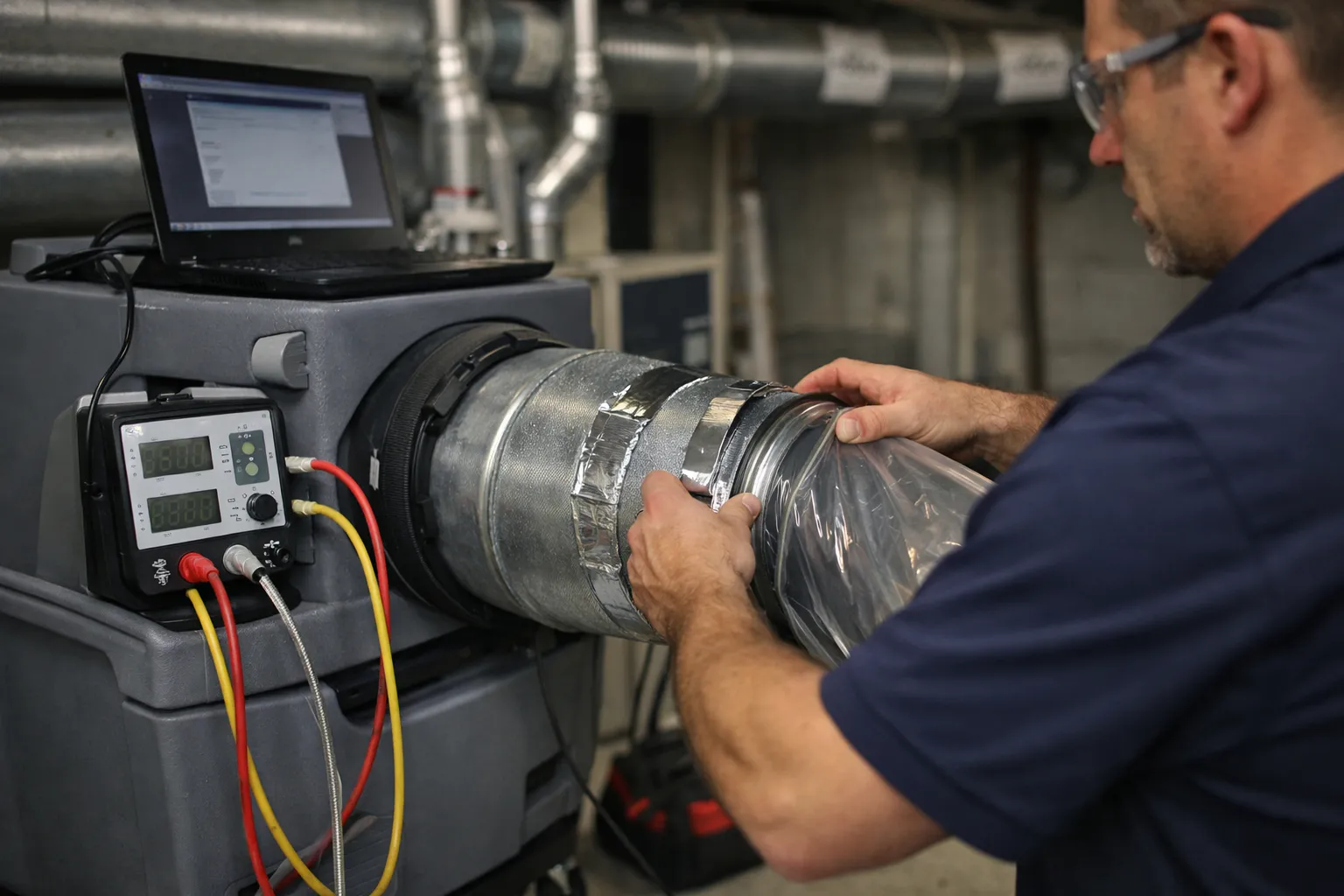
Aeroseal—the in-duct aerosol sealing process that deposits a flexible polymer film at leakage points—remains the most widely used aerosol sealing method in 2026. This August 2026 field update keeps the structure of our May 2026 review but adds fresh market context, updated price ranges, program trends, and tightened safety and verification guidance that matter now as electrification and heat-pump retrofits accelerate.
Overview: What are we reviewing? Key specs at a glance
- Service: In-duct aerosol sealing (proprietary Aeroseal process and equivalent franchised machines)
- Measurement: Pre/post duct leakage in CFM25 (cubic feet per minute at 25 pascals) using Duct Blaster protocols
- Typical residential cost (Aug 2026): roughly $1,400–$4,000 depending on baseline leakage, access, and prep
- Typical measured outcomes: broad range—about 40–90% reduction on structurally sound, accessible systems; much lower if major mechanical repairs are required first
Background — who makes it and why it matters in August 2026
Aeroseal remains the incumbent brand; certified operators run franchised or independent machines. Two trends since mid‑2024 have amplified Aeroseal’s relevance: faster residential heat-pump adoption and wider utility/state incentive programs that increasingly require verified duct sealing as part of electrification and whole‑house retrofit incentives. That combination makes accurate testing and robust documentation more important than ever.
Features analysis — what to expect in the field (what’s new)
Field experience through 2026 reinforces two constants: (1) results vary widely with baseline leakage, duct geometry, and how much mechanical prep is done; (2) operator skill and documentation make a measurable difference. In practice this year I’ve seen more contractors pair targeted mechanical repairs (reconnecting trunks, replacing short runs of crushed flex) before an Aeroseal run—this hybrid approach raises the net leakage reduction and avoids wasted polymer at large physical failures.
Two operational shifts worth noting:
- Digital verification: More contractors now deliver time-stamped digital pre/post CFM25 reports, photos of test setups, and short video clips of the run. For incentive-funded jobs many utilities require these files.
- Enhanced combustion safety workflows: Worst-case depressurization tests, CO monitoring, and written combustion-safety clearance are more often standard practice—driven by program requirements and a clearer understanding of pressure interactions in tightly-sealed, electrifying homes.
Savings remain case-dependent. For a previously very leaky system, sealing that reduces CFM25 by 25–40% often translates into double-digit HVAC energy savings—especially for heat pumps that are sensitive to airflow and system balance. In tight homes the incremental benefit is small. Expect the clearest return when sealing both reduces leakage and restores room-by-room balance.
Costs, incentives, and return on investment (updated)
Market pricing has inched up with labor costs, certification, and program documentation demands. In August 2026 residential Aeroseal quotes commonly fall between $1,400 and $4,000. The lower end typically covers modest single‑zone homes with accessible ducts; the high end reflects larger homes, difficult access, or inclusion of required mechanical prep and third‑party verification.
Example ROI (practical): a $2,000 job that produces a 20% HVAC energy reduction might save $200–$480 per year depending on climate and fuel. That yields a simple payback in roughly 4–10 years for many households—shorter if you qualify for a utility/state incentive or if the sealing resolves a heat-pump performance issue. Before booking, always check current local incentives; many programs now require documented pre/post CFM25 and combustion safety reports to qualify.
Pros and cons — practical considerations
- Pros: Non‑invasive (no drywall openings), measurable leakage reductions when ducts are structurally sound, restores airflow to distant rooms, increasingly accepted by incentive programs, quicker and less disruptive than full duct replacement.
- Cons: Not a substitute for mechanical repair of disconnected trunks, collapsed ducts, or missing plenums; effectiveness depends on thorough prep and proper isolation of intentional openings; some homeowners report a brief polymer odor or fine dust—contractors should ventilate and clean registers post‑job.
Practical tip: don’t skip the pre‑test walkthrough. If a contractor resists documenting visible defects (crushed flex, rodent damage, missing sections), walk away. Proper prep—tightening connections, replacing short collapsed runs, and isolating intended openings—often increases the final leakage reduction more than a longer Aeroseal run alone.
Safety and diagnostic caveats — stricter expectations in 2026
Two safety checks are non‑negotiable and are now commonly required by incentive programs:
- Combustion safety testing: Conduct worst‑case depressurization tests before and after sealing. This includes testing for spillage/backdrafting of gas appliances and documenting CO levels. Don’t skip this: altering duct pressures can change appliance venting behavior.
- Intentional opening isolation: Identify and protect dryer vents, combustion make‑up air ducts, fresh‑air intakes, and relief paths. A reliable contractor will produce a checklist of what they isolated and what they will not seal.
Many incentive programs now require a signed combustion-safety statement and a stamped pre/post CFM25 report. For homes with combustion appliances that cannot be safely cleared, Aeroseal may be deferred until mechanical ventilation or appliance repairs are completed.
Installer variability, quality control, and what to ask for
The machine is only as good as the operator. Before you commit, ask for:
- Signed pre‑ and post‑CFM25 reports with test setup photos and timestamps.
- A written scope that lists mechanical repairs excluded or included, and the isolation plan for intentional openings.
- Documentation that combustion safety testing was completed and passed (or an explanation if not possible).
- Warranty terms—many providers offer a measurable leakage warranty; get it in writing and note what voids the warranty (e.g., later duct work).
- Third‑party verification if an incentive requires it; if the contractor does in‑house reporting, ask how the program accepts it.
Don’t be shy about an on‑site walkthrough before the job starts. Look for loose connections, crushed flex, water stains, or evidence of pests. If the contractor resists transparent documentation, consider another provider.
Who should consider Aeroseal in Aug 2026?
- Owners of homes or small commercial spaces with confirmed high duct leakage and comfort or airflow problems.
- Properties being electrified with heat‑pump installations where duct losses would blunt expected efficiency gains.
- Projects tied to utility/state incentives or building performance programs that require documented pre/post sealing.
Avoid Aeroseal when ducts are structurally compromised, largely inaccessible, or when a pre‑test shows already‑low leakage—the marginal benefit won’t justify the cost.
Alternatives
- Targeted mechanical repairs and manual sealing with mastic and foil tape—best for visible, reachable leaks and often cheaper for isolated issues.
- Partial or full duct replacement—necessary when ducts are collapsed, corroded, or grossly undersized.
- Building‑envelope improvements—sometimes addressing air‑leaks in the envelope is a higher‑value first step, depending on goals.
Verdict
Aeroseal remains a useful, field‑proven tool in August 2026—especially when paired with sensible mechanical prep and robust safety verification. Its value has increased where heat‑pump performance and incentive programs create measurable stakes. Insist on clear pre/post CFM25 documentation, combustion‑safety verification, a written scope, and a warranty before you sign. When done right, you’ll see quieter registers, better room balance, and measurable leakage reductions that endure—when done poorly, results are underwhelming and documentation is missing.
Do I need Aeroseal if my home is noisy or drafty?
Aeroseal can help if CFM25 testing shows significant duct leakage is causing room imbalance. But noise or drafts can also come from register placement, duct sizing, or envelope leaks. Use a CFM25 test to confirm ducts are a primary problem before spending on aerosol sealing.
Will Aeroseal harm my HVAC equipment or indoor air quality?
When properly performed, technicians isolate intakes and protect equipment; long‑term harm is unlikely. Some homeowners notice a faint polymer scent or fine dust briefly after service—good contractors ventilate, wipe registers, and give after‑care instructions. Most importantly, insist on combustion safety testing to rule out pressure‑related spillage risks.
How long does the seal last?
The polymer film is designed to be flexible and long‑lasting; industry practice shows measurable reductions often persist for years. However, future mechanical work or renovations can reintroduce leaks, so periodic re‑testing (every few years or after major HVAC work) is prudent.
Can Aeroseal be used during wildfire smoke events or with an ERV/HRV in place?
During active wildfire smoke you may prefer to postpone non‑essential HVAC work to limit indoor particle disturbance. For homes with ERVs/HRVs, technicians must consider where those devices are isolated in the duct network—intentional ventilation paths should not be sealed. A competent contractor will list and protect these devices during prep.