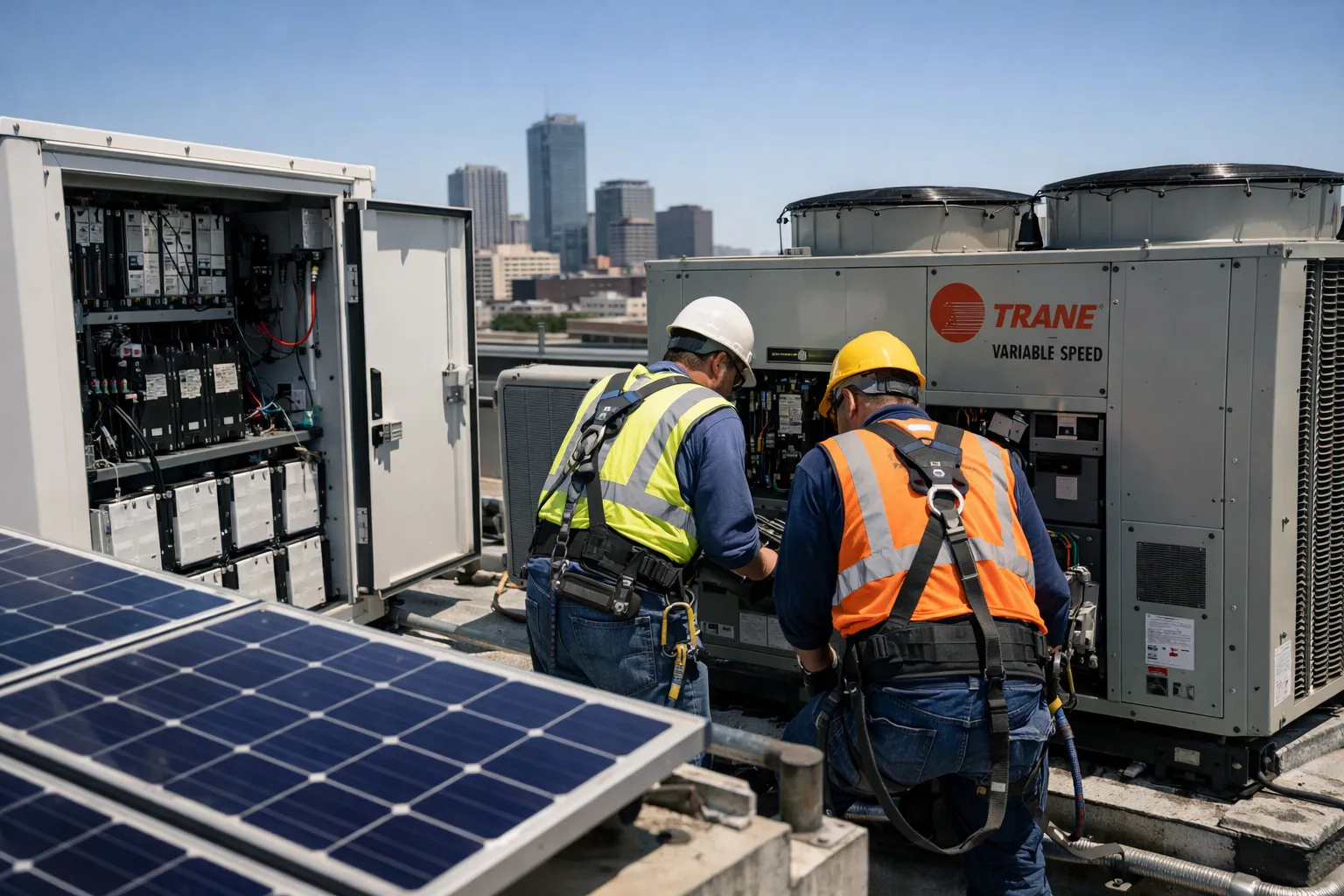
Overview: This update reviews what’s changed for microgrid-ready HVAC through August 2026 and what HVAC teams must know right now. The core idea — tightly integrating photovoltaic (PV) generation, battery energy storage systems (BESS), and electric heat pumps (and often thermal energy storage, TES) — remains valid. What’s new is more mature inverter and EMS functionality, wider commercial availability of DC-coupled and grid-forming components, clearer permitting pathways in many jurisdictions, and refined cost/benefit trade-offs from larger data sets and real projects. This article synthesizes current evidence, practical examples, and updated recommendations for designers and specifiers.
Background: why HVAC sits at the center of building-level microgrids
HVAC typically represents a major share of commercial building electrical load and is often mission-critical for occupant safety and for facilities such as hospitals, data centers with thermal constraints, emergency shelters, and life-safety buildings. Over the last three years the industry’s electrification push — driven by building codes, corporate emissions targets and incentive programs — has converted many fossil systems to electric heat pumps, creating a natural load to pair with on-site PV and batteries. Simultaneously, more frequent extreme-weather outages and utility grid constraints have pushed owners to seek not only emissions reductions but operational resilience.
Data and evidence: what deployments and studies are showing (through 2026)
- Greater prevalence of grid-forming inverters: Inverter vendors and system integrators have widely adopted grid-forming (GFM) BESS in commercial microgrids. GFMs make intentional islanding and black-start capabilities far more reliable compared with legacy grid-following architectures; several mid‑size commercial projects completed in 2024–2026 report seamless transition times measured in seconds rather than tens of seconds.
- Cost trajectory and soft-cost declines: Hardware unit costs for mainstream lithium‑ion BESS and standard rooftop PV continued to decline modestly through 2025, while soft costs — engineering, integration and commissioning — have fallen more significantly as repeatable microgrid packages and pre-certified control stacks have become available. Owners report integration premiums now commonly in the 8–18% range of equipment costs for turnkey microgrid services, versus the 10–25% range seen earlier in the decade.
- Thermal storage multiplies resilience value: Multiple case studies (commercial office, multi-family and education campuses) completed 2023–2026 show that adding chilled-water TES or ice storage often increases effective outage hours of HVAC for a given battery capacity by 40–120%, because TES decouples the timing of electrical energy consumption from cooling delivery.
- Operational performance: Modeling and field data converge: for cooling-dominant commercial buildings, a BESS sized to provide 2–6 hours of essential HVAC operation is common. Exact runtime depends on HVAC share of electrical load, control aggressiveness (pre-cooling, setpoint relaxation), and available on-site PV during daylight outages.
- Market signals and incentives: Policy continued to shape projects in 2024–2026. Incentive programs and tax credits in multiple jurisdictions (including bonus credits tied to domestic manufacturing or energy communities) materially improved project economics for many owners; utility pilots increasingly reimburse resilience or capacity services, improving payback in some markets.
Emerging architectures and trends
The three architectures that matured earlier (AC-coupled, DC-coupled, and hybrid with TES) remain relevant, but expectations for each have shifted:
- AC-coupled PV + BESS + variable-speed heat pumps: Still the most common because it supports retrofits and leverages standard equipment. Improved inverter firmware and EMS algorithms now enable tighter coordination and export-limited operation for jurisdictions that restrict PV exports.
- DC-coupled systems and DC HVAC components: More vendors are offering DC compressors, pumps and controls for commercial systems, reducing conversion losses. DC-coupled solutions are gaining traction in new-build campuses and industrial facilities where lifecycle efficiency justifies ecosystem lock-in.
- Hybrid with TES (chilled-water, PCM, or seasonal thermal storage): Increasingly considered the best resilience-to-cost lever for cooling-heavy buildings. Recent projects show combining modest BESS with TES can reduce required battery capacity by half for specified essential-service durations.
- Microgrid-as-a-Service and standardized packages: A growing number of integrators now sell pre-engineered microgrid packages that include pre-tested EMS profiles, factory-tested switchgear, and commissioning checklists — reducing deployment times and permitting friction.
Multiple perspectives: what stakeholders are saying
- Building owners: Owners in high-outage-risk regions prioritize staged investments — making systems “microgrid-ready” with space and conduits for future BESS/TES rather than committing to large upfront battery batteries.
- Integrators and vendors: Vendors emphasize that software and controls now drive more of the value than raw battery capacity. Many integrators recommend investing in robust EMS that supports layered storage strategies and open communication protocols (BACnet, Modbus, OpenADR, IEEE 2030.5 where applicable).
- Utilities and regulators: Utilities highlight interconnection and safety concerns but also increasingly offer capacity or resilience tariffs that improve economics for buildings that can island or provide peak shaving. Early engagement with utilities remains essential.
- Engineers and code officials: Engineers advocate staged commissioning and documented islanding tests; code officials—supported by updated guidance from UL and IEEE—now expect formal verification of anti-islanding and transfer logic for systems claiming resilience performance.
Updated cost drivers and economic trade-offs
Three cost elements still dominate decisions, but their relative importance has shifted:
- Hardware: PV and BESS remain principal capital items, but the marginal capital cost of variable-speed heat pumps versus similar-capacity DX units is often modest in retrofit scenarios. Owners increasingly choose modestly larger BESS paired with TES rather than very large batteries alone.
- Controls and integration: A mature EMS that supports grid-forming inverters, predictive preconditioning, and seamless islanding yields outsized operational value. Expect to allocate budget for continuous EMS updates and cybersecurity reviews.
- Permitting and commissioning: Permit friction has reduced in many jurisdictions due to standardized packages and clearer UL/IEEE testing expectations, but detailed islanding and protection testing — including witness tests — remain part of insurance and AHJ requirements and can add schedule time.
Practical recommendations for HVAC teams (2026 edition)
- Define measurable resilience and performance objectives: Specify outage duration targets, critical zones, and acceptable comfort bands. Convert those objectives into hourly energy and thermal loads before sizing PV, BESS and TES.
- Model with hourly, scenario-based tools: Use REopt (NREL) or equivalent tools alongside vendor models to test scenarios including daytime outages, prolonged multi-day outages, and heat-pump performance under reduced voltage. Include TES and pre-cooling strategies in simulations.
- Prioritize controls and staged commissioning: Invest in EMS and factory-tested microgrid control stacks that support grid-forming operation, PV-following modes, and rapid islanding. Plan staged commissioning and witnessed islanding tests with utilities and AHJs.
- Design for staged implementation: Provide physical space, AC/DC raceways, and spare capacity in switchgear for future BESS/TES additions. A smaller initial BESS + TES often offers better near-term value and lower initial capex.
- Engage stakeholders early and often: Bring utilities, insurers, AHJs and O&M teams into design reviews to align interconnection, export limits, protection schemes and insurance requirements.
- Lock down cybersecurity and interoperability: Require secure, auditable communication protocols and a plan for over-the-air EMS updates; include fallbacks for local manual control during incidents.
Comparative, real-world scenarios (updated)
Three representative retrofit examples, informed by 2024–2026 project outcomes, illustrate trade-offs for a 50,000 ft² office in a hot-humid climate:
- Scenario A — PV 150 kW + BESS 300 kWh + variable-speed heat pumps: Delivers meaningful peak shaving and typically 2–5 hours of essential HVAC in practice, depending on aggressive pre-cooling and load shedding. Best where demand-charge savings are primary.
- Scenario B — Same PV/BESS + 40–60 m³ chilled-water TES: TES enables daytime pre-cooling and extends meaningful HVAC support by roughly 50–100% versus Scenario A for comparable essential-service outcomes — commonly the best resilience-to-cost ratio.
- Scenario C — PV + larger BESS (600 kWh) + modest backup genset + heat pumps: Prioritizes extended runtime and flexibility; higher CAPEX but reduces dependence on fuel-supply logistics for long-duration outages.
Implications
For HVAC professionals, the practical takeaway is that system-level design and controls now deliver more of the performance than simply buying more battery capacity. TES and smarter EMS strategies unlock resilience at lower capital cost. Because inverter and EMS capabilities have matured, more predictable commissioning and clearer testing workflows are possible — but the need for early stakeholder engagement and formal islanding verification has increased.
Outlook: what to watch for next
Over the next 12–24 months watch for:
- Further standardization of microgrid control stacks and increased availability of pre-certified turnkey microgrid packages for commercial buildings.
- Broader commercial deployment of DC-driven HVAC components for new builds where lifecycle efficiency is a priority.
- Refined utility tariffs and capacity markets that explicitly value building-level resilience and fast-response load flexibility.
- Advances in long-duration thermal storage materials (PCMs) and integration patterns that will further reduce required battery capacity for cooling-dominant buildings.
FAQs
How much battery do I need to keep HVAC running during an outage?
There’s no one-size-fits-all answer. For many commercial buildings in hot climates, owners are targeting 2–6 hours of essential HVAC support with battery sizes in the 200–600 kWh range, supplemented by controls (pre-cooling, setpoint relaxation) and critical-zone shedding. Adding chilled-water TES often reduces the battery requirement for a given resilience target.
Are grid-forming inverters necessary for reliable islanding?
Grid-forming inverters significantly improve islanding reliability and restore faster, more stable voltage and frequency control during island operation. For projects that prioritize seamless islanding or black-start capability, specifying grid-forming-capable BESS inverters and verifying GFM performance in commissioning is advisable.
Should I choose AC- or DC-coupled architecture?
AC-coupled systems are still preferable for retrofits because they use standard equipment and simplify installers’ workflows. DC-coupled architectures can be more efficient and are attractive for new builds or where the owner wants a tightly integrated DC ecosystem, but vendor maturity and lifecycle support should factor into the decision.
What are the most common pitfalls to avoid?
Common pitfalls include under-specifying controls/EMS, neglecting space and conduit planning for future additions, failing to engage the utility and AHJ early, and treating commissioning as a checklist instead of a staged validation process including witness tests of islanding behavior.
How do I quantify the resilience benefit versus cost?
Quantify resilience by converting your operational objectives (e.g., maintain critical zones at X°C for Y hours) into energy and thermal demand profiles, then model scenarios (daytime vs. nighttime outages, multi-day events) including TES and preconditioning strategies. Use a combination of NREL REopt or similar optimization tools and vendor-level simulations to compare lifecycle costs and resilience metrics.
Microgrid-ready HVAC in 2026 is less experimental and more a systems discipline: success depends on disciplined sizing, layered storage, mature EMS, and early stakeholder coordination. For HVAC teams, investing time in EMS strategies and thermal storage integration now will yield the best resilience and economic outcomes as microgrid technology becomes mainstream.