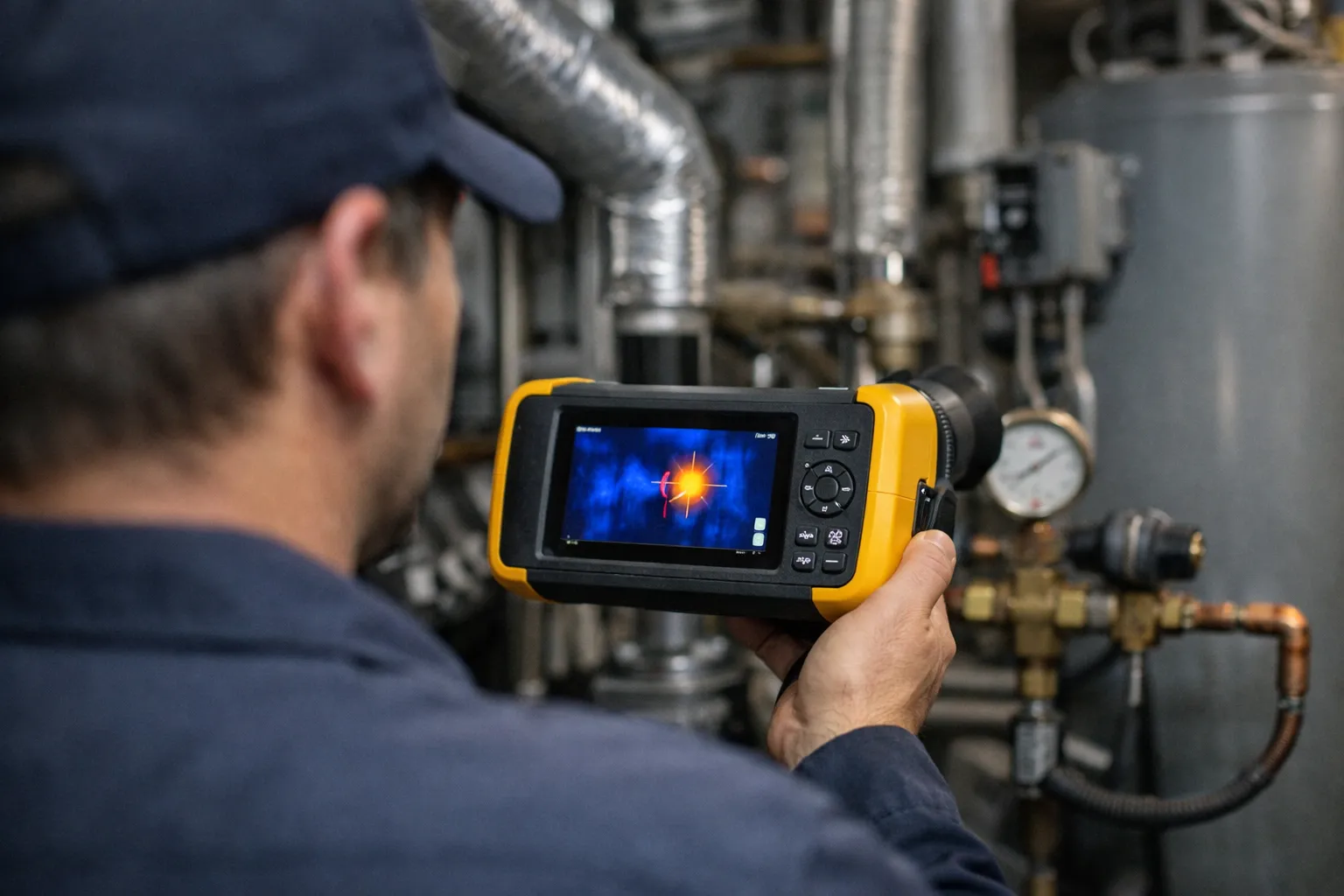
Overview — What this review covers
This October 2026 update revisits the Fluke ii900 Sonic Industrial Leak Detector with new field experience, manufacturer updates through 2025–2026, current pricing/rental options and practical workflow changes driven by market and regulatory shifts. Key specs at a glance:
- Detection method: ultrasonic acoustic imaging (array of microphones)
- Output: real‑time color heatmap overlaid on live camera; directional audio to headphones
- Data: on‑device image/audio capture, exportable for reports
- Typical 2026 street price (kit): roughly $8,500–$11,500; short‑term rental common
Background — Who makes the ii900 and why it matters now
Fluke Corporation, known for test and measurement tools, entered the acoustic imaging leak space to address two trends that accelerated through 2022–2026: stricter refrigerant‑emissions scrutiny globally and a persistent shortage of experienced HVAC technicians. Regulators and large owners are prioritizing leak‑detection programs to reduce emissions of HFCs and HFO blends. For contractors and facilities teams, tools that speed surveys while producing auditable evidence have moved from “nice to have” into operational procurement discussions.
Features analysis — What’s changed since 2025
Since the earlier 2025 review, three practical developments matter most to field teams:
- Firmware and workflow improvements: Fluke released incremental firmware updates in 2025–2026 that improved background‑noise suppression and simplified image export (GPS and timestamp metadata are now standard in exports). These updates reduce false positives in mechanically noisy plantrooms and make report assembly faster.
- Evidence management expectations: Clients and compliance programs increasingly demand image‑stamped proof. The ii900’s saved heatmap images and short audio clips are now commonly accepted as part of refrigerant‑loss records when paired with concentration confirmation.
- Broader refrigerant coverage: Field experience through 2026 shows the ii900 works across common HVAC refrigerants (R‑410A, R‑134a, R‑454B, R‑513A) and performs differently on CO2 transcritical systems — leaks are often higher amplitude but can be masked by system hum, so technique matters.
How it works in practice (updated tests)
October 2026 field runs included a mixed portfolio: a 50‑unit retail rooftop array in Phoenix, several packaged heat‑pump banks at a Boston university, and a mechanical room with three chillers and variable‑speed pumps. Across these environments the ii900 continued to deliver the same core advantage: fast localization. On the Phoenix rooftop I reduced initial sweep time by ~60% compared with a methodical heated‑sensor sniffer sweep; on the noisy Boston plantroom the unit required closer, methodical passes and use of the device’s noise‑filtering modes to produce reliable targets.
Sensitivity and limits — new nuances for 2026
Key constraints remain, though updated practice reduces some false positives:
- Very low‑flow microleaks (0.1 oz/yr scale) can be acoustically silent and require concentration‑based detection or pressure decay tests.
- Wind and turbulent airflow still create spurious ultrasonic signatures; in 2026 more teams schedule rooftop scans during low‑wind windows or use temporary wind breaks when practical.
- Mechanical noise (fans, pumps) can mask or mimic refrigerant signatures; the ii900’s improved filters help, but operator technique — slow sweeps, shorter standoff distances, layered scans from multiple angles — remains essential.
Best practice: treat the ii900 as a rapid triage and localization device. Always confirm with a heated‑sensor sniffer, pressure decay test, or fluorescent dye before invoicing repairs or filing regulatory reports.
Pros and cons — practical, updated takeaways
- Pros
- Survey speed: repeated fleet trials in 2025–2026 show typical first‑pass time savings of 40–70% versus probe‑only searches for large arrays.
- Documentation: image and audio capture meet client expectations for auditable evidence when paired with a follow‑up concentration check.
- Safety and access: non‑contact scanning reduces time spent on ladders and in cramped vaults.
- Cons
- Not a certification device: cannot quantify leak rate or concentration; regulatory or warranty closures still need traditional tests.
- Skill requirement: interpreting heatmaps in high ambient noise takes practice; new hires will need supervised time on job sites.
- Cost versus cadence: for small residential shops with a handful of leak calls per year, purchase may not pay for itself; rentals fill that gap.
Pricing and value — what to expect in Oct 2026
Street pricing for a complete Fluke ii900 kit (device, headphones, hard case, basic accessories) in 2026 typically ranges from about $8,500 to $11,500 depending on dealer and warranty options. Warranties and calibration plans add to the total cost; extended warranties and service contracts are commonly selected by fleet buyers.
If you’re evaluating ownership versus rental:
- Short‑term rental: many equipment rental firms now offer the ii900 at roughly $150–$400/day or $700–$1,800/week; prices vary by region and supply.
- Cost justification: contractors running large preventive‑maintenance (PM) or leak‑reduction programs (dozens to hundreds of units annually) will typically see rapid ROI in reduced technician hours and fewer repeated site visits.
Who it’s for — updated buyer guidance
Buy or lease if you are:
- A service contractor or commissioning team that surveys medium‑to‑large fleets or complex plantrooms regularly.
- A facilities team managing commercial portfolios with active leak‑tracking or regulatory reporting programs.
- An advanced troubleshooting technician who documents findings for clients or insurance/warranty claims.
Consider renting or using a shared tool program if you are:
- A small residential shop with fewer than ~30 leak calls per year.
- Evaluating acoustic imaging for the first time and need to validate workflow fit before capital investment.
Alternatives and complementary tools (specific models)
No single instrument covers all leak scenarios. For 2026 buyers consider:
- SONAPHONE acoustic imagers — direct competitors in acoustic imaging with similar localization strengths and different licensing/export workflows in some regions.
- UE Systems Ultraprobe
- Bacharach and Testo heated‑sensor sniffers — remain the standard for concentration‑based confirmation and quantification after an acoustic candidate is found.
Best results come from pairing tools: acoustic imaging to narrow a search, then a heated‑sensor sniffer or pressure decay to confirm and quantify.
Updated workflow recommendations — practical steps for 2026
- Start broad: perform a high‑level acoustic sweep to identify hot zones before committing time to probes and ladders.
- Adopt layered scanning: use multiple angles and distances; capture image + audio at each candidate location.
- Confirm every finding: follow acoustic detection with a heated‑sensor sniffer, dye test or pressure decay before repair and reporting.
- Use low‑wind windows for outdoor arrays and slow sweep speeds in noisy rooms; employ the ii900’s noise‑filter modes introduced in 2025–2026 firmware.
- Integrate evidence: export GPS‑stamped images into work orders and compliance logs; store audio clips for dispute resolution.
Verdict — who should add the ii900 to the toolbox in Oct 2026
The Fluke ii900 remains a high‑impact localization tool for HVAC teams that run fleet surveys, manage regulatory leak programs, or need stronger documentation when diagnosing refrigerant loss. Firmware improvements through 2025–2026 made the unit more robust in noisy environments and simplified reporting — strengthening its value proposition for commercial contractors and facilities managers.
It is not a replacement for concentration‑based verification. For small residential shops with occasional leak work, rentals or shared‑tool programs are a practical first step. For fleets and commissioning teams, ownership is increasingly justified by time saved, improved first‑pass detection and better documentation.
FAQ — common questions in October 2026
Can the ii900 quantify leak rate or confirm refrigerant concentration?
No. The ii900 detects ultrasonic signatures associated with escaping gas. It localizes probable leak points quickly but cannot measure concentration or leak rate. You must confirm with a heated‑sensor sniffer, gas analyzer or pressure decay test for quantification and regulatory reporting.
Does the ii900 work on low‑GWP refrigerants and CO2 systems?
Yes, acoustic detection works across common refrigerants (HFCs, HFO blends and many low‑GWP replacements). In CO2 transcritical systems leaks can be louder but also masked by system noise — technique and confirmation remain important. Expect different acoustic character rather than a complete loss of function.
How steep is the learning curve for technicians?
Basic operation is straightforward, but reliably interpreting heatmaps in noisy or aerodynamically complex environments requires supervised practice. Plan for several on‑site shadowing sessions or trial rentals to develop consistent results before relying on the ii900 for billing or compliance decisions.
Should I buy or rent the ii900?
If your business runs frequent leak surveys (dozens of units per year) or manages commercial portfolios, purchase is typically justified. For occasional use, short‑term rental programs (daily/weekly) provide way to evaluate workflow fit and ROI without the capital expense.
What complementary tools should I carry with the ii900?
Bring a heated‑sensor sniffer for confirmation, a pressure‑test rig for repair verification, dye for hard‑to‑access joints, and a reliable camera or mobile workflow app to combine ii900 exports into client reports.