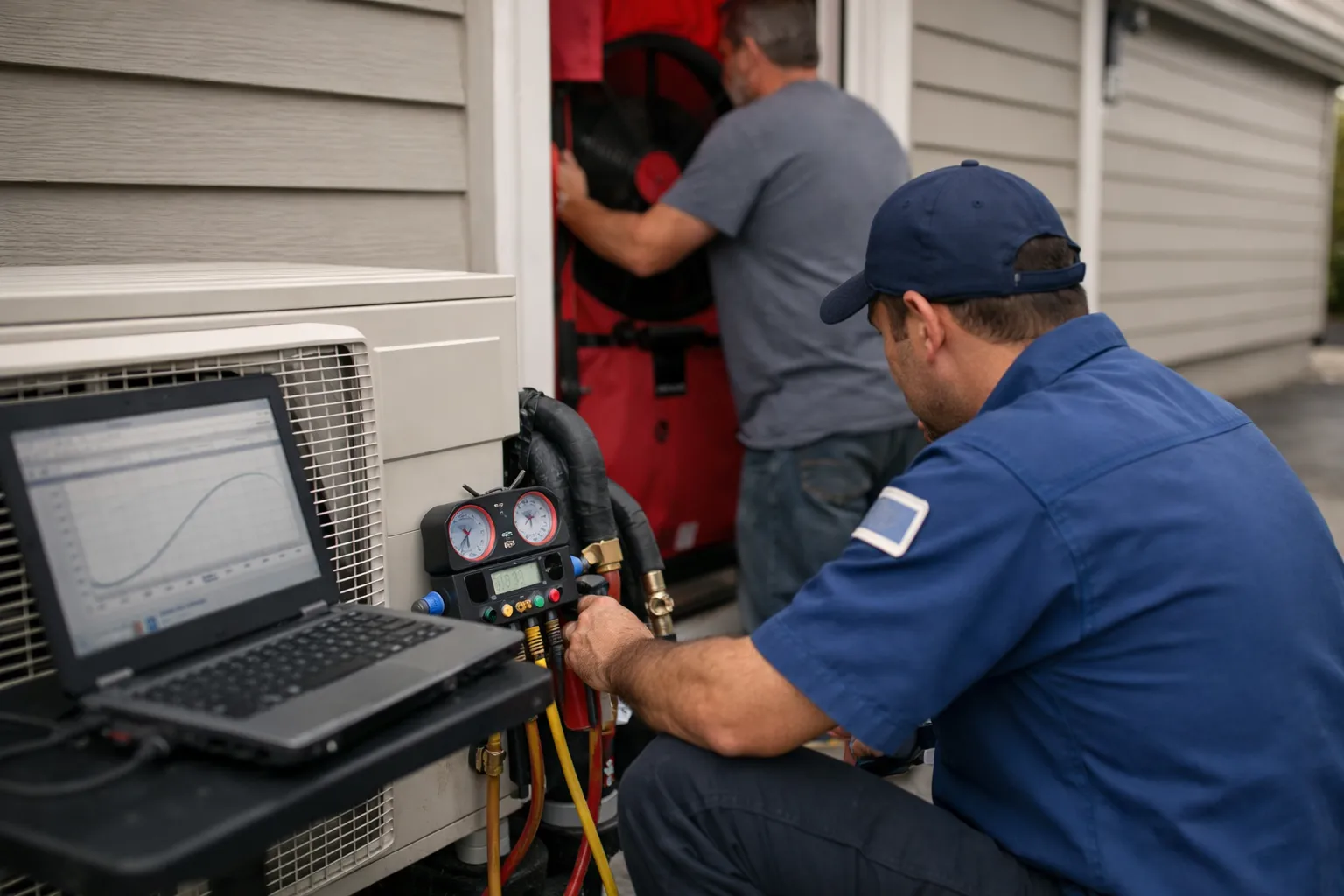
As the U.S. and regional incentive programs continue to prioritize residential and small‑commercial heat‑pump retrofits in 2026, technicians are asking the same question: which credential best prepares me — and proves my competence — for installs, diagnostics and commissionings of modern air‑source heat pumps? This review compares the two most widely recognized credentialing bodies among HVAC professionals — NATE (North American Technician Excellence) and BPI (Building Performance Institute) — focusing on their heat‑pump‑related credentials, practical value for retrofit work, and how each stacks up for different installer profiles.
What each credential aims to certify
NATE: NATE’s exams have traditionally focused on trade‑level HVAC skills, equipment theory, diagnostic procedures and safety. In recent years NATE has broadened its exam catalog to include heat‑pump specific testing and updated content to reflect inverter‑driven compressors, refrigerant transitions, and basic controls diagnostics. NATE credentials are widely recognized by contractors and many equipment manufacturers.
BPI: BPI’s certifications are grounded in whole‑house performance, building science, and energy‑efficiency diagnostics. BPI credentials cover heat‑pump systems in the context of envelope interactions, distribution systems, and measurement‑based verification. BPI places stronger emphasis on load calculations, duct diagnostics, air‑sealing, and how HVAC interacts with the building fabric — skills vital for successful retrofits.
Features compared — scope and content
- Hands‑on vs. systems thinking: NATE leans toward equipment diagnosis and repair skills (compressors, reversing valves, controls troubleshooting). BPI emphasizes whole‑house integration (proper sizing after envelope upgrades, distribution efficiency, combustion safety where applicable).
- Testing format: Both organizations use proctored exams; NATE’s format is test‑centric with practical questions on troubleshooting, while BPI combines written exams with performance‑based assessments for some credentials.
- Relevance to retrofit projects: BPI’s focus on building science makes it particularly useful where air‑sealing, duct improvement, and load reduction are needed before heat‑pump sizing. NATE is more directly valuable for equipment selection, commissioning and in‑field fault diagnosis.
- Manufacturer acceptance and utility programs: Many manufacturers accept NATE as evidence of equipment competence. BPI credentials often align with utility rebate requirements that require whole‑house verification, weatherization programs, or prioritized energy‑efficiency measures before incentive issuance.
Pros and cons — practical view for installers
NATE
- Pros: Directly relevant to heat‑pump diagnostics and service; widely recognized by contractors and suppliers; efficient exam path for technicians focused on equipment.
- Cons: Less emphasis on building envelope interactions and load reduction strategies that affect retrofit outcomes; may leave installers under‑prepared for projects that require integrated building science skills.
BPI
- Pros: Strong grounding in load calculations, duct testing, and air‑sealing — skills that reduce call‑backs after heat‑pump retrofits; recognized by many weatherization and utility programs; useful for technicians who perform broader retrofit scopes.
- Cons: Less detailed focus on manufacturer‑specific heat‑pump troubleshooting and advanced refrigeration diagnostics; some BPI credentials require additional hands‑on performance testing which can lengthen the certification timeline.
Which credential fits which installer profile?
- Service technician at a contractor that installs only equipment: NATE first. It delivers the equipment‑level knowledge employers expect for commissioning, warranty work, and troubleshooting inverter heat pumps.
- Technician doing whole‑home retrofits, envelope improvements, or working with utility programs: BPI first. Its emphasis on diagnostic blower door testing, duct leakage, and load assessment makes it a better match.
- Ambitious technicians or company owners doing both installs and retrofits: Both. Combine NATE for detailed equipment competence and BPI for building‑level diagnostics. The paired skill set is becoming the industry gold standard for high‑quality retrofit outcomes.
Real‑world examples
Example A — Cold‑climate ASHP retrofit in New England: A crew with NATE certification alone may correctly install the outdoor unit and commission controls, but without BPI skills they risk oversizing, unaddressed duct losses, or blower adjustments that cause low capacity in deep‑cold conditions. A combined NATE+BPI team will better size the system, tighten and balance ducts, and verify real‑world COP under load.
Example B — Solar‑ready small commercial retrofit: A mechanical contractor called for diagnostics on intermittent capacity loss. A NATE‑trained tech diagnosed a communication issue between inverter drive and BAS. BPI knowledge added value by revealing that a poorly performing distribution system and unexpected infiltration were increasing loads — explaining frequent staging and short‑cycling.
Cost, time and pathway considerations
Time to credential varies (a few days of study and a single exam for some NATE tests vs. multi‑day training and performance tests for some BPI credentials). Both require continuing education and periodic recertification. For contractors, the strategic investment is less about fees and more about deployment: sending one technician to BPI training and another to NATE creates in‑house cross‑competence quickly.
Gaps and how to fill them
- If you hold only NATE: add targeted building‑science modules — blower door and duct leakage testing, load calc refresher — ideally via BPI or community‑college courses.
- If you hold only BPI: supplement with manufacturer training and deeper refrigeration theory workshops to handle inverter‑drive diagnostics, refrigerant charge methods for variable‑speed systems, and advanced BAS integration.
- Manufacturer micro‑certs and OEM commissioning courses remain essential — neither NATE nor BPI replaces product‑specific training required for warranty compliance.
Bottom line recommendations
For 2026 retrofit work, one credential alone is no longer the clear optimum. If you must choose a single path:
- Choose NATE if your work is predominantly equipment service, warranty and commissioning.
- Choose BPI if your work includes whole‑house retrofits, weatherization programs or utility incentive projects.
Best practice: combine them. A technician team with both NATE and BPI capabilities — supplemented by OEM training on specific heat‑pump lines and smart controls — delivers the lowest callback rates, highest customer satisfaction, and best eligibility for incentive programs that increasingly demand both equipment competence and verified whole‑house performance.
Action checklist for installers
- Audit your job mix: % of equipment installs vs. whole‑home retrofits.
- Map credentials to jobs: assign NATE to lead equipment commissioning; BPI to lead pre‑retrofit diagnostics.
- Budget for manufacturer commissioning courses — they unlock warranty and technical support.
- Track utility and state rebate requirements — many now ask for blower door or verified HSPF/COP measurements.
In an industry moving toward integrated, measured performance, certification strategy matters. NATE and BPI are complementary tools in an installer’s toolbox — pick the right one for your role, or better yet, combine them to meet the higher expectations of 2026 heat‑pump retrofit work.