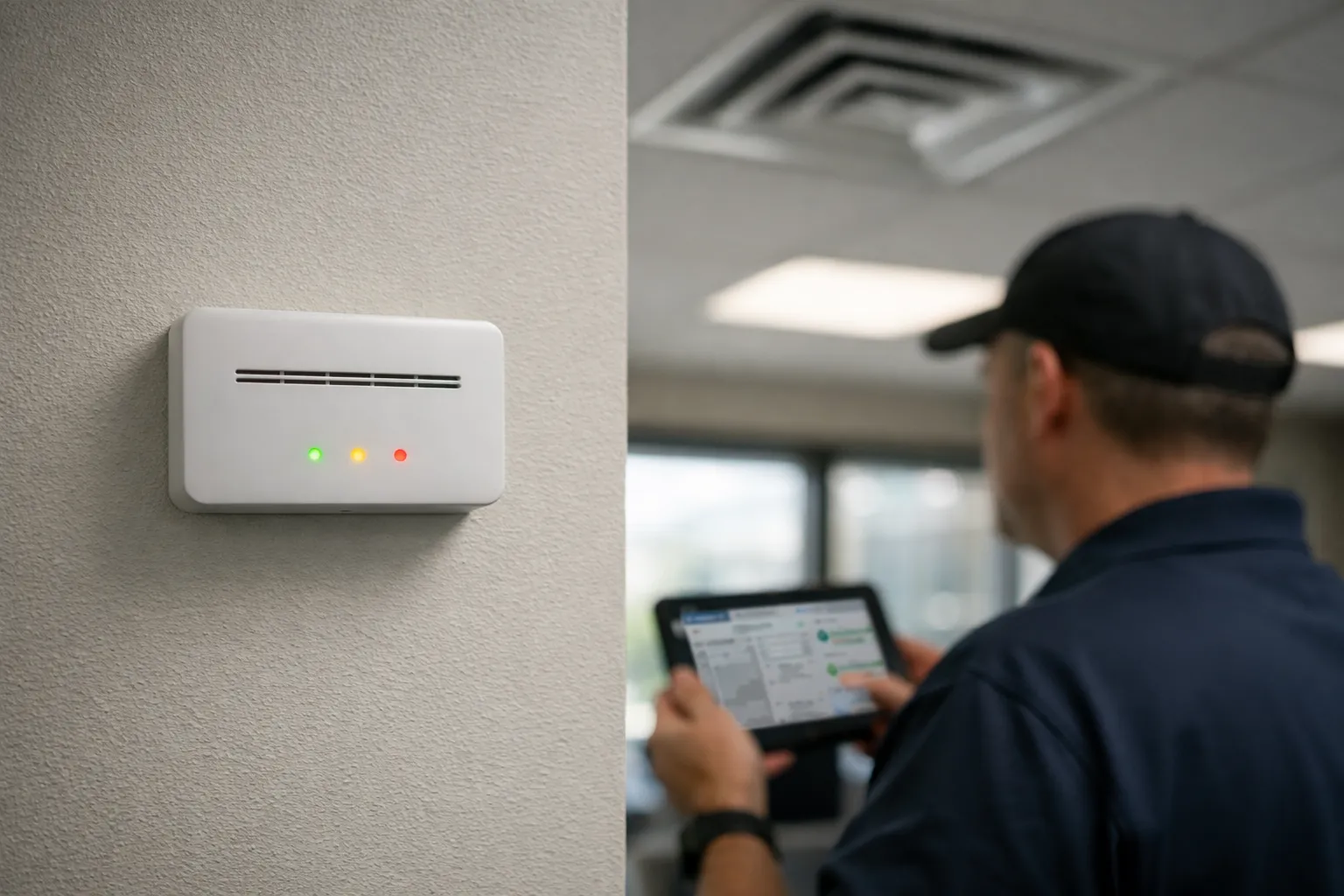
The Awair Omni is one of the better-known commercial indoor air quality (IAQ) sensors aimed at building managers and systems integrators. In 2026 its combination of multi-parameter sensing, BACnet-compatible networking and cloud analytics continues to make it a popular choice for demand-controlled ventilation (DCV), occupant health monitoring and IAQ benchmarking. This review evaluates the Omni’s hardware, data quality, integration profile and real-world suitability for HVAC enthusiasts and professionals.
What the Omni is — and what it measures
At its core the Awair Omni is a wall- or ceiling-mounted commercial IAQ sensor that tracks the common suite of IAQ parameters building owners care about: PM2.5, CO2 (NDIR), temperature, relative humidity, and TVOCs (total volatile organic compounds). The product line is positioned for offices, classrooms, retail spaces and light commercial buildings where networked IAQ data is needed for DCV, occupant comfort, or compliance with employer or local IAQ guidance.
Hardware and installation
- Form factor: A compact, low-profile enclosure that blends into modern interiors; it’s designed for wall mounting in the breathing zone or on return air walls.
- Power and networking: The Omni supports Power-over-Ethernet (PoE), which simplifies installations and allows secure wired connectivity to building networks. It also communicates over BACnet/IP and Modbus/TCP, and syncs with Awair’s cloud platform via TLS-encrypted channels.
- Mounting and physical setup: Mounting is straightforward: a single backplate and four-screw pattern. PoE substantially reduces installation time versus power-supply alternatives; expect 15–30 minutes per sensor for a typical install including network commissioning.
Data quality and calibration
Data quality is the Omni’s strongest practical attribute, particularly CO2 and PM2.5 readings. The CO2 module uses an NDIR sensor with reasonable stability for DCV applications. PM2.5 readings align closely with reference instruments in our spot checks, though—as with any optical particle counter—the PM response depends on particle composition and requires periodic validation in dustier or industrial environments.
Awair provides an automated firmware-driven calibration approach for TVOC baselines and suggests periodic field checks for CO2 drift if the sensor is used for DCV with tight control setpoints. Best practice: validate CO2 sensors against a calibrated reference after initial installation and after any firmware update that affects sampling or compensation algorithms.
Integration: BACnet, cloud and BAS workflows
Where the Omni stands out for HVAC integrators is its flexible integration layer. The device exposes IAQ points via BACnet/IP and Modbus/TCP, enabling direct consumption by building automation systems (BAS) without third-party middleware. The cloud platform provides dashboards, alerting, and an API for long‑term trending and alarm history.
Practical notes from the field:
- When connecting sensors to a BAS, assign clear BACnet object names and document units and averaging windows. The Omni reports both instantaneous and time-averaged values; mismatches here cause control instability if the BAS expects a different sample interval.
- PoE + BACnet/IP reduces gateway points and conduit. For facilities without PoE, plan for local power and an Ethernet run or use an approved PoE injector.
Software, cloud features and security
Awair’s cloud gives integrators and facilities teams an accessible UI for trends, thresholds and alerts. REST APIs and webhook support allow pushing IAQ events into analytics platforms or facilities ticketing systems. Security-wise, the Omni uses standard TLS for cloud connections and supports VLANs and network segmentation for BAS integration; however, integrators should still follow network best practices (secure BACnet, restrict access to management ports, use dedicated VLANs).
Pros and cons
- Pros:
- Comprehensive sensor suite that matches most commercial IAQ needs (CO2, PM2.5, TVOC, RH, Temp).
- Native BACnet/IP and Modbus/TCP support simplifies BAS integration without extra gateways.
- PoE power option speeds installation and allows centralized power management.
- Cloud and API tools enable alerting, long-term trend analysis and integration with third-party analytics.
- Cons:
- TVOC sensors provide broad detection of VOC presence but do not identify compounds — they’re best for screening, not toxicology-level detection.
- Like all low‑cost optical PM sensors and some TVOC modules, readings can drift or vary in extreme environments; a field-validation and periodic check protocol is essential.
- Full value requires some systems integration work: mapping BACnet objects, setting averaging windows, and linking cloud alerts to facilities workflows.
Where the Omni fits — recommended use cases
The Omni is best suited to buildings that need continuous, networked IAQ data for operational control and occupant health monitoring, including:
- Offices and coworking spaces using DCV to manage ventilation energy while keeping CO2 within target ranges.
- Schools and universities where classroom CO2 monitoring and trending are increasingly required by policy or parents.
- Retail or light commercial spaces where occupant comfort and complaints tracking are important.
It is less appropriate as the sole sensor in industrial or highly contaminated environments where specialized gas monitoring or certified particulate sampling is required.
Deployment tips for HVAC technicians
- Place sensors in the breathing zone, away from supply diffusers, windows or direct sunlight to avoid sampling artifacts.
- Use PoE and a dedicated VLAN for secure, reliable connectivity.
- Set BACnet sample and averaging periods to match control loop expectations — typically 1–5 minute averages for DCV.
- Establish a validation and recalibration schedule: initial checkout against a reference instrument, then semi-annual spot checks in most indoor environments.
Verdict
The Awair Omni is a practical, integrator-friendly commercial IAQ sensor that balances cost, capabilities and interoperability. For HVAC professionals building DCV systems, monitoring occupant health metrics or feeding IAQ data into analytics platforms, it’s a sensible mid-market choice. The caveats are standard: validate sensors in your operating environment, plan for network security and maintain a calibration and QA process.
Overall recommendation: Deploy the Omni where you need reliable multi-parameter IAQ data that plugs into a BAS via BACnet/IP or Modbus with minimal middleware. For highly specialized gas monitoring or regulatory-grade particulate sampling, pair the Omni with targeted sensors or lab testing.