
Who: Homeowners doing heat-pump conversions, HVAC technicians, and IAQ-minded DIYers.
What: A July 2026 refresh of a practical guide that debunks nine persistent static-pressure myths and adds new tools, manufacturer trends, and measurement best practices.
When: Updated July 2026 to reflect the latest product rollouts, field data, and commissioning practices.
Where: U.S. residential systems and similarly configured homes elsewhere.
Why this matters now: Heat-pump adoption, higher-MERV filtration, and more aftermarket IAQ devices remain at record levels in 2026. Those good-for-health moves can wreck airflow when they’re stacked without measurement. Static pressure controls whether systems are quiet, efficient, and dehumidify properly—get it wrong and you pay in comfort and energy.
Context: what changed since April 2026
Three clear shifts are shaping the static-pressure landscape in mid-2026. First, ongoing federal and state incentives continued to accelerate heat-pump installs and whole-home electrification—installers increasingly retrofit existing duct systems instead of replacing them. Second, higher-efficiency filters and add-on IAQ devices (in-duct purifiers, ERVs/HRVs, UV) are now common on retrofit scopes. Third, instrumentation and controls matured: several major manufacturers put pressure-sensing options and pressure-managed zoning into mainstream product lines, while Bluetooth and cloud-enabled manometers became standard on service vans.
That combination—more stacked restrictions and easier diagnostics—changes the playbook. You can no longer rely on rules of thumb. Measure baseline TESP and component drops before upgrades, then measure again afterward. The tools to do that affordably are now standard; the problem is practice.
Reality check: the scoreboard still matters
Manufacturers and trade guidance still point to roughly 0.5 in. w.c. total external static pressure (TESP) as the ballpark for many residential air handlers. In the field, well-commissioned systems typically fall between 0.2–0.5 in. w.c. Modern air handlers with larger coils and ECM blowers may tolerate higher numbers, but performance, humidity control, sound, and electrical draw usually worsen as TESP climbs above 0.5 in. w.c.
9 HVAC static-pressure myths that keep wrecking airflow (and what to do instead)
Myth #1: “A higher MERV filter is always better.”
Higher MERV removes finer particles but increases pressure drop—especially in 1-inch throwaway filters. In 2026 we’re seeing MERV 11–13 used widely; they work only if filter area increases proportionally.
Try this: Use deeper media cabinets, multi-filter return plenums, or boxed media filters sized for the CFM. If you must use a tighter filter, add return area or a larger filter bank.
Myth #2: “Static pressure problems always mean dirty ducts.”
Dirty ducts contribute, but the common offenders now are undersized returns, restrictive aftermarket grilles, crushed or kinked flex runs, and stacked IAQ devices. Think geometry and resistance, not just dust.
Try this: Walk supply and return trunks—look for crushed flex, tight bends, or restrictive registers. Replacing a compressed trunk or upsizing a return grille often restores balance for a few hundred dollars.
Myth #3: “If my house reaches setpoint, airflow must be fine.”
Systems can reach thermostat setpoint while running stressed. Signs include short cycling, louder operation, reduced humidity control, and higher blower amps.
Do this: Measure CFM or at minimum compare room-to-room deltas and register throw. If upper floors or bedrooms lag, static pressure is a likely suspect.
Myth #4: “Closing vents boosts airflow to other rooms.”
Closing supply registers increases system pressure, drives air through leaks, and can make far rooms worse. Smart dampers without pressure relief are not a free hack.
Do this instead: Use engineered zoning with pressure-management or fix the duct imbalance causing the problem.
Myth #5: “Variable-speed blowers ‘solve’ static pressure.”
ECM blowers can mask issues by ramping up, but they consume more watts and may sound strained. They don’t remove blockages or increase return capacity.
Watch for: Frequent speed surges, unusually high blower amps, or sharp noise changes after adding a filter or ERV—these are compensation, not solutions.
Myth #6: “Only the filter causes pressure drop.”
The system is a chain: grille → filter → cabinet → coil → plenum → runs → registers. Component-level testing matters.
Ask for: Before-and-after pressure-drop numbers for filters, coils, and the total external static pressure during diagnosis.
Myth #7: “Bigger equipment fixes weak airflow.”
Upsizing equipment without addressing duct constraints leads to short cycling, humidity problems, and noise. Size ducts and returns first; equipment to the load second.
Myth #8: “Smart vents are a free zoning hack.”
Smart vents can help for localized tweaks, but uncontrolled damper modulation creates pressure spikes. Use pressure-aware control strategies if you deploy them.
If you insist: Choose systems that include a pressure-relief path or a master pressure sensor to prevent too many dampers closing at once.
Myth #9: “If it’s noisy, the blower is the problem.”
Whistles and hisses are usually ductwork. A quick diagnostic trick: briefly remove or bypass the filter door (do not operate extended this way) to see if noise or airflow changes—if it does, you’ve narrowed the restriction.
Updated checklist: what to measure in July 2026
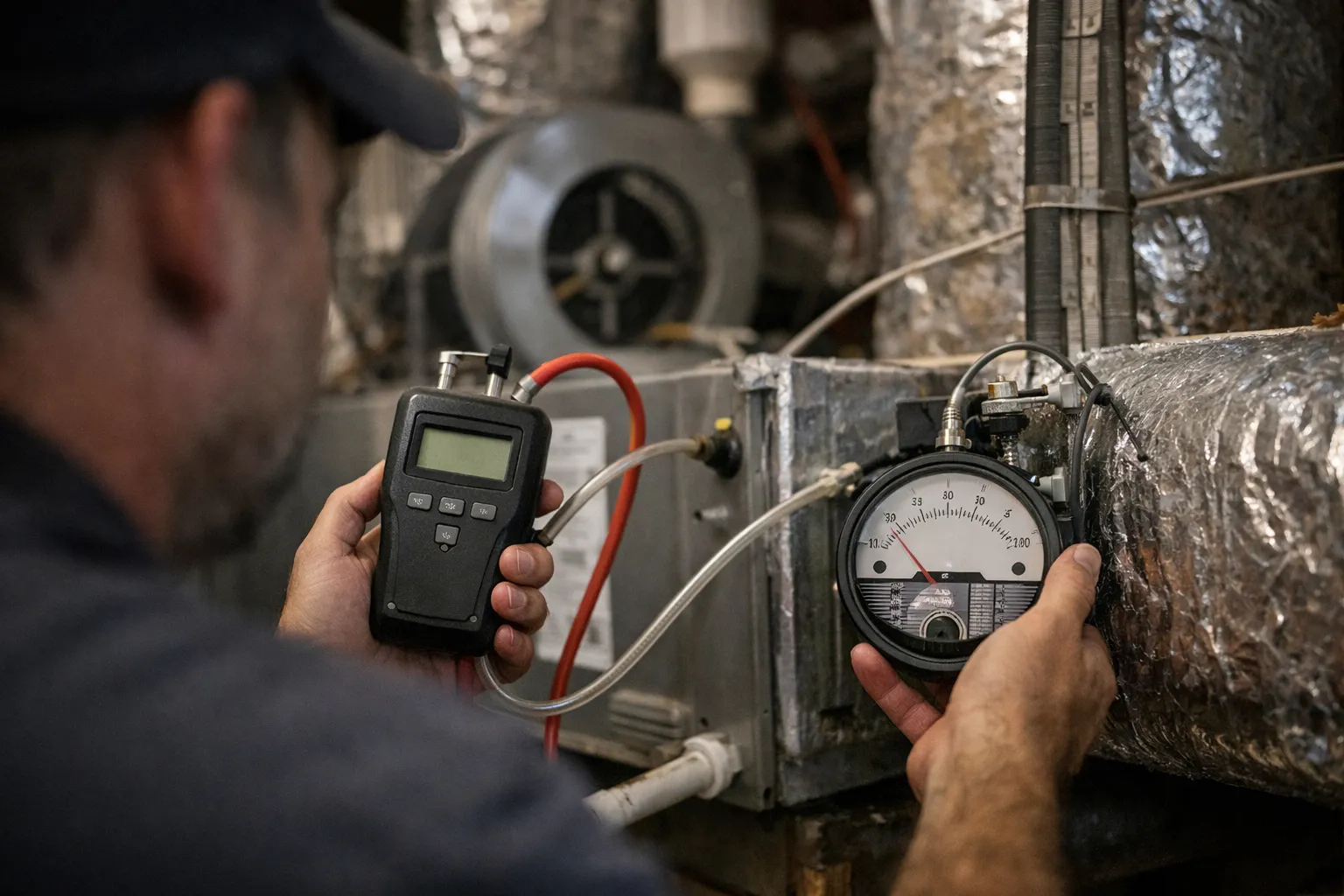
- TESP: Measure total external static pressure with the system running, ports external to the air handler. Aim for <0.5 in. w.c.; 0.2–0.4 in. w.c. is a practical sweet spot for most homes.
- Component drops: Record pressure drop across the filter and the coil separately; a dirty coil can add significant drop even with a clean filter.
- Return grille free area: Verify the free area supports the required return CFM—many retrofit grilles undersize returns by design.
- Branch/room checks: Spot-check supply CFM to key rooms and measure register throw.
- Baseline logging: Use Bluetooth/cloud manometers to log 24–72 hours before and after upgrades; transient behaviors (short cycling, night-time humidity) often show up only in time-series data.
- Post-upgrade verification: Re-check TESP and component drops after adding IAQ devices, filters, or zoning.
Tools and manufacturer trends to use now
Bluetooth-enabled manometers and apps from established test-equipment makers are now standard. Field instruments from long-established brands (Testo, Dwyer, Fieldpiece, Fluke) offer live logging and cloud export; learn the technique—measure with the system running, use ports external to the cabinet, and capture both return and supply. Several major HVAC OEMs introduced factory options for integrated pressure sensing and pressure-managed zoning in 2025–2026; those features help contractors protect airflow during automated damper operation, but they don’t replace proper duct sizing.
Impact: who this affects and how
Homeowners converting to heat pumps, specifiers adding whole-home IAQ, and contractors doing quick retrofits are most at risk. The real costs are comfort, energy, and equipment life: higher electric draw, compromised dehumidification, noisy systems, and callback labor. The good news: many fixes—adding a media cabinet, upsizing an undersized return grille, or replacing crushed flex—are inexpensive relative to the homeowner pain they resolve.
What to watch next
Look for wider adoption of integrated pressure sensors in residential air handlers, pressure-managed zoning controllers becoming a commissioning standard, and more contractors offering 24–72 hour commissioning logs as part of install packages. Until then, insist on measurement: document TESP and component drops before and after any IAQ or equipment change. Measurement makes the argument; fixes win comfort.
FAQ
How high is “too high” for TESP?
Most residential air handlers target around 0.5 in. w.c. total external static pressure. If you’re above 0.5 in. w.c., investigate—aiming for 0.2–0.4 in. w.c. usually gives the best balance of airflow, noise, and humidity control.
Will switching to a thicker filter fix the problem?
A deeper media filter can reduce pressure drop at a given MERV by increasing media area. The solution is more filter surface, not just thickness. Make sure the cabinet and grille provide the increased free area and measure the filter pressure drop under operating conditions.
Are smart vents worth it?
Smart vents can help in limited cases, but they’re not a substitute for proper duct design and return capacity. If you use them, pair them with pressure-aware controls or a master pressure sensor to prevent system pressure spikes.
Should I demand numbers from my contractor?
Yes. Ask for TESP and component pressure-drop readings before and after work. A competent contractor will provide instrumented data; if they won’t, get a second opinion. Physics beats opinion every time.
We’re farther along in 2026: better tools and smarter equipment exist, but common-sense commissioning hasn’t changed—measure before upgrades, watch the numbers, and make the simple fixes first. Trust the data; comfort will follow.