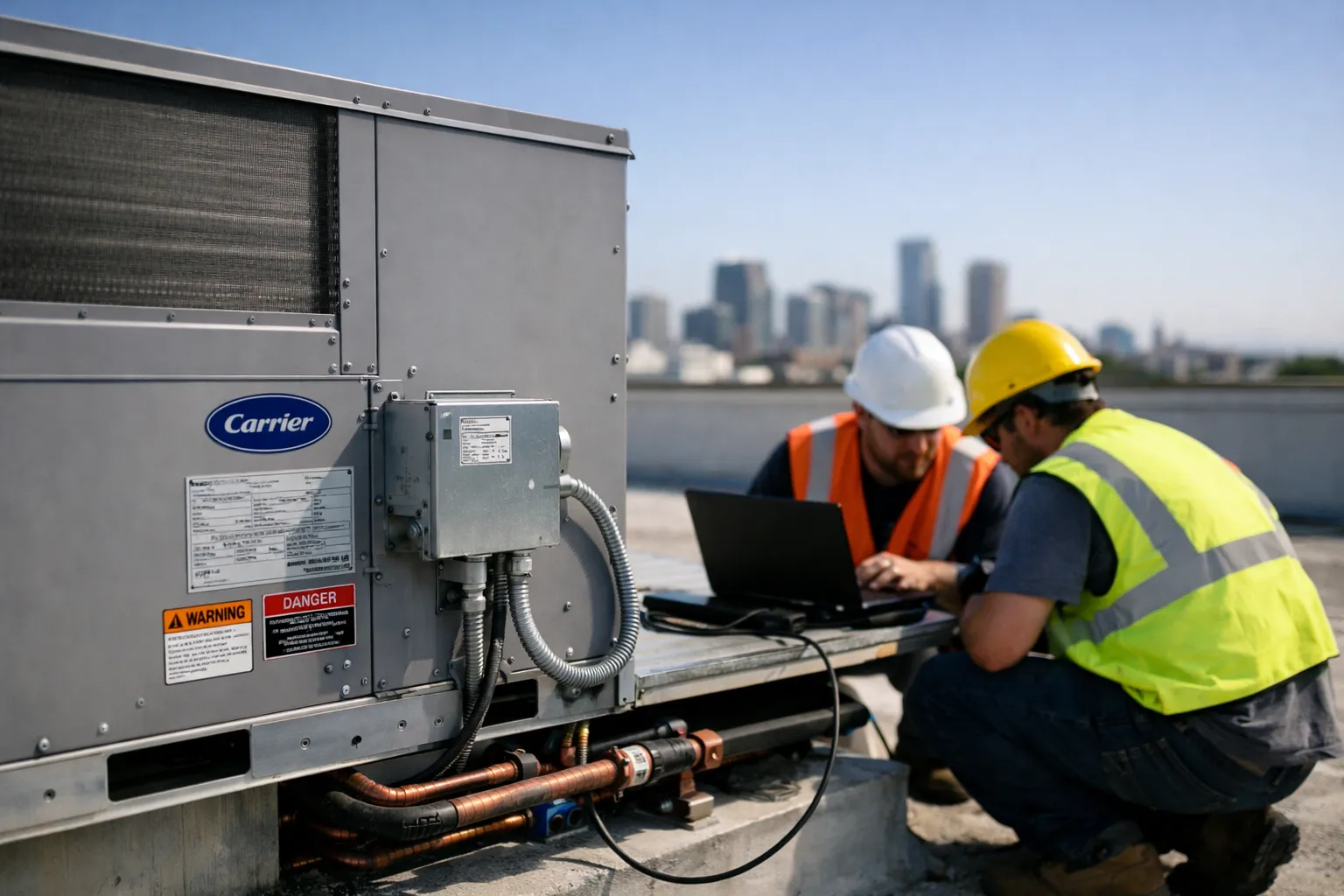
Overview
Electrification of commercial rooftop units (RTUs) is no longer an experimental niche. By August 2026 the question for building owners, contractors and designers is tactical: which sites should move to all‑electric heat‑pump RTUs now, which are better served by hybrid or staged approaches, and how should projects be specified to avoid costly surprises for refrigerants, commissioning and distribution‑grid interaction? This update synthesizes market developments since mid‑2024, practical cost and deployment shifts through 2026, and updated recommendations that HVAC systems professionals can act on this year.
Background: What Changed Since 2024
Three broad forces that were already visible in 2023–24 continued to accelerate into 2025–26:
- Product availability expanded. Nearly every major RTU OEM increased their commercial heat‑pump RTU portfolios to cover a wider set of capacities and climate‑rated options. That expansion reduced the need for custom conversions in many common applications.
- Policy and incentive momentum deepened. Federal funding streams and state/utility rebate programs continued to direct capital to electrification and to building‑level load flexibility—improving project economics in many jurisdictions.
- Field and grid experience scaled up. Multiple utility pilot programs and larger commercial deployments produced operational data on demand management, cold‑climate heat‑pump performance, and the practicalities of A2L refrigerants in packaged equipment.
Those three trends—supply, money, and operational data—are the reason the implementation conversation in 2026 is markedly more granular than it was in 2024.
Data and Evidence: Market, Costs and Performance
Product and market trends
- OEM uptake: By 2026, most tier‑1 manufacturers (national and multinational OEMs) offer multiple heat‑pump RTU platform variants, including inverterized multispeed compressors and factory‑integrated controls. That has reduced lead‑time variability for standard models compared with bespoke retrofits.
- Refrigerants: A2L low‑GWP refrigerants (e.g., R‑454B, R‑32) are now common in commercial packaged equipment lines; several OEMs also offer lower‑GWP HFO blends or CO2 options for niche applications. The industry broadly accepts A2L as the near‑term mainstream pathway for packaged heat pumps, with safety and installation practices evolving accordingly.
Costs and lifecycle economics
- First‑costs remain situational. Incremental capex for replacing a gas RTU with an all‑electric heat‑pump RTU still varies: typical estimates for a 10,000 ft² retail RTU remain in the mid‑five to low‑six‑figure total installed range depending on controls and interconnection needs. Many early adopters now report lower incremental equipment costs compared with 2023, but distribution‑upgrades and commissioning costs are prominent line items.
- Operating costs are more sensitive to tariff design than to equipment efficiency alone. In many service territories, demand charges, time‑of‑use (TOU) periods and commercial rate structures have a larger effect on owner economics than small differences in seasonal COP.
- Incentives matter more than ever. Federal programs and a growing number of state/utility rebates frequently reduce first‑costs by 20–40% for covered projects when paired with tax incentives or performance‑based utility rebates—shifting many lifecycle paybacks into practical investment windows for owners.
Performance and field evidence
- Cold‑climate capability: Recent field deployments (multiple utility pilots and manufacturer case studies) show modern heat‑pump RTUs with cold‑climate compressors and effective controls can meet heating loads down into the single‑digit °F range with reasonable auxiliary strategies. That expands the viability of all‑electric swaps in regions formerly seen as "too cold."
- Demand flexibility: Integrated control strategies—scheduled pre‑heating/pre‑cooling, coordinated ventilation (DOAS), and utility DR—have demonstrably reduced peak transformer loads in pilot projects. Owners that install telemetry and automation are seeing better utility bill management and DR program revenue streams.
Multiple Perspectives: Stakeholders and Concerns
Manufacturers
OEMs emphasize standardized platforms, factory safety features for A2L refrigerants, and bundled commissioning services to reduce field risk. Their priority is reducing installation variability that leads to performance shortfalls.
Contractors and technicians
Contracting firms stress two continuing bottlenecks: skilled labor for A2L handling and commissioning expertise for inverterized controls. Training pipelines have expanded (manufacturer and trade‑association programs), but uptake varies regionally.
Utilities and grid planners
Utilities are split. In areas with winter peaking driven by heating loads, planners are cautious about uncontrolled RTU electrification and emphasize integrated load management, targeted incentives for flexibility, and coordinated transformer upgrade programs. In summer‑peaking regions, utilities see electrified RTUs as an opportunity to shift and shave peak with DR programs.
Owners and facility managers
Facility decision‑makers cite reduced onsite combustion risk and simpler fuel logistics as strong motivations, but they also flag concerns about unexpected distribution upgrades and demand‑charge exposure. Owners who engage utilities and specify controls up front report smoother outcomes.
Implications: What This Means for Practitioners in 2026
- Procurement must be more prescriptive: Specify refrigerant family and A2L safety features, require OEM factory commissioning and clarify performance warranties tied to measured energy performance.
- Model utility tariffs early: Run lifecycle analyses with demand charges, TOU periods and anticipated utility rebate conditions. Small changes in assumed peak demand can swing paybacks substantially.
- Plan for grid interconnection: For buildings with multiple large RTUs, model transformer loading and engage the serving utility in the design phase. Some utilities offer siting or upgrade cost‑sharing for projects that provide verifiable grid benefits.
- Include flexibility technologies: Paired measures—onboard controls with telemetry, thermal storage, or modest onsite batteries—can turn a cost item into a revenue source via demand response or capacity programs in many areas.
- Invest in people: Include explicit budget lines for A2L refrigerant handling training, controls commissioning and periodic performance verification. These investments typically avoid warranty disputes and reduce project delays.
Updated Best Practices and Specification Checklist
- Specify refrigerant, charge limits and leak‑detection requirements in the contract; require manufacturer‑approved A2L safety documentation and training completion certificates.
- Require integrated metering and open‑protocol telemetry (e.g., BACnet/IP, Modbus TCP, or open‑ADR where available) to enable utility DR and building‑level optimization.
- Model both energy and demand costs in procurement scenarios—include worst‑case demand periods in your sensitivity runs.
- Engage the utility before ordering equipment to confirm service limits, upgrade timelines and available rebates or capacity payments.
- Insist on factory or OEM‑led commissioning and a defined performance verification period (e.g., 12 months) with measurable metrics for seasonal COP and capacity.
Outlook to 2030 (Practical Signals to Watch)
Through 2030 the RTU market will likely continue to mature along three vectors:
- Component cost declines: Continued scale in inverter drives and variable compressors should reduce equipment costs modestly.
- Policy and rate evolution: More utilities will adopt tariff elements and incentive structures that reward managed load and on‑site flexibility—how those programs are shaped will strongly influence adoption geography.
- Workforce normalization: A2L handling and advanced commissioning may become standard trade skills, reducing soft costs and project friction.
For HVAC professionals, the next 18–36 months are an opportunity to standardize procurement templates, expand A2L and controls training, and build partnerships with utilities so projects deliver predictable outcomes.
Practical Example (Illustrative)
Consider a 10,000 ft² retail RTU replacement in a mixed‑climate city with moderate electricity rates and a utility rebate that pays for measured peak reduction. If the owner specifies factory commissioning, integrated telemetry and enrolls in a utility DR tariff that pays capacity credits, the lifecycle economics commonly shift in favor of an all‑electric heat‑pump RTU versus hybrid approaches—largely because avoided transformer upgrades and DR payments materially reduce net first costs. Exact outcomes are site specific; the key point is that integration with utility programs can flip marginal projects into winners.
FAQ
Are A2L refrigerants safe to use on rooftop packaged units?
Yes—when systems are designed, installed and serviced to current safety standards. A2L refrigerants are mildly flammable and require appropriate charge‑limit strategies, ventilation, leak detection and technician training. Specify OEM A2L‑rated equipment and require documented training and commissioning to manage risk.
When should I choose hybrid (electric + gas) versus all‑electric RTUs?
Choose hybrid when site constraints (transformer capacity, restrictive utility tariffs, or lack of trained technicians) make a full electric swap risky or prohibitively expensive. All‑electric is increasingly viable in mild climates and where incentives and DR revenues exist. Run lifecycle models that include demand charges and potential grid upgrade costs to decide.
How important is controls and telemetry for RTU electrification projects?
Critical. Advanced controls, open‑protocol telemetry and demand management capabilities are often the difference between a successful, low‑cost deployment and a project that triggers distribution upgrades or high bills. Require these as part of equipment specifications.
What are the biggest project pitfalls to avoid in 2026?
Failing to engage the utility early, under‑specifying refrigerant safety and training, omitting commissioning and measurement requirements, and ignoring rate structures and demand charges are the most common pitfalls. Address these in the RFP and contract.
What should contractors prioritize to be competitive?
Invest in A2L and inverter controls training, build repeatable commissioning protocols, and develop partnerships with utilities or energy‑services firms to bundle DR-enablement and performance verification into project offers.
Electrified RTUs are now a mainstream technical and business decision in many markets. For HVAC systems enthusiasts and practitioners who invest in training, prescriptive procurement and early utility engagement, 2026 offers practical project pipelines that are both technically interesting and financially defensible.