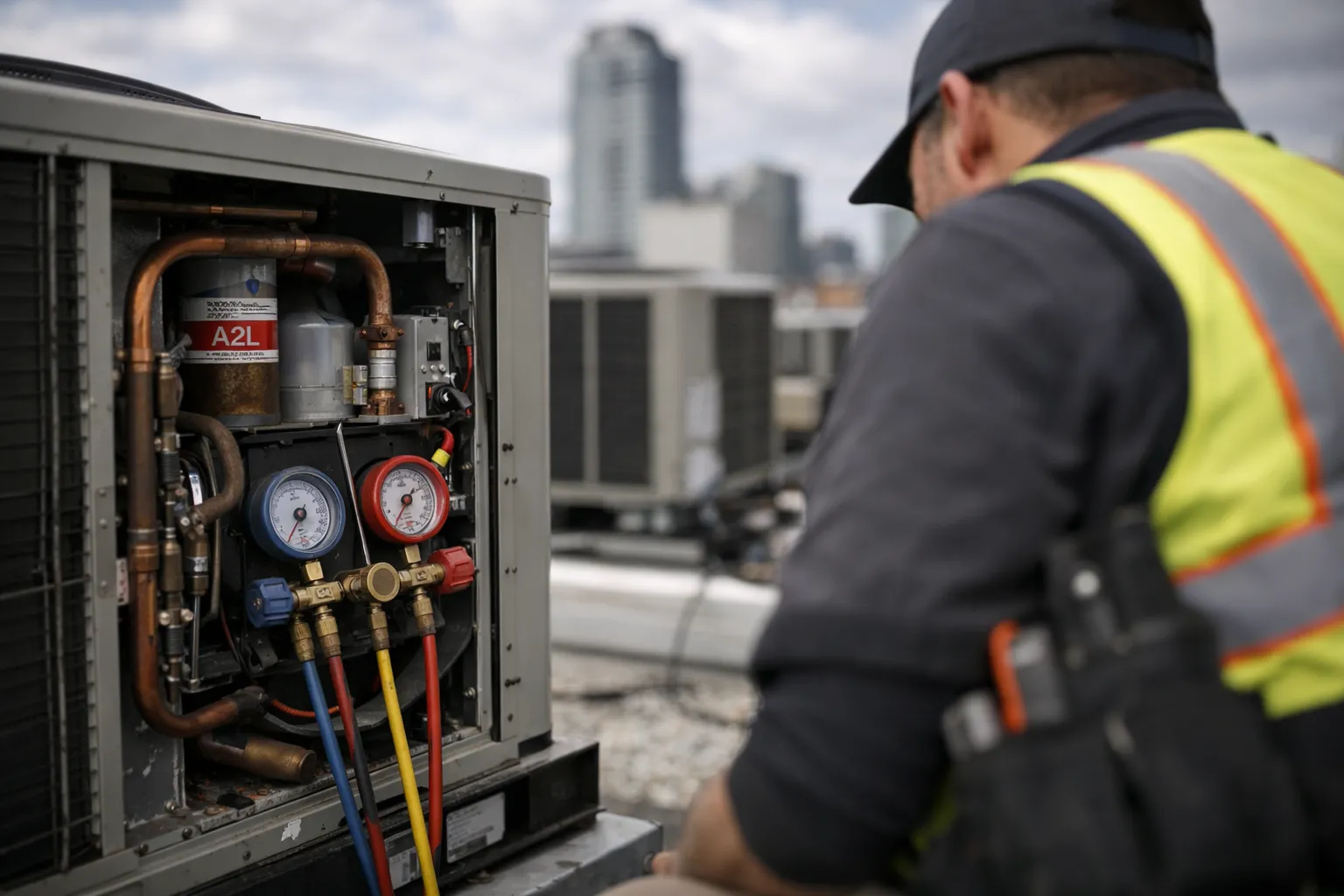
In a development likely to reshape commercial rooftop HVAC installs, the International Code Council’s 2026 mechanical code cycle has advanced a package of provisions aimed at making mildly flammable A2L refrigerants safer for use in packaged rooftop units (RTUs). The measures, which tighten refrigerant‑charge limits, mandate detection and local ventilation in certain installations, and formalize installation‑site risk assessments, are expected to accelerate adoption of low‑charge architectures and change how contractors approach rooftop work.
What changed in the 2026 code cycle
The code language adopted in the 2026 mechanical cycle focuses on three related areas:
- Lowered charge thresholds for rooftop and other packaged systems using A2L refrigerants, reducing the maximum allowable design charge in many common rooftop configurations.
- Mandatory leak‑detection and alarm requirements for equipment spaces and rooftop installations where charge is above a specified reduced threshold.
- Local ventilation and risk assessment requirements, which call for either engineered ventilation or a documented site evaluation that demonstrates acceptable occupant and egress risk for larger charges.
Together, these provisions create a stronger presumption in favor of low‑charge designs (micro‑channel circuits, secondary loops, distributed split systems, or packaged units with integral refrigerant containment) for new commercial rooftop installations, while still permitting larger charges where documented mitigation is provided.
Why the change matters
The shift reflects a pragmatic industry response to two overlapping trends: the global phase‑down of high‑GWP HFCs and the broad movement toward A2L low‑GWP refrigerants (for example R‑32, R‑1234yf and R‑1234ze) in mainstream HVAC equipment. A2L refrigerants deliver much lower global warming potential than legacy blends but introduce mild flammability concerns that have prompted regulators and standards bodies to clarify installation safety expectations.
By moving safety requirements into the model mechanical code, the ICC is creating a common regulatory floor that many U.S. jurisdictions use as the basis for local adoption. Contractors, specifying engineers and building owners who work across jurisdictions can expect more consistent enforcement of leak‑detection and charge limitations.
Immediate implications for manufacturers and contractors
- Design shifts: OEMs are likely to accelerate development and marketing of low‑charge RTUs and packaged systems that meet the new thresholds without additional ventilation or detection systems.
- Installation practices: Contractors will need to include leak‑detection sensors, local exhaust provisions, or documented engineered controls for rooftop installs with charges between the old and new thresholds.
- Permitting and inspection: Permit submittals will increasingly require refrigerant charge calculations, site risk assessments and detection system specifications; inspectors will look for compliance with the new code language.
Industry reaction and practical questions
Trade associations and equipment makers have signaled conditional support for clearer code language that reduces uncertainty while enabling A2L adoption. The Air‑Conditioning, Heating, and Refrigeration Institute (AHRI) and other stakeholders have previously advocated for harmonized requirements that allow manufacturers to plan product lines with predictable safety constraints.
But several practical questions remain for contractors and building owners:
- What equipment meets the new charge limits? Contractors will need updated equipment technical data sheets that list nominal refrigerant charge in a manner consistent with code reporting requirements.
- How will inspectors evaluate risk assessments? The code’s allowance for site‑specific risk evaluation is practical, but jurisdictions will vary on whether they accept engineering reports or require prescriptive ventilation/detection implementations.
- Who pays for added detection or ventilation? For retrofit projects, owners and service contractors must anticipate added scope and cost if existing rooftop assets exceed the new charge limits.
What contractors should do now
HVAC contractors and service providers can take practical steps over the next 6–12 months to adapt and avoid project slowdowns:
- Audit common rooftop products in your portfolio for stated refrigerant charges and identify units likely to exceed the new thresholds.
- Build partnerships with manufacturers offering factory‑configured low‑charge RTUs or modular split alternatives that simplify code compliance.
- Train installation crews on code changes, leak‑detection sensor placement, alarm integration and documentation expectations for permit submittals.
- Engage local code officials early on projects that may sit in a gray area—proactive review of site risk assessments can prevent rework.
Market winners and losers
Equipment suppliers that can supply certified low‑charge packaged systems or pre‑integrated detection and ventilation options are positioned to gain market share. Likewise, controls and sensor vendors that provide compact, code‑compliant leak‑detection packages will see increased demand.
Conversely, legacy rooftop equipment with large refrigerant charges may need redesign or may face reduced demand in new construction unless owners are willing to accept the cost and complexity of supplemental mitigation measures.
Outlook
The ICC’s 2026 mechanical code changes represent a turning point in how the industry will deploy A2L refrigerants at scale. The new package aims to balance climate goals with safety by incentivizing low‑charge technologies and clarifying site mitigation requirements. For the HVAC community—manufacturers, specifiers, contractors and code officials—the next 12–24 months will be a period of fast‑moving product introductions, training needs and localized adoption as jurisdictions incorporate the 2026 code.
Staying ahead will require contractors to modernize their specification checklists, invest in training and monitor both manufacturer data and local adoption timelines. The end result should be wider access to lower‑GWP systems with well‑defined safety practices—if the industry can coordinate on implementation.