Introduction — What you'll learn and who this is for
This article updates a practical step‑by‑step guide for retrofitting heat‑recovery ventilators (HRVs) and energy/enthalpy‑recovery ventilators (ERVs) into older single‑family homes. It is written for HVAC contractors, building performance professionals and technically inclined homeowners. You'll get current June 2026 best practices for selecting units, correct sizing methods, retrofit ducting strategies, filtration for wildfire and urban pollution events, commissioning tests that matter, and smart control integrations. The update adds 2024–2026 industry trends (higher filtration, low‑power EC fans, demand‑control ventilation and cybersecurity-aware controls) and clarifies sizing with ASHRAE 62.2 and ACH methods.
Prerequisites and context — What you should know first
- Standards: Use the latest locally adopted version of ASHRAE 62.2 as your baseline; many jurisdictions continue to adopt 62.2‑2019 or the later updates — always check local code.
- House realities: Older homes typically have higher envelope leakage and legacy combustion appliances; retrofit plans must address combustion safety, potential depressurization and duct routing constraints.
- New 2024–2026 trends to consider: greater emphasis on particle filtration (wildfire/PM2.5), wider availability of low‑power EC (ECM) fans, and HRV/ERVs with native smart controls and integrated CO2/humidity sensors. Expect firmware updates and remote diagnostics on many modern units.
1. Decide HRV vs ERV: pick by climate and moisture profile
Core distinction (unchanged): HRVs move sensible heat; ERVs move sensible plus latent energy (moisture) via enthalpy wheels or membrane cores. Updated considerations for 2026:
- Cold, dry climates: an HRV still typically makes sense to avoid over‑drying in winter. Confirm defrost strategy—modern electric or recirculation defrost controls are common and more efficient than older resistance heaters.
- Mixed‑humid and humid climates: ERVs remain preferable to reduce summer latent load and prevent bringing in excess moisture. New membrane cores introduced 2023–2025 improved long‑term moisture transfer and reduced cross‑contamination risk—ask manufacturers for long‑term performance data and field test results.
- Wildfire‑prone or high‑PM regions: ERV vs HRV choice is less important than filtration. Use supply‑side filtration compatible with the unit (see Section 5). Consider units that accept MERV13 or higher filters without excessive fan energy penalty.
- Hybrid strategies: In regions where winters are very cold and summers humid, consider a dedicated HRV for winter plus a ducted ERV or local dehumidification in summer, or choose an ERV with selectable enthalpy bypass if available.
2. Sizing: how much ventilation is required (2026 clarification)
Two commonly used sizing approaches exist; both remain relevant. Use the one required by code or the one that matches your IAQ goals.
- ASHRAE 62.2 method (occupant + area): Q = 7.5 × (Bedrooms + 1) + 0.01 × Floor Area (CFM). This is the code basis in many jurisdictions—calculate per the latest adopted edition. Example: for a 1,800 ft², 3‑bedroom house: Q = 7.5×(3+1) + 0.01×1800 = 30 + 18 = 48 CFM continuous.
- ACH or 0.35 ACH rule (occupant exposure focus): Older rule-of-thumb for continuous whole‑house ventilation is 0.35 ACH. For 1,800 ft² with 8‑ft ceilings (14,400 ft³), 0.35 ACH ≈ 84 CFM continuous. Many contractors size to this for improved short‑term pollutant removal during occupied times.
Practical recommendation (2026): design to meet the code‑required ASHRAE 62.2 minimum, but consider provisioning the unit and ducting to deliver higher intermittent flows (or slightly higher continuous flows) to handle events (cooking, gatherings, smoke). Many installers now select a unit ~10–20% above the code target to allow for duct losses and filtration pressure drop—confirm delivered CFM at expected static pressure from manufacturer curves.
3. Assess the house and system interactions (new checks for 2026)
Site survey must document:
- Combustion appliances and venting paths; check for natural‑draft water heaters, furnaces and masonry chimneys. Even as electrification increases, many older homes still have gas appliances—do not assume otherwise.
- Envelope leakage and expected depressurization: tighter retrofits increase the relative impact of ventilation flows. Measure or estimate ACH50 if available.
- Existing ductwork condition and capacity: modern HRV/ERVs can still be integrated with central systems, but filter compatibility and cross‑contamination risks have become higher‑profile concerns since 2020.
- Electrical capacity and site for unit mounting; many newer units require only 120V but check motor start/load and whether a fused or GFCI circuit is needed.
- Air quality drivers: occupant density, presence of smokers, pets, or local wildfire smoke risk—these influence filter choice and control strategy.
4. Layout and ducting strategies for retrofits
Two primary approaches remain valid; updated details below:
- Dedicated ducting (preferred): Separate supply and exhaust runs from the HRV/ERV to bedrooms/living rooms and wet rooms. In 2026, installers increasingly use rigid or semi‑rigid duct with smooth interior elbows and external insulation. This reduces losses and allows MERV13 filters on the supply side without straining the fan.
- Connect to central forced‑air: Tie into the return or supply when duct runs or wall space limit options. Modern best practice is to add motorized dampers and check flow balancing at the system blower’s static pressure. Avoid relying on an uncontrolled connection—install interlocks to prevent crossflow when the furnace fan runs if manufacturer guidance requires it.
General rules:
- Keep runs short and straight where possible; use 45° elbows and limit equivalent length. For long exterior runs consider sheet‑metal for the first several feet to reduce flex duct losses.
- Insulate ducts in unconditioned spaces (R‑6 or better in cold climates) to prevent condensation and freeze risk.
- Locate supply terminals in living spaces and bedrooms; put exhaust terminals in baths and the kitchen (note: heavy kitchen range hoods should be independent and vented directly outside).
- Outdoor terminations: follow local code clearances and position intake at least 3–6 ft from potential re‑entrainment sources—avoid placing supply intakes near dryer vents, exhaust flues, or driveways.
5. Unit selection details — 2026 priorities
Key specs and 2026 additions to compare:
- Delivered airflow at installed static pressure: verify CFM at 0.2–0.6 in. w.g. using the manufacturer’s system curve. Expect measurable drops when adding MERV13+ filters—ask for performance with filters installed.
- Sensible and enthalpy recovery efficiency: request tested data at conditions similar to your location. For ERVs, request long‑term durability data on membrane performance and washability.
- Fan power (W): look for low fan power at target flow. A practical guideline in 2026 is to prefer units with fan power under ~1 W/CFM at target flow where possible—this reduces operating cost and aligns with utility incentive thresholds.
- Defrost strategy: confirm frost control mode and verify that manufacturer software supports cold startup and low‑load operation. Modern algorithms reduce energy use and condensate formation compared with older fixed‑time defrosts.
- Filtration: choose models that accept MERV13 or higher on the supply side without exceeding fan limits. For wildfire events, plan a supplemental HEPA portable or an inline HEPA module if needed.
- Controls and sensors: many 2024–2026 units include integrated CO2, RH and PM2.5 sensing. These support demand‑control ventilation (DCV). Verify sensor calibration procedures and firmware update policies.
- Noise and vibration: ask for sound ratings (dB(A) and sone) at installed flow; consider external sound attenuators or soft‑mounts for bedroom adjacency.
6. Installation: practical steps & tips
- Mount in conditioned or semi‑conditioned space where possible. If you must use an attic, provide robust insulation, frost control and a condensate pump if gravity drain isn't available.
- Run insulated intake and exhaust through unconditioned zones; seal all duct joints with mastic or foil tape rated for HVAC use. Avoid long sections of small‑diameter flex duct.
- Install condensate drain per instructions with a P‑trap and accessible cleanout; if freezing is possible, use a heated condensate pump or locate the unit where freezing is unlikely.
- Provide accessible filter access; homeowners must be able to replace filters without tools in most cases. Include a replacement schedule and spare filters with the handover packet.
- Wire controls on a dedicated circuit if specified. For smart integrations, configure Wi‑Fi or BACnet/Modbus carefully; document credentials and change default passwords to avoid insecure devices on the home network.
- If tying into central HVAC, install motorized dampers and verify control sequencing: prevent the central system from pressurizing the HRV/ERV in a way that creates unintended flow paths.
7. Commissioning and testing: make sure it works
Commissioning remains the single most important step to ensure IAQ and safety. Updated 2026 commissioning checklist:
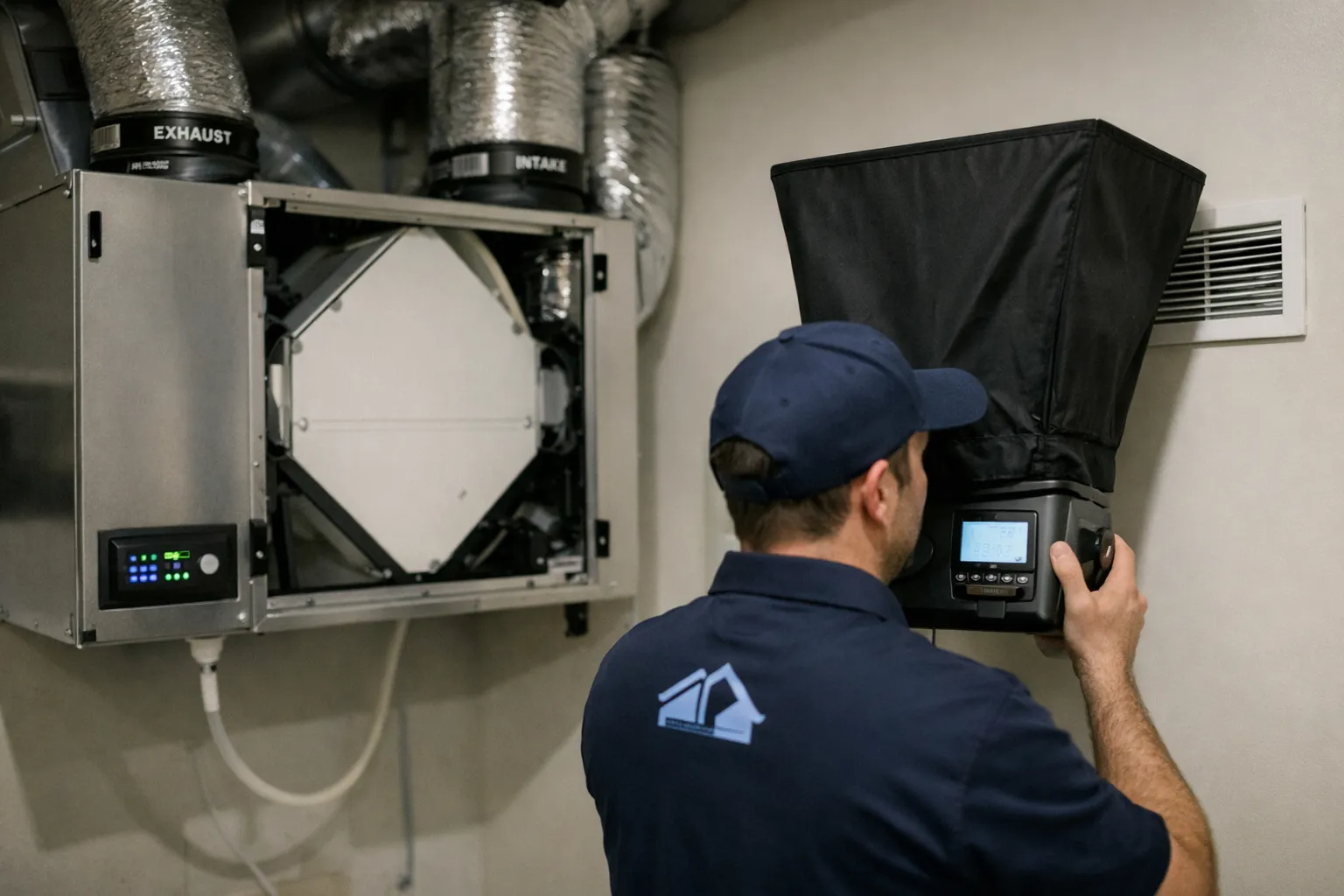
- Airflow verification: use a flow hood or in‑duct pitot probe to measure supply and exhaust CFM at installed static pressure. Record results at baseline and after filters are installed.
- House pressure and combustion safety: perform spillage/backdrafting tests on combustion appliances per BPI/NFPA/local code and document. If testing reveals spillage risk, mitigate before enabling whole‑house ventilation (makeup air, appliance conversion, or remediation).
- CO2 or tracer tests: a CO2 decay or steady‑state check during normal occupancy verifies ventilation effectiveness. Aim to keep occupied CO2 below ~800–1,000 ppm as a practical target for good ventilation (use local guidance where required).
- Particle and smoke response: for smoke‑prone areas perform a short test with a high‑efficiency filter installed and measure indoor PM2.5 reduction. Document how the system performs when filters are dirty to understand worst‑case behavior.
- Noise and vibration: test at night in bedrooms. If noise exceeds comfort targets, move supply registers, add sound attenuators, or rebalance flows.
- Save commissioning data (flows, pressures, test results, filter types) in a handover packet for the homeowner and for rebate/funding documentation where applicable.
8. Controls and smart operation
Smart and sensor‑based control has matured rapidly by 2026:
- Demand‑control ventilation (DCV) using CO2 and RH sensors is now common and useful for occupancy‑driven homes — configure thresholds (e.g., CO2 800–1,000 ppm) and verify sensor calibration periodically.
- For wildfire events, configure a "smoke mode" that increases filtration, reduces outdoor intake or switches to closed‑building recirculation with portable HEPA units.
- Integrate with home energy management systems carefully; enable firmware updates from the manufacturer but document update authority and cybersecurity settings (change default passwords, restrict remote access where unnecessary).
- Implement interlocks for range hoods and dryers to avoid conflicts—use time delays and occupant overrides per manufacturer guidance.
9. Maintenance and long‑term operation
Maintenance keeps performance consistent:
- Filters: check every 1–3 months initially; replace MERV13 filters typically every 3–12 months depending on dust and smoke frequency.
- Core servicing: inspect and clean cores annually; more frequently in dustier or smoky environments. Inspect seals and gaskets for wear.
- Condensate and defrost: inspect drain and trap before and after winter; test defrost function at low ambient temps.
- Sensors and controls: verify CO2 and RH sensors annually and update firmware per manufacturer security guidance.
10. Common retrofit pitfalls and how to avoid them
- Undersized ducts/unit: results in inadequate delivered flow and noise. Use manufacturer curves, account for added filter pressure drop and measure delivered CFM at commissioning.
- Ignoring combustion safety: always test for spillage/backdrafting and remediate before commissioning whole‑house ventilation.
- Poor intake/exhaust placement: avoid re‑entrainment; maintain code clearances and stay clear of neighbor vents and windows.
- Not planning for wildfire events: supply filtration and supplemental HEPA strategies need to be considered in the design phase.
- Leaving smart controls insecure: change defaults, document network requirements and inform homeowners about privacy and update practices.
11. Updated example: 1,800 ft², 3‑bedroom retrofit (2026 example)
- Calculate ASHRAE 62.2 target: 7.5×(3+1) + 0.01×1800 = 48 CFM continuous. This is the code baseline in many areas.
- Decide occupancy strategy: if occupants frequently host gatherings or if the home is in a smoke‑prone area, plan for higher intermittent flows (e.g., design the unit to deliver 80–90 CFM at installed static pressure during boosts) or pair continuous 48 CFM with scheduled/hourly boosts to 80 CFM.
- Select a unit rated for ~100 CFM free‑air that delivers ~85 CFM at 0.3–0.4 in. w.g. and accepts MERV13 filters without exceeding fan capacity. Confirm fan power and noise ratings at those points.
- Install dedicated supply registers in living room and all bedrooms; place exhausts in two bathrooms and a kitchen exhaust (if not using a separate high‑CFM hood). Commission using a flow hood and a CO2 decay test to confirm performance.
12. Rebates, codes and documentation (2026 guidance)
Since 2023 many utilities and state programs expanded incentives for ventilation, filtration and whole‑home efficiency. Check local utility rebate portals, state energy office, and federal programs for eligible measures (units, controls, commissioning). Document all commissioning measurements (flows, static pressures, spillage tests and filter types) to support incentive applications and for warranty claims.
Common mistakes — quick checklist
- Failing to account for filter pressure drop when picking unit size.
- Skipping combustion spillage tests before enabling ventilation.
- Installing intakes too close to exhausts or pollutant sources.
- Connecting to central HVAC without dampers/interlocks and verifying cross‑contamination risk.
Pro tips
- Choose units with replaceable, widely available cores and a clear maintenance access path — this lowers lifetime cost and preserves performance.
- When wildfire smoke is a risk, design a "smoke mode" strategy: close intake, increase recirculation with high efficiency filtration, and run portable HEPA units in living areas.
- Record commissioning snapshots (photos, PDFs of manufacturer curves, measurement logs) and hand them to the homeowner in digital and paper form.
- For tight budgets, prioritize a correctly sized duct layout and commissioning over buying the highest‑efficiency core — a well‑installed mid‑range unit outperforms a poorly installed premium unit.
FAQ
How do I decide between ASHRAE 62.2 and 0.35 ACH for sizing?
Use the locally adopted ASHRAE 62.2 as the code baseline. 0.35 ACH is a conservative rule‑of‑thumb for continuous ventilation that delivers better pollutant removal in many older homes. Practically, design to meet ASHRAE 62.2 but size the unit and ducts so the system can provide higher intermittent flows (or slightly higher continuous flow) when needed.
What filter level should I use for wildfire or high‑PM areas?
Prefer supply‑side filtration of MERV13 or higher during smoke events. Ensure the selected HRV/ERV can maintain required flow with that filter in place—confirm delivered CFM at the added pressure drop. When smoke is severe, supplement with portable HEPA air cleaners in occupied rooms.
Can I connect an HRV/ERV to my existing central ductwork?
Yes—this is common—but follow best practices: use motorized dampers or recombination kits recommended by the manufacturer, verify filter compatibility, and commission for cross‑contamination. Dedicated ducting remains the preferred option for predictable airflow and easier balancing.
How do I verify combustion safety after installing ventilation?
Perform spillage/backdrafting tests on all atmospheric‑vented combustion appliances according to BPI, NFPA or local protocols. If any appliance spillage is detected, provide makeup air, convert appliances to direct vent, or remediate venting issues before enabling continuous exhaust flows.
Are smart HRV/ERV controls worthwhile?
Yes, when used correctly. CO2 or RH‑based demand control can reduce energy use while maintaining IAQ. Ensure sensors are calibrated, firmware is maintained, and networks are secured. Provide homeowners with simple operating guidance and reminders for maintenance.
Conclusion
Retrofitting an HRV or ERV in an older home still delivers substantial IAQ and comfort benefits when designed and installed with attention to combustion safety, actual delivered airflow, filtration needs and controls. The main 2026 changes are more widespread availability of low‑power EC fans, improved enthalpy membranes, stronger emphasis on supply filtration for smoke/PM events, and smart controls with DCV capability. The most important actions you can take: run a complete site survey, calculate ASHRAE 62.2 requirements, choose a unit sized to deliver required CFM at realistic static pressure with filtration in place, commission with airflow and combustion testing, an