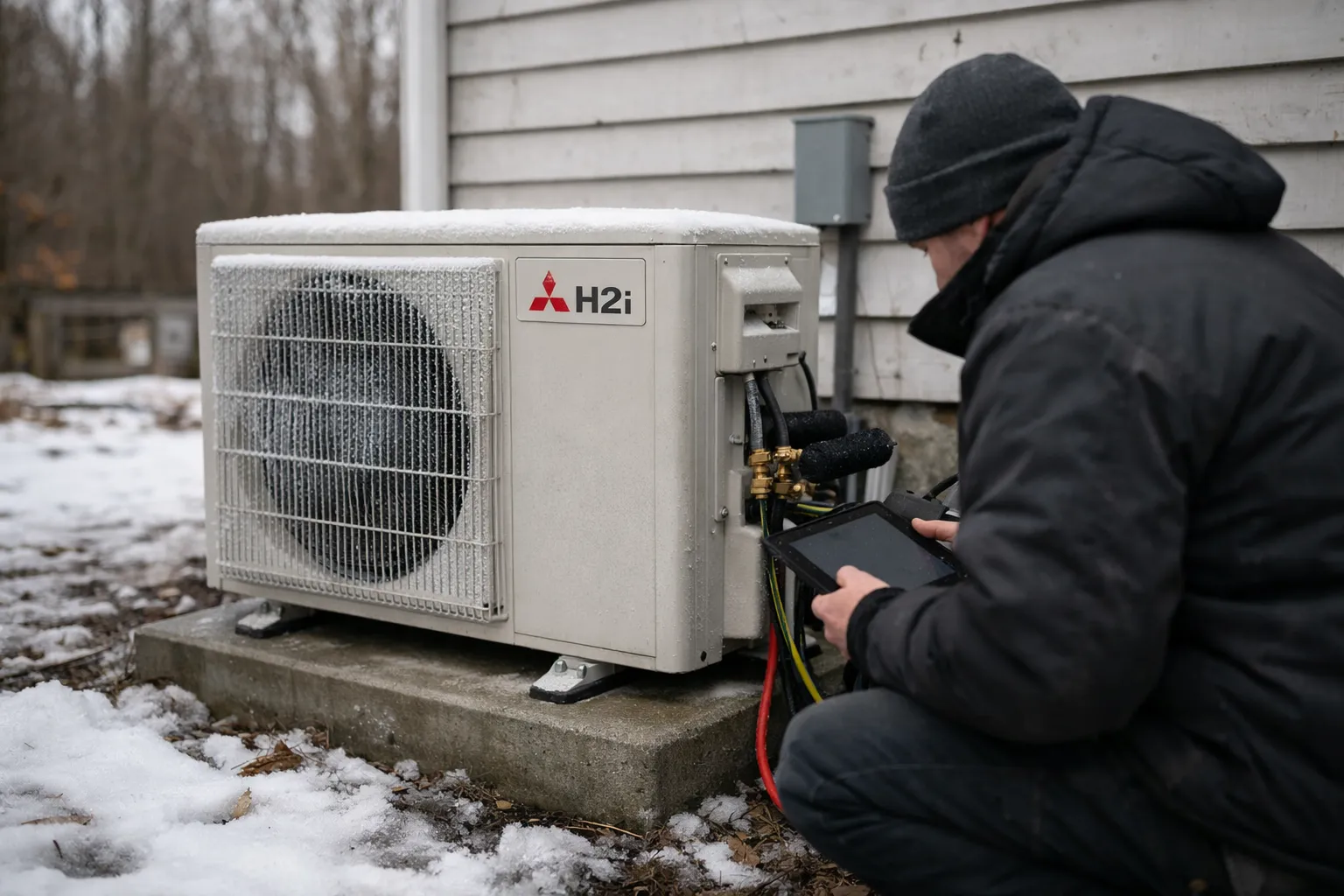
As heat‑pump adoption accelerates across cold‑climate regions, Mitsubishi Electric’s Hyper‑Heating INVERTER (H2i) line remains one of the most discussed options for reliably delivering heat when temperatures drop below freezing. In this review I evaluate the H2i lineup as a system for retrofit and new‑build applications in 2026 — focusing on cold‑weather performance, installation realities, operating economics, and the trade‑offs owners and installers should weigh.
What the H2i family is (and what it isn’t)
The H2i family is Mitsubishi Electric’s long‑standing product line engineered to extend usable heat‑pump capacity into colder outdoor temperatures than conventional air‑source units. Key architectural features include variable‑speed inverter compressors and control strategies designed to preserve capacity at low ambient temperatures. The H2i portfolio covers ductless mini‑split indoor heads, compact ducted units, and multi‑zone systems commonly used in single‑family homes, light commercial spaces, and multifamily units.
Core strengths
- Cold‑weather capability: H2i systems are engineered to maintain meaningful heating capacity down to deep subfreezing conditions, making them a practical primary heat source in many northern climates where earlier heat‑pump models would require large auxiliary electric heat.
- Zoning and flexibility: Broad indoor‑unit options and multi‑zone outdoor models allow owners to prioritize rooms and avoid oversizing. This modularity helps in staged retrofits and incremental electrification strategies.
- Quiet operation and comfort: Variable‑speed compressors and inverter‑driven indoor blowers deliver steady‑state comfort with lower noise and reduced temperature swing compared with single‑stage systems.
- Proven track record: The H2i platform has been field‑tested for years in markets like New England, the Pacific Northwest, and parts of Canada, providing a depth of installer experience and aftermarket support.
Where H2i falls short
- Higher upfront cost: Relative to non‑cold‑climate air‑source heat pumps, H2i equipment and matched indoor units command a premium. That cost often persists even after utility incentives.
- Installer skill sensitivity: Performance depends heavily on correct line length, refrigerant charge, and control sequencing. Poor commissioning can erase the cold‑climate advantages.
- Defrost and auxiliary heat trade‑offs: Although H2i reduces reliance on electric resistance backup, defrost cycles and very low‑temperature COP degradation still occur — meaning hybrid strategies (boilers, fossil gas, or thermal storage) can remain sensible in extreme sites.
- Supply chain and parts: Like many specialized HVAC platforms, lead times for specific indoor head types or control boards can be longer during peak seasons, complicating staged installs.
Performance in practice — what to expect
Owners and technicians should expect H2i systems to deliver usable heat at temperatures where conventional ASHPs struggle. That said, “usable” is not synonymous with “unchanged.” Capacity tapers with falling outdoor temperature; the H2i advantage is a shallower taper and more resilient COP profile, not a perfectly flat output.
Real‑world performance depends on heat load sizing, distribution strategy, and commissioning. Systems sized to meet design loads down to a conservative low‑temperature setpoint (for example, design day −5°F to −10°F in many northern U.S. climates) will rely less on backup heat than undersized installs. For enthusiasts, pay attention to manufacturer guidance on maximum line lengths, elevation change limits, and recommended indoor head pairings — deviations materially affect capacity and efficiency.
Controls, monitoring and integration
Mitsubishi supports remote control, fault logging, and integrations into building‑level controls through vendor gateways and third‑party interfaces. For hobbyists and pros who want to monitor performance over a season, add‑on dataloggers or BACnet/Modbus gateways make it possible to track outdoor air temperature, compressor speed, and run‑time of auxiliary heat — information that separates a good install from a great one.
Installation and commissioning: critical tips
- Charge and piping: Always adhere to the manufacturer’s refrigerant‑charge adjustment procedure for line length and elevation. Subtle errors reduce low‑temp capacity dramatically.
- Line set and oil return: Maintain the correct pitch and minimum length for reliable oil return at low head pressures.
- Defrost strategy: Verify defrost timing and sensor placement. In high‑soiling or roof‑mounted installations, defrost frequency can increase fuel use and reduce occupant comfort if not tuned.
- Backup heat sequencing: Use staged auxiliary heat with hysteresis and lockout controls rather than a simple temperature differential to avoid unnecessary resistance heat use.
- Monitoring: Install local metering or connect to a BMS for at least the first heating season to confirm expected seasonal energy performance.
Who should choose H2i in 2026?
The H2i line is well suited to:
- Single‑family homes in cold climates pursuing full or high‑percentage electrification while minimizing electric‑resistance backup.
- Retrofits where ductwork is limited and zoning flexibility is valuable — especially in older homes that benefit from mini‑split heads.
- Commercial and multifamily common areas where reduced auxiliary heating and quieter operation improve occupant satisfaction.
H2i may be a poor match when budget constraints are severe, when buildings already have robust hydronic heating that can be converted more cost‑effectively, or where installers lack experience with cold‑climate line‑set practices.
Verdict — value for the HVAC enthusiast
Mitsubishi’s H2i remains a leading cold‑climate air‑source heat‑pump option in 2026 for owners and enthusiasts who value reliable heating capacity in subfreezing weather and the flexibility of multi‑zone deployments. Its advantages are most visible in carefully sized, professionally commissioned installations. The downsides — higher capital cost and installer‑sensitivity — are real but manageable for buyers who budget for quality installation and monitoring.
If you’re evaluating H2i for a project, get quotes that separate equipment, installation, and commissioning tasks; insist on performance guarantees or season‑long monitoring; and compare lifecycle cost estimates to hybrid alternatives. For many northern homeowners and small‑building operators, H2i is not just a marginal upgrade — it’s a practical foundation for decarbonizing space heat without sacrificing wintertime comfort.