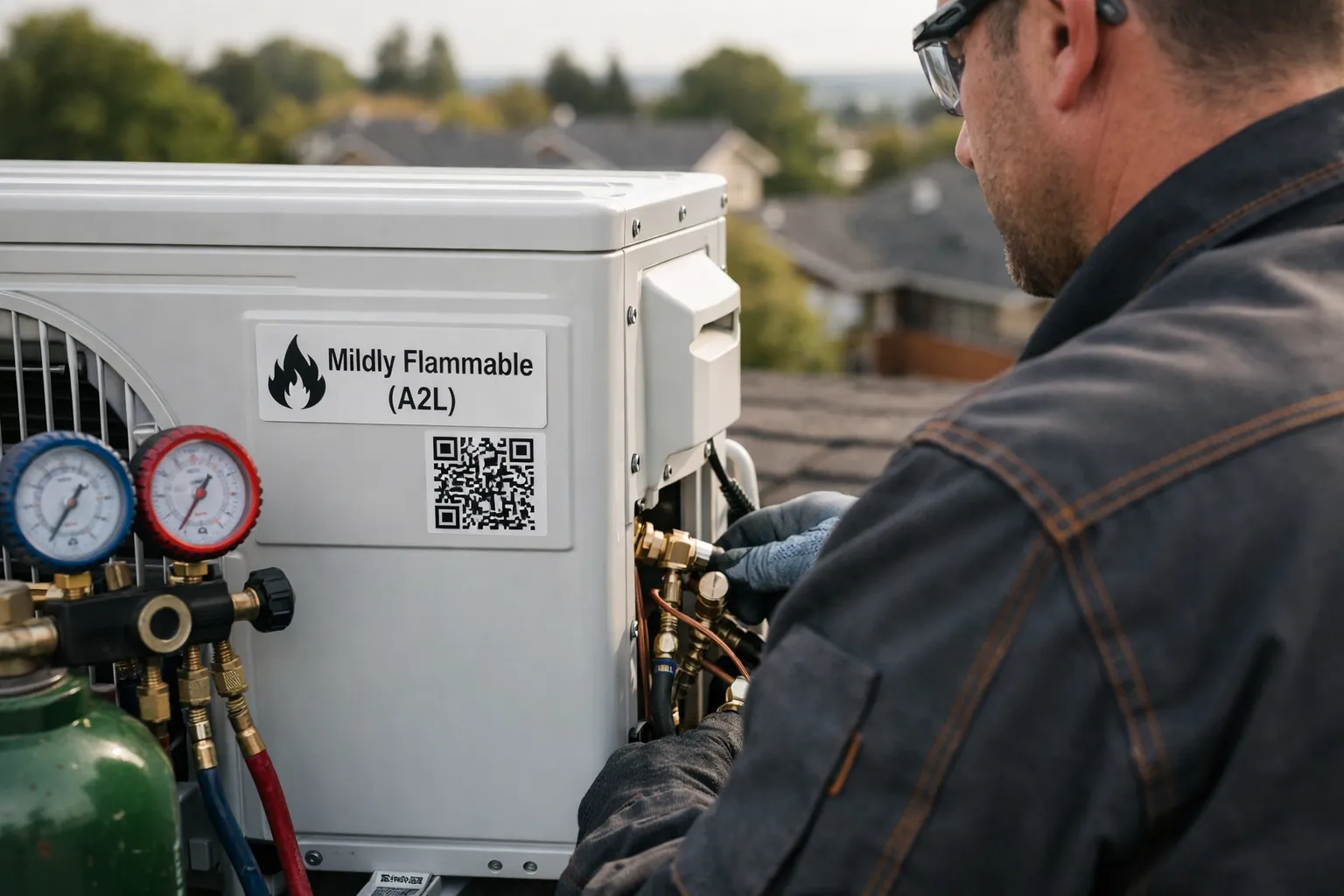
Across 2024–2026 the HVAC industry has moved decisively toward lower‑GWP refrigerants. For residential and light‑commercial heat pumps, that shift increasingly means A2L ("mildly flammable") chemistries. The move promises large greenhouse‑gas savings, but it also forces rethinking of retrofit strategies, technician skillsets, product certification, and supply chains.
Why A2L matters now
Regulatory pressure and OEM product planning are the twin drivers behind A2L adoption. Stricter GWP targets and the phase‑down of legacy HFCs have pushed manufacturers to choose either nonflammable HFO blends or mildly flammable A2L options for high‑volume residential and small commercial equipment. A2L refrigerants commonly offer a balance of thermodynamic performance, cost, and energy efficiency that keeps system SEER/SCOP competitive while delivering far lower GWP than R‑410A.
Markets outside North America—Europe, Japan, and parts of East Asia—began adopting A2L (notably R‑32 and several HFO blends) earlier, creating experience that U.S. installers and code bodies are now studying. By mid‑2026, many OEMs have A2L variants of popular mini‑splits and packaged heat pumps available or near commercialization for the U.S. market.
Three adoption pathways and what they mean for retrofits
When owners and contractors face systems that use legacy refrigerants, they generally confront three choices. Each pathway carries distinct implications in an A2L era.
-
1. Like‑for‑like replacement (preferred)
Replace the failing outdoor unit with an OEM‑designed A2L model or a nonflammable alternative. This approach minimizes risk: equipment is certified and charged to design specifications, safety controls and pressure reliefs are sized appropriately, and manufacturer warranties remain valid. For split‑system mini‑splits and many light‑commercial units, this is usually the most economical compliance route when the existing indoor coil and piping are compatible.
-
2. System replacement (next‑best)
Replace the entire system—indoor and outdoor—particularly when indoor coils, controls, or charge lines are inaccessible or non‑compliant with A2L safety requirements. This is costlier up front but removes uncertainty and avoids retrofitting an old charge containment envelope for a mildly flammable refrigerant.
-
3. Direct retrofit (rare, high‑risk)
Converting a R‑410A system to an A2L refrigerant in place is generally discouraged. A2L adoption in existing hardware can create incompatibilities: different lubricants, compressor oil miscibility, altered pressure/temperature glide, and higher flammability considerations around fan coils, basements, and equipment rooms. In many jurisdictions, codes and manufacturers prohibit direct retrofit to an A2L without engineering approval and often component changes. Expect direct‑retrofit options to be limited to controlled, engineered projects with rigorous safety measures and insurer approval.
Codes, standards and the practical hurdles
A2L refrigerants are workable technically, but they require alignment among standards, listings and building codes. Key practical issues installers and facility managers encounter:
- Equipment Listings: UL/ETL evaluations and other listings must explicitly cover the A2L variant. An A2L model based on an earlier R‑410A platform is not automatically listed for A2L service.
- Leakage and charge limits: Mechanical rooms and enclosed spaces have different allowable charge limits and ventilation requirements for A2L refrigerants. ASHRAE/industry guidance on charge size per volume is applied in design reviews and code enforcement.
- Service practices: Brazing, vacuuming, and recovery procedures need adaptation. A2L service often mandates inert‑gas purge, A2L‑rated recovery equipment, and stricter hot‑work controls.
- Fire and electrical coordination: NFPA and local fire authorities may require additional separation, detection, or automatic ventilation when A2L charges exceed thresholds; electric disconnects and control locations are evaluated to limit ignition sources near potential leak locations.
Because these layers interact, retrofit feasibility is not just an HVAC engineering question—it becomes a code, insurance and facility management issue. Contractors must coordinate early with AHJs (Authorities Having Jurisdiction) and owners.
Supply‑chain and market dynamics through 2026
The transition to A2L is opening new bottlenecks and reshaping supplier relationships:
- Compressor and component lead times: Compressors designed and tested for A2L charge envelopes, motor insulation systems, and valve tolerances are in higher demand. OEMs prioritized these components for new A2L product lines, creating transient supply tightness in 2024–2025 that eased in some segments by 2026 but remains a planning factor for contractors.
- Refrigerant availability and pricing: While major refrigerant producers scaled production, spot prices for certain HFO blends and A2L refrigerants showed volatility in 2024–2025. Contracting earlier and establishing recovery/reclamation practices reduces exposure to price swings.
- Training and certification capacity: The technician base is the slowest link. Training programs and apprenticeship slots expanded after 2024, but practical on‑the‑job A2L experience is still concentrated among early adopters and larger service firms in 2026.
Economics: retrofit cost vs lifecycle value
Owners ask whether to retrofit to A2L, replace, or wait. The analysis must include:
- Upfront capital: Replacement cost of an A2L‑listed unit vs the theoretical cost to convert and certify an existing system. In many cases, replacement is cheaper than an engineered retrofit once labor, code work, and insurance stipulations are included.
- Operating efficiency: A2L systems often deliver modest efficiency improvements over R‑410A hardware because of refrigerant thermodynamics. Those savings improve lifecycle ROI, especially where decarbonization incentives or electrification rebates apply.
- Resale and regulatory risk: Legacy refrigerants will face tighter restrictions and possibly higher taxes or disposal costs over the coming decade. Owners of large portfolios will likely accelerate replacement to reduce future compliance risk.
For small owners and single‑family retrofits, the common pathway in 2026 is replacement with a factory‑configured A2L or nonflammable alternative rather than in‑place conversion.
Practical recommendations for contractors and owners
Based on field experience through 2026, here are concrete steps to navigate the A2L era:
- Inventory and label existing systems by refrigerant and charge size—identify which units are near end‑of‑life and would be logical candidates for replacement.
- Prioritize like‑for‑like OEM replacements where possible; seek A2L‑listed equipment that matches line‑set lengths and indoor coils to avoid piping rework.
- Engage AHJs early on projects where A2L will be introduced; get written guidance on allowable charge limits and required detection/ventilation measures.
- Invest in A2L‑specific service tools (recovery/charging equipment rated for A2L, inert purge kits) and set hot‑work policies for brazing near charged systems.
- Train technicians not just on equipment operation, but on risk assessment, emergency response, and insurer requirements for A2L projects.
- For portfolio owners, establish a multi‑year replacement roadmap synced to refrigerant availability, incentives, and code milestones.
Outlook
By mid‑2026 the HVAC market is past the proof‑of‑concept phase for A2L refrigerants. The technology is mature enough for mainstream product lines, but the ecosystem—standards, installation practices, supply chains and training—remains uneven. For retrofits, the practical advice is conservative: favor certified equipment replacements and system upgrades rather than in‑place conversion to A2L, unless a careful engineering and code compliance process is followed.
Over the next three years, expect deeper supply chain normalization, broader availability of A2L‑listed tools and components, and wider technician competency. That will make A2L transition cheaper and safer—but only if the industry continues investing in training, code alignment, and robust service protocols.