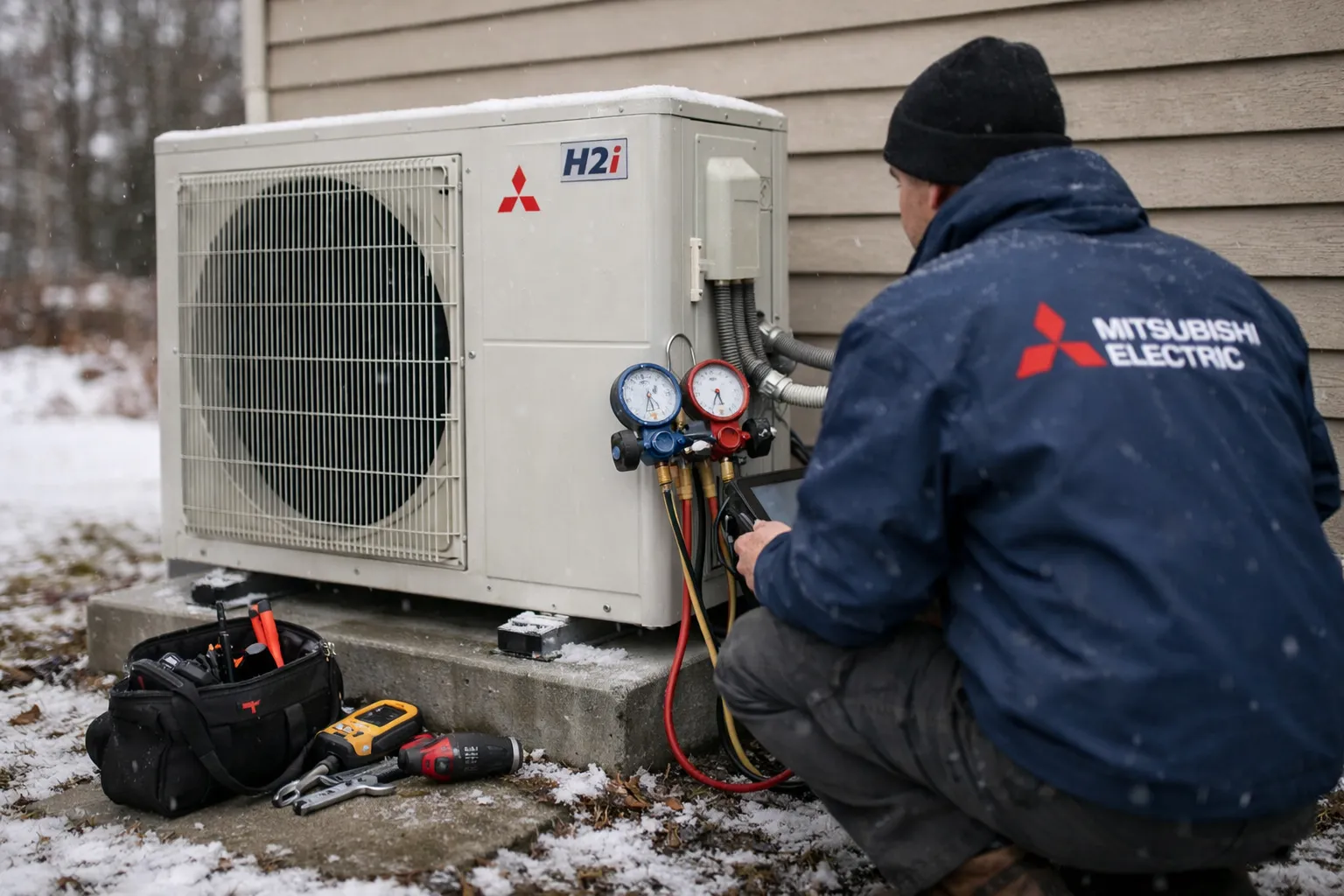
Overview: What are we reviewing? Key specs at a glance
The Mitsubishi Electric H2i (Hyper‑Heating INVERTER) family is Mitsubishi’s cold‑climate line of inverter-driven air‑source heat pumps. Designed for ductless single splits, multi‑split and small multisystem applications, H2i models aim to preserve usable heating capacity at low ambient temperatures while providing variable capacity modulation for improved part‑load efficiency and comfort. Typical capabilities to confirm for the specific SKU: variable capacity modulation, manufacturer low‑ambient capacity curves (check rated capacity at -5°F/ -15°C and below), supported indoor unit types (wall, cassette, floor, ducted), and refrigerant type (R‑32, R‑454B or region‑specific variants).
Background
Mitsubishi Electric has positioned H2i for homeowners, contractors and light‑commercial specifiers in cold and mixed climates since the early 2010s. By August 2026 the product line remains targeted at projects that prioritize cold‑weather reliability, zoned comfort, and quiet operation. Market context in 2026: heat‑pump adoption accelerated through federal and state incentives, tighter building codes, and utility electrification programs. That broader uptake makes H2i systems an increasingly common specification for cold‑climate retrofits and new‑builds where fossil‑fuel replacement is a priority.
Features Analysis
What the H2i architecture delivers
- Inverter modulation: Continuous capacity control reduces short‑cycling and improves seasonal efficiency when systems are sized properly.
- Low‑ambient heating: H2i is engineered to retain a high fraction of rated capacity below freezing. Always verify the model‑specific capacity curve for your design temperature rather than relying on generic claims.
- Flexible indoor options: Wide range of indoor units (wall, floor, cassette, ducted) supports retrofits and zoned control without a central plant.
- Controls and integration: Kumo Cloud and Mitsubishi system controllers remain standard; integration to BMS is possible via gateway interfaces. In recent years (2024–26) distribution partners and third‑party integrators have expanded gateway options and remote monitoring tooling—confirm interface compatibility for new projects.
Field performance and real‑world context (2023–2026)
Installer and owner feedback collected through 2023–2026 shows H2i systems delivering the expected cold‑weather benefits when correctly specified and commissioned. Key patterns:
- When sized using heating‑load calculations and manufacturer ambient‑capacity curves, occupants report stable heat delivery down to design temperatures commonly used in northern U.S. and Canadian markets.
- Part‑load operation often dominates annual runtime; inverter modulation materially improves comfort and reduces noise versus single‑stage systems.
- Projects that skipped detailed commissioning or used rule‑of‑thumb sizing commonly underperform relative to lab numbers.
Installation realities
The H2i family offers mechanical adaptability but places high demands on design and commissioning discipline.
- Sizing discipline: Oversizing reduces modulation benefits and seasonal efficiency. Use full heating‑load calculations and consult model low‑ambient capacity charts for expected design temps.
- Refrigerant routing and oil return: Multi‑split systems require careful line‑set planning; long line runs, improper slope, or poor oil‑return practices reduce low‑temp capacity and complicate service.
- Controls planning: Order gateway/BMS modules early if integration is required. Recent projects have benefited from specifying remote diagnostics, demand‑response capability, and grid‑friendly control options at bid time.
- Commissioning needs: Expect longer initial commissioning for set‑up of inverter parameters, superheat/subcooling checks, and airflow balancing. Specify commissioning deliverables in contracts to protect performance.
- Technician skills: Service teams must be fluent in electronic diagnostics and inverter behavior; ongoing manufacturer training remains important as firmware and accessory options evolve.
Maintenance, reliability and lifecycle costs
Inverter technology increases initial equipment and repair costs versus legacy single‑stage compressors, but owners who run heat pumps as primary heating generally recover higher first costs through reduced operating expense. Notes for 2026:
- Preventive maintenance emphasizes airflow, condensate path integrity on indoor units, and periodic inverter diagnostics.
- Parts and support remain widely available through authorized Mitsubishi dealers; control modules and boards are more costly than mechanical parts for conventional systems.
- Lower‑GWP refrigerant trends: the HVAC industry has increased adoption of R‑32 and other lower‑GWP refrigerants. Confirm refrigerant type for the model you specify and the implications for service equipment and certification.
Pricing and value (current Aug 2026 guidance)
Equipment and installed costs vary by region, system size, indoor unit mix, ductwork work and commissioning scope. Current installed cost ranges observed in North America (indicative):
- Single‑head ductless H2i (1–1.5 nominal tons): equipment $1,200–$3,000; installed turnkey $3,000–$7,500.
- Two‑ to three‑head multi‑split systems for moderate single‑family homes: equipment $3,000–$7,500; installed turnkey $7,000–$15,000.
- Larger multisystem or small commercial installations: installed costs commonly $15,000–$40,000 depending on zoning complexity and controls integration.
Incentives materially affect value: federal, state and utility rebates available in many markets can reduce homeowner out‑of‑pocket by $1,000–$8,000 (varies widely). For commercial projects, utility demand‑response programs and commercial incentives can change payback calculations. Always run site‑specific economics including local electricity rates and available incentives.
Pros and cons — concise takeaway
- Pros: Proven cold‑climate performance when sized and commissioned correctly; strong part‑load modulation and occupant comfort; flexible indoor unit choices; mature dealer/service network.
- Cons: Higher upfront and commissioning costs; requires skilled installers and servicers; multi‑split refrigerant routing and control integration can be complex in retrofits; refrigerant transition means service training and tooling considerations.
Who it's for
H2i is a practical choice for:
- Single‑family and light‑multifamily retrofits in cold and mixed climates where maintaining heat‑pump capacity at low ambient is essential.
- Small commercial spaces that need zoned comfort and lack space for a central boiler/plant.
- Projects where owners will invest in disciplined design, commissioning, and skilled maintenance to extract the advertised benefits.
Alternatives
Consider these competing approaches depending on priorities:
- Fujitsu Halcyon — strong competitor in cold‑climate ductless markets with similar multi‑split architectures.
- Daikin Aurora / Daikin cold‑climate splits — comparable low‑ambient performance and enterprise integration options.
- Bosch / Carrier ducted inverter systems — better fit where centralized ducted solutions or packaged equipment is preferred.
Verdict
Updated for August 2026: Mitsubishi H2i remains a leading cold‑climate consumer and light‑commercial heat‑pump platform when projects are specified and executed with engineering discipline. The core strengths—low‑ambient capacity, tight modulation and indoor‑unit flexibility—continue to deliver value in electrification projects. The incremental considerations in 2026 are the growing importance of controls/gateway planning for grid interaction, the industry shift toward lower‑GWP refrigerants, and the crucial role of commissioning and trained service personnel. If your project requires robust cold‑weather heat‑pump performance and you can budget for careful design, commissioning, and competent service, H2i is still worth strong consideration.
Specifying tips (practical checklist)
- Require a full heating‑load calculation and signed review of the manufacturer’s low‑ambient capacity curves for the chosen SKU.
- Specify commissioning deliverables in the contract (superheat/subcooling, airflow targets, inverter parameter list, and a post‑occupancy performance check).
- Order any BMS/gateway interface modules with the equipment and confirm firmware compatibility before field wiring.
- Confirm refrigerant type and ensure service technicians have the right training and tools for lower‑GWP refrigerants used in your region.
- Model projected annual energy and demand costs using local electric tariffs and include expected rebates in the business case.
FAQs
Do H2i units really work below freezing?
Yes—H2i models are engineered for low‑ambient performance and generally retain a useful fraction of rated heating capacity below freezing. The exact retained capacity varies by model and outdoor temperature; always consult the manufacturer’s ambient‑capacity curve for the specific unit and design temperature.
How much should I budget for commissioning?
Commissioning for a correctly functioning H2i installation commonly adds 5–12% to labor costs versus a simple equipment swap because of airflow balancing, refrigerant verification, and control tuning. For complex multi‑zone or commercial jobs, budget more and require documented commissioning deliverables.
Are there refrigerant or service‑training concerns in 2026?
Yes. The industry has been transitioning to lower‑GWP refrigerants (R‑32, R‑454B and others in some markets). Confirm the refrigerant used in your specified models and ensure service technicians are trained and equipped for that refrigerant and for inverter‑system diagnostics.
Can H2i systems participate in demand‑response or grid programs?
Many installations can, but you must plan controls and gateways at the design stage. Ask suppliers about demand‑response capable controllers, utility program compatibility, and firmware options that enable setback or remote dispatch without sacrificing occupant comfort.