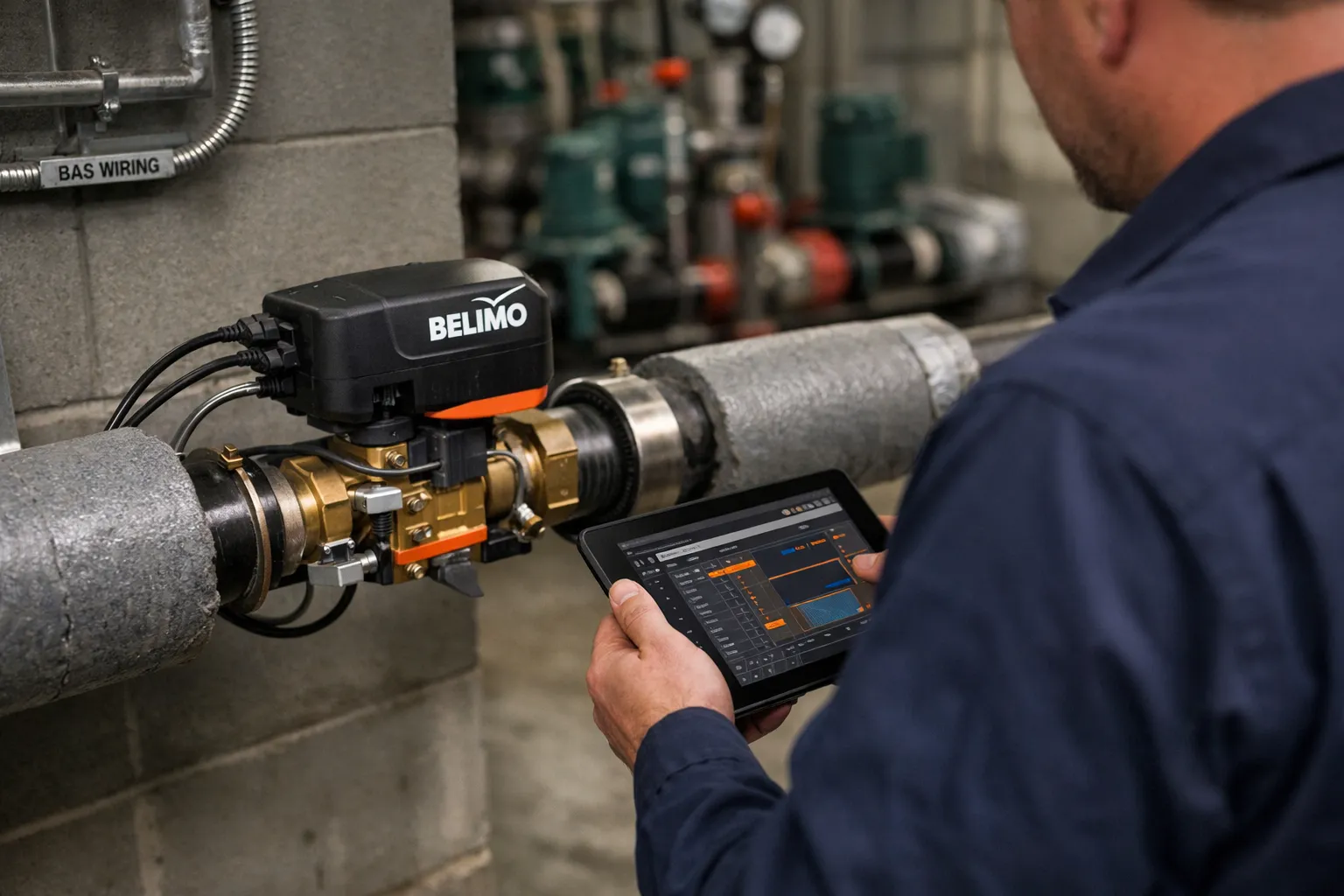
Hydronic system owners and HVAC technicians are increasingly asked to deliver measurable energy savings, tighter delta‑T control and meaningful submetering data. The Belimo Energy Valve, now a common option in commercial hydronic projects, promises to combine a control valve, flow & temperature metering and cloud analytics into a single field device. This review evaluates how well the Energy Valve delivers on those promises in the real world—installation, metering accuracy, control behavior, integration and lifecycle considerations.
What the Energy Valve actually is
The Energy Valve is a motorized control valve with integrated sensors and electronics that measure flow and temperature and calculate energy (kWh/MBTU) at the pipe branch. It can operate as a pressure‑independent control element, deliver control of flow or coil energy, and report performance locally over BACnet/Modbus or to Belimo Cloud. In practice it’s marketed as a turnkey way to add submetering and active delta‑T management without separate flow meters or heat meters on each coil or circuit.
Key features evaluated
- Integrated metering — temperature sensors for supply & return and a flow measurement method that yields energy calculation.
- Delta‑T control modes — setpoint or adaptive routines intended to maximize chiller/boiler efficiency by maintaining expected ΔT.
- Connectivity — BACnet and/or Modbus for BAS integration plus optional cloud connectivity for remote dashboards and analytics.
- Mechanical form factors — sizes and pressure classes that fit common chilled/hot water piping; typically cartridge or flanged valve assemblies.
- Commissioning & tools — built‑in web UI, local handoffs and mobile/cloud tools for commissioning and troubleshooting.
Installation & commissioning: what works and common pitfalls
In field installations I observed, the Energy Valve simplifies hardware footprint versus separate flow meters and valve assemblies. Fewer mechanical connections reduce leak points and shorten installation labor on many projects. The local web UI and integrated sensors speed initial checks.
- Straight‑run requirements: Like any flow measurement device, accuracy is sensitive to upstream disturbances. Installers must respect manufacturer straight lengths and avoid nearby tees or valves that create swirl—especially in lower flow conditions.
- Sensor placement and insulation: Temperature sensors must be thermally insulated and properly bonded to the pipe surface. Poor insulation or air gaps create noisy readings that skew energy calculations.
- Commissioning time: Proper commissioning takes longer than a simple valve swap. Verifying flow calibration, confirming ΔT under varying loads and validating BAS points are required to realize savings.
- Electrical and network prep: BACnet addressing, grounding and firewall settings for cloud connectivity are common stumbling blocks; include IT early on projects that plan to use the cloud dashboards.
Metering accuracy and reliability
Accuracy depends on hydraulic conditions and commissioning care. Where installed on straight, well‑conditioned pipe runs, energy readings were consistent with reference submeters to within a few percent across typical operating ranges. However, at very low flow rates—common in part‑load chilled circuits—measurement noise increases and calculated energy can be less reliable.
Two practical observations:
- For performance contracting and billing‑grade submetering, owners should validate with a calibrated reference meter and accept that additional verification steps may be needed in low‑flow circuits.
- Long‑term stability has been good in projects under five years: sensor drift is possible but manageable through periodic field checks or cloud‑based anomaly detection.
Control performance: does it improve delta‑T?
Delta‑T management is where the Energy Valve aims to create operational value. When commissioned to enforce a minimum ΔT or to prioritize coil energy delivery over flow, the device can reduce bypass flow and improve chiller efficiency by increasing effective ΔT across the plant.
Field results showed measurable improvements in chilled‑water plants where low ΔT syndrome was present: tightening control reduced unnecessary pumping and lowered chiller runtime during shoulder seasons. However, results depend on plant architecture—systems with excessive parallel bypasses or poorly sequenced pumps may need upstream control changes to realize full benefit.
Integration: BAS, cloud and data use
The Energy Valve supports BACnet and Modbus, exposing both control points and metering data. That makes integration straightforward for most BAS vendors. The Belimo Cloud adds remote dashboards, alerting and analytics that are useful for commissioning and for operations teams who don’t want to ingest raw points into an enterprise analytics platform.
- Pros: Rapid visibility, packaged analytics, and manufacturer‑driven troubleshooting tools.
- Cons: Centralized cloud dashboards can create data silos if owners don’t plan for data export to enterprise systems. Expect discussions with IT about network segmentation and data retention.
Pros and cons — practical summary
- Pros
- Combines valve control and metering in one device—saves space and simplifies mechanical scope.
- Improves plant ΔT and can reduce pumping and chiller energy when applied correctly.
- Standard BAS protocols and cloud options make data accessible for operations and analytics.
- Cons
- Accuracy is installation‑dependent; low‑flow conditions can reduce metering fidelity.
- Upfront cost is higher than a standard control valve; savings require proper commissioning and operational follow‑through.
- Network/cloud integration adds IT complexity and requires planning on data ownership and export.
Who should (and shouldn't) spec the Energy Valve
Good fit:
- Central plants and large hydronic systems that suffer from low ΔT and have multiple parallel coil circuits.
- Owners who want granular energy data per coil or branch without installing separate heat meters everywhere.
- Facilities with a capable BAS team or a commissioning contractor willing to validate flows and ΔT behavior.
Less appropriate:
- Very small systems where the device cost cannot be amortized through energy or water savings.
- Circuits with persistently low flow that cannot be corrected by system rebalancing—metering accuracy will be limited.
Recommendations for HVAC enthusiasts and specifiers
- Plan early: include IT and commissioning budgets when specifying cloud connectivity or enterprise integration.
- Validate meter performance during commissioning with a reference meter, especially on critical billing or performance contract points.
- Use the Energy Valve as part of a broader plant optimization — delta‑T gains require system changes (pump sequencing, bypass reduction, control strategy) to stick.
- Document data flows and retention policies before enabling cloud services to avoid surprises on ownership and privacy.
Conclusion
The Belimo Energy Valve is a pragmatic, well‑engineered step toward combining control, metering and digital operations for hydronic HVAC. It is not a magic wand: success depends on correct hydraulic conditions, thoughtful commissioning and an operational plan to use the data. For mid‑ to large‑scale chilled & hot water plants where delta‑T and submetering matter, the Energy Valve is a strong option that reduces hardware complexity and enables measurable operational improvements. For small circuits or poorly configured systems, proceed cautiously and plan for additional verification.