
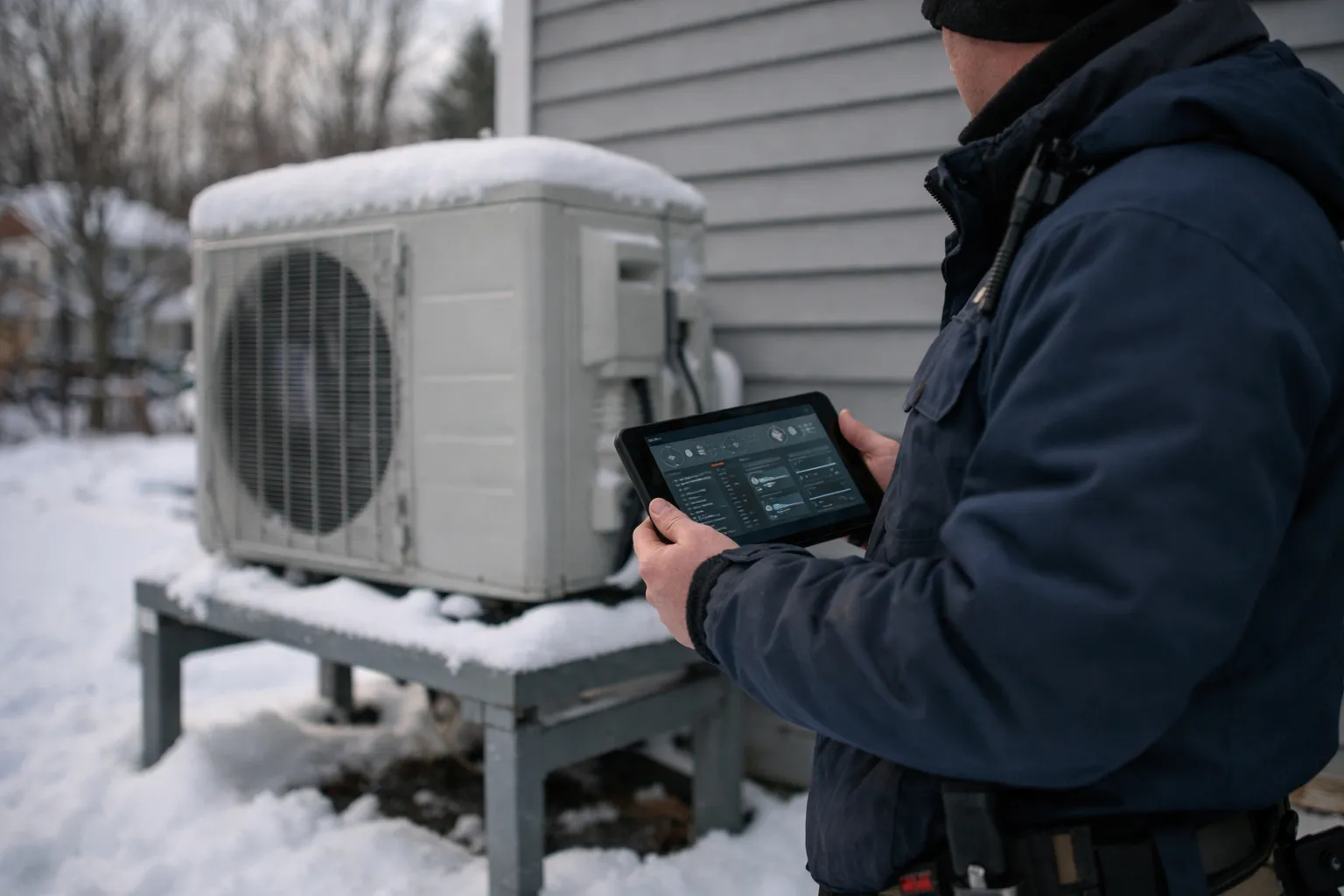
Overview: What we’re reviewing (key specs at a glance)
This is a June 2026 field update comparing two leading cold-climate mini-split lines sold in North America: Mitsubishi Electric’s Hyper-Heat (H2i) and Daikin’s Aurora. Both lines are intended to deliver usable heating in sub-freezing conditions and are available in single-zone and multi-zone outdoor units with multiple indoor styles (wall mounts, compact ducted, cassettes).
- Category: Cold-climate ductless/ducted inverter heat pumps
- Configurations: 1:1 single-zone, 1-to-many multi-zone (model-dependent)
- Key data to request: AHRI-rated capacity and input watts at 47°F, 17°F and 5°F for the exact outdoor+indoor pairing; ask also for minimum-stage capacity and part-load input watts
- Controls: native remotes, vendor Wi‑Fi modules, growing OTA/remote-diagnostics support; integration depends on accessory choices
- Best fit: electrification retrofits, high-end renovations, ADUs, and rooms requiring quiet, precise heating
Background: Who makes these, and who are they for?
Mitsubishi Electric remains a go-to for broad indoor-unit choices and deep installer familiarity with Hyper-Heat. Daikin, now aggressively positioning Aurora in cold-climate segments, emphasizes improved software tools for commissioning and remote diagnostics. Both target homeowners and contractors prioritizing decarbonization, year-round comfort, and reliable performance through deep cold snaps.
What has changed in 2026 is not the basic engineering—both product families still rely on variable-speed compressors and heated defrost strategies—but the surrounding ecosystem: more robust OTA support, clearer commissioning expectations from incentive programs, and tighter regional installer networks affecting real-world outcomes.
Features analysis: Cold-weather performance, comfort, controls, and install realities
1) Low-ambient heating: beyond the brochure
Brochure claims about “operates to -13°F” are marketing shorthand; the practical buyer needs AHRI pairing sheets showing net capacity and input at 47°F, 17°F and 5°F. In 2026 this remains the single most actionable verification step. Also request the minimum modulation point in watts—this predicts whether a unit will short-cycle in small rooms.
Field note: conservatively sized single-zone pairings still outperform over-extended multi-zone outdoor units when rooms have varied loads. Where installers in 2026 have improved outcomes is by specifying outdoor-unit staging and using dedicated single-zone units for bedrooms and primary living areas.
2) Modulation and part-load comfort
Luxury comfort today depends on fine modulation, minimal short-cycling, and low indoor noise. Both Hyper-Heat and Aurora have improved low-end control through iterative firmware updates released in 2024–26; in practice the deciding factors are correct sizing and the installer’s commissioning of minimum-frequency limits and anti-short-cycle timers. Ask for a measured run-time profile from commissioning (sample log for 24–72 hours) as part of acceptance.
3) Defrost behavior and winter comfort
Defrost remains perceptible, but modern defrost logic and better site work reduce homeowner noticeability. In mid-2026 installers increasingly use raised stands, wind baffles, and subtle intake skirting to lower defrost frequency. If your site is wind-exposed, insist on photos of proposed siting and, if possible, a local installer’s defrost-log examples for the model you will buy.
4) Controls, OTA and energy integration
OTA firmware updates and remote diagnostics are far more common in 2026—both manufacturers publish update channels and some distributors offer registration-as-a-service. That said, true thermostat-style integrations (multi-sensor averaging, whole-house schedules) still require accessory modules or third-party controllers. If you want smart-home or utility demand-response compatibility, specify exact parts (Wi‑Fi module SKU, gateway accessory) in the proposal and require the installer to register the system for firmware pushes.
5) Sound and installation nuance
Indoors, both platforms are effectively quiet; outdoor noise and vibration depend on placement and mounting. Recent municipal noise enforcement and condo associations have raised demand for anti-vibration pads and acoustic screening; include published dB(A) figures in the bid and require contractor mockups of screening if noise is a concern.
6) Serviceability and parts ecosystem
Regional variation persists. Mitsubishi benefits from broad install familiarity in many U.S. markets; Daikin’s Aurora dealer depth is expanding but can be uneven. Practical checks before signing: call two local shops, ask how many installs of the exact outdoor model they've serviced in the past 12 months, and confirm lead times for common PCBs, sensors and fan motors.
Pros and cons (specific, practical)
Mitsubishi Hyper-Heat: Pros
- Extensive indoor-unit portfolio—easier to match luxury interiors (compact ducted, cassettes, low-wall heads).
- Broad installer familiarity and spare-parts availability in many regions.
- Conservative real-world track record when systems are properly sized and commissioned.
Mitsubishi Hyper-Heat: Cons
- Accessories and advanced controls can materially raise the invoice; require line-iteming in the bid.
- Marketing family claims need confirmation with AHRI pairings for a specific outdoor/indoor match.
Daikin Aurora: Pros
- Competitive cold-climate performance on capacity curves and quieter part-load modulation in many pairings.
- Improved OTA and remote-diagnostics support has reduced some service-trip guesswork where distributor networks are strong.
- Often aggressive local pricing where Aurora is a focus product for the distributor.
Daikin Aurora: Cons
- Dealer depth and advanced troubleshooting expertise vary regionally.
- Whole-house integration sometimes needs extra accessories and pre-planning.
Pricing/value: June 2026 market reality and what’s included
Installed pricing remains regional and labor-influenced. As of June 2026, typical ranges observed across North America are:
- Single-zone (9k–18k BTU) installed: commonly $6,000–$13,000
- Two- to three-zone multi-split installed: commonly $13,000–$30,000+
- Electrical upgrades (if needed): commonly $700–$5,000+
“Good value” bids in 2026 include: a documented Manual J, the exact AHRI pairing submittal, a clear line-set and condensate routing plan, commissioning deliverables (micron vacuum log, decay test, and factory-charge verification), and an itemized list of accessories (Wi‑Fi/OTA module, raised stand, anti-vibration pads). Incentive programs and rebates increasingly require these documents for eligibility—confirm requirements with the program administrator before signing.
Who it’s for: Choosing between Hyper-Heat and Aurora
- Choose Mitsubishi Hyper-Heat if: you need the widest indoor-head choices, local Mitsubishi expertise is strong, and you prefer conservative sizing and robust parts channels.
- Choose Daikin Aurora if: your local Daikin distributor shows proven Aurora experience, the proposal includes commissioning and firmware registration, and the AHRI pairing meets your design load.
In high-end renovations, the system should be unobtrusive—quiet, smooth, and reliably commissioned. Brand matters, but commissioning, siting, and firmware maintenance win long-term comfort.
Alternatives (2–3 competitors worth considering)
- Fujitsu Halcyon XLTH: well-regarded in cold climates; compare local service network and capacity curves.
- LG RED Series: competitive on paper with aggressive pricing in some regions; warranty and installer experience vary.
- Carrier/Bryant select ductless lines: compelling where dealer networks are strong—verify low-ambient data and controls approach.
Verdict: A recommendation grounded in the details
My practical rule for June 2026 remains: pick the contractor first, then the platform. Demand documented AHRI pairings for the exact outdoor+indoor bundle, require a Manual J, insist on commissioning evidence (micron vacuum, decay test, and a run-time log), and get the firmware/update registration plan in writing. Mitsubishi Hyper-Heat is still the conservative default in many markets due to installer depth and indoor-head variety; Daikin Aurora is a strong alternative where backed by competent local support and clear documentation.
FAQ
Do I still need backup electric heat with Hyper-Heat or Aurora?
Maybe. It depends on your home's design heating load and the AHRI-rated capacity of the specific pairing at your design temperature. Use a Manual J and compare the capacity at the outdoor design temp—not a family label—to determine if supplemental heat or a small resistance backup is required.
Can these systems integrate with smart-home or demand‑response programs?
Partial integrations are common: both vendors now offer Wi‑Fi modules and some utility-facing demand-response modes. Full thermostat-style integration or multi-sensor averaging often requires specific accessories. Specify the control architecture in the contract and require the installer to confirm compatibility and firmware support.
What installation detail most affects long-term reliability?
Refrigerant piping quality and commissioning. Proper brazing or flare practices, insulation, and a verified deep vacuum (micron gauge and decay test) are essential. Require the contractor to document these steps and deliver the vacuum/decay logs as part of final acceptance.
How should I evaluate an installer proposal in 2026?
Look for: Manual J documentation, exact AHRI pairing submittal, line-set routing photos, commissioning steps and evidence, parts warranty details, and a clear statement on who will register firmware and apply OTA updates. If these aren’t included, ask the installer to revise the bid.
Is a multi-zone system a mistake for cold climates?
Not inherently. Multi-zone systems are more sensitive to mismatched zone loads. For winter reliability, single-zone units for major living areas often provide more predictable comfort. If selecting multi-zone, match zone sizing carefully and verify aggregated low-ambient capacities for the full grouping.