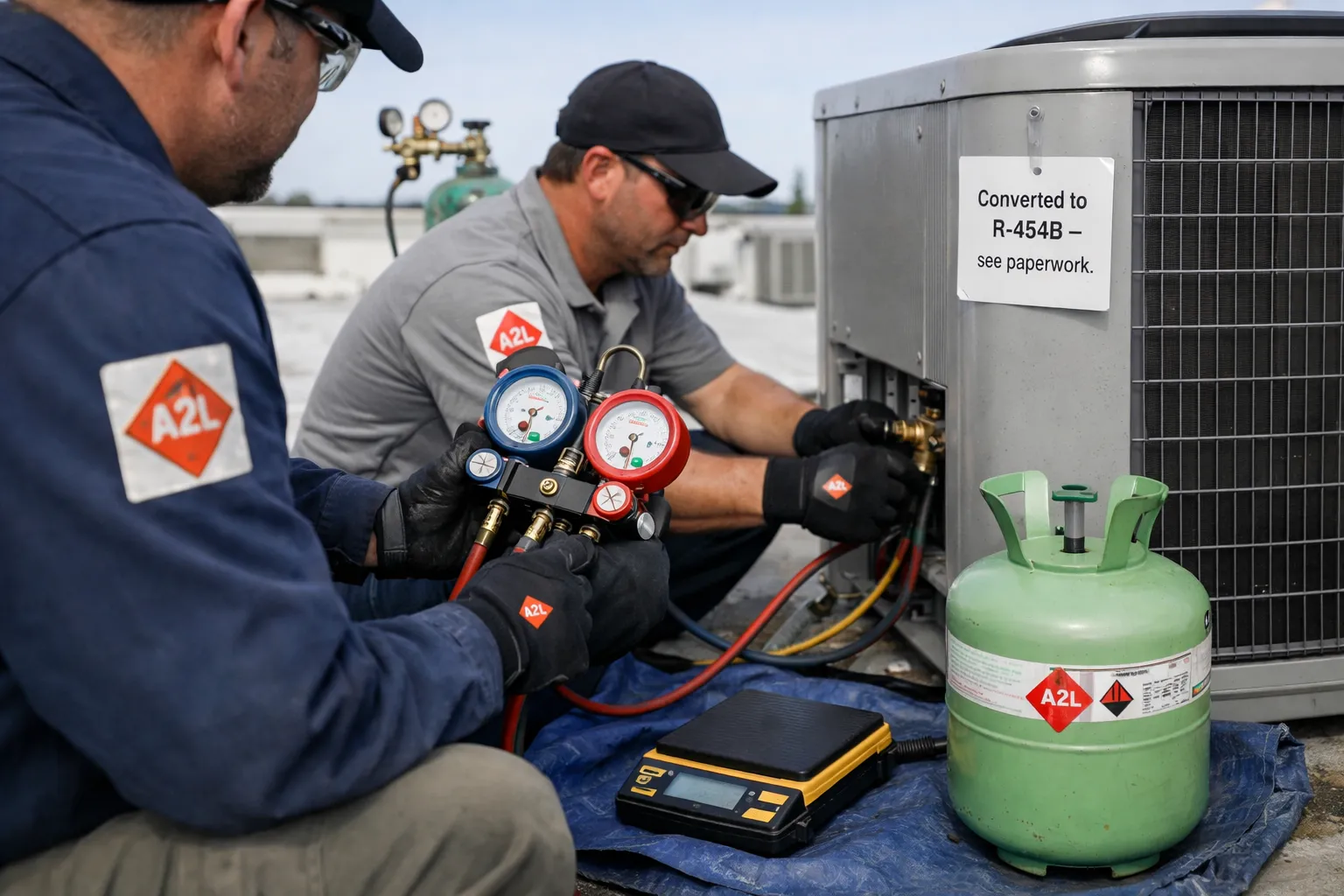
As global refrigerant policy accelerates phase-down of high‑GWP blends, R‑454B (an A2L, low‑GWP alternative) has emerged as a practical retrofit option for many light commercial split systems originally charged with R‑410A. This field guide walks HVAC technicians through a safe, code‑aware, step‑by‑step conversion process: assessing suitability, handling the mildly flammable A2L charge, performing oil and component checks, executing recovery/evacuation and re‑charge, and commissioning for reliable performance and warranty compliance.
Why R‑454B? What techs must know in 2026
R‑454B is a low‑GWP, mildly flammable (A2L) refrigerant increasingly specified by OEMs and regulators as a near‑term replacement for R‑410A in many applications. Its 100‑year GWP is roughly in the mid‑hundreds, dramatically lower than R‑410A, and system pressures are broadly comparable. However, A2L classification changes safe work practices, labeling, and sometimes component selection—so conversion must be performed to OEM guidance, EPA rules, and local code.
Key takeaways
- R‑454B is A2L (mildly flammable): handle with A2L safety measures (no ignition sources during charge, adequate ventilation, trained technicians).
- Follow EPA Section 608 rules—no venting; certified recovery is required.
- Verify OEM retrofit guidance and warranty implications before converting.
- Most R‑410A systems using POE oil are compatible, but systems using mineral oil require oil change and flush.
Pre‑work assessment (15–30 minutes)
Do not start without confirming suitability.
- Review OEM service bulletins. Some manufacturers allow R‑454B as a retrofit only on specified models; others require new factory charge.
- Check local codes and building policies; some jurisdictions limit A2L use in certain occupancies.
- Assess system size and accessibility. Light commercial split systems (up to ~6–8 tons typically) are common retrofit candidates; verify that piping and components are in good condition.
- Inspect oil type: find the compressor oil label or service records. If mineral oil is present, plan a full oil change and flushing procedure.
- Confirm leak history—systems with repeated leaks should be repaired and re‑tested extensively before conversion.
Tools, supplies, and PPE
- Refrigerant recovery machine rated for mildly flammable refrigerants
- Charging manifold with A2L‑rated hoses and fittings; digital scales accurate to ±10 g
- Nitrogen regulator, leak detection solution, and electronic A2L gas detector
- High‑vacuum pump and micron gauge
- Replacement filter‑drier (sized for the system and compatible with POE oil)
- Replacement service valves, gaskets, and Schrader cores if needed
- PPE: safety glasses, gloves, flame‑resistant clothing as required, and appropriate respirators if confined spaces
- A2L safety signage and refrigerant cylinders labeled R‑454B
Step‑by‑step conversion procedure
1. Pre‑job safety steps
- Post A2L signage and ensure no ignition sources (open flames, hot work) will be present while charging. If brazing is required on the system, complete all brazing before introducing refrigerant.
- Confirm all technicians on site hold current EPA 608 certification and any required A2L-specific training.
2. Recover existing R‑410A
Recover all existing refrigerant into DOT‑approved recovery cylinders using a recovery machine rated for high‑pressure refrigerants. Record recovered weight and serial numbers for paperwork. Never vent.
3. Open, inspect, and replace service components
- Replace the liquid line filter‑drier with a unit compatible with POE oil and R‑454B. A new drier is best practice after any refrigerant change.
- Inspect and, if necessary, replace Schrader valves, service valve seats, and sight glass (if present).
- Confirm TXV/expansion device compatibility. Many TXVs designed for R‑410A will function with R‑454B, but check OEM guidance. If the system uses fixed orifices, verify performance expectations and consider consultation.
4. Oil management and compressor considerations
Oil compatibility is critical.
- If the system already uses POE oil (common in many R‑410A systems), full oil change may not be necessary—but inspect oil level and quality. If contaminated, change oil.
- If mineral oil is present, a full oil change and multiple system flushes are required. Oil miscibility with R‑454B is limited for mineral oil.
- For scroll compressors, consider OEM guidance on oil charge adjustments and whether compressor replacement is suggested.
5. Pressure testing and leak check
With new components installed, pressure test with dry nitrogen to service pressure per ANSI/ASHRAE practice. Hold pressure and conduct leak detection at all joints. Repair any leaks and re‑test until tight.
6. Evacuate to deep vacuum
Purge with nitrogen to remove moisture and oxygen, then pull a vacuum to at least 500 microns (or achieve manufacturer‑specified vacuum). Hold vacuum—if pressure rises, locate and fix leaks or moisture.
7. Charging with R‑454B (by weight)
- Charging must be done by weight—do not rely on subcooling targets alone for initial fill. Use the OEM charge amount when available; otherwise charge to match existing liquid line subcooling and performance targets during commissioning.
- Because R‑454B is mildly flammable, charge outdoors or in well‑ventilated mechanical rooms, and avoid inside charging in occupied spaces without adequate ventilation.
- Introduce refrigerant as liquid into the liquid line (per OEM guidance) where safe; follow cylinder orientation instructions. Use A2L‑rated hoses and ensure tight connections.
8. Start‑up and commissioning
Commissioning with R‑454B requires methodical checks.
- Confirm oil levels and compressor sound at low load.
- Run the system and allow it to stabilize. Monitor suction and discharge pressures, superheat and subcooling, and compressor current.
- Target superheat/subcooling: follow OEM specifications. If OEM data are unavailable, use conservative ranges (e.g., TXV systems: 8–12°F superheat at the evaporator outlet; subcooling similar to prior R‑410A levels) and verify capacity with temperature differentials and airflow checks.
- Adjust TXV or charge incrementally to reach stable performance under typical loads. Re‑check for leaks during and after run‑in.
- Document final refrigerant weight, pressures, temperatures, and serial numbers of replaced components.
Troubleshooting and common issues
- Low capacity after conversion: check airflow, verify correct charge by weight, confirm TXV operation and superheat, inspect for oil logging in evaporator.
- High discharge temperatures: verify correct oil level and that compressor is not starved; consult OEM if discharge rise is significant.
- Compressor noise or early failures: often due to inadequate oil miscibility or contamination—ensure proper flushing and oil exchange before charging.
- Persistent leaks: A2L refrigerants require prompt repair; permanent or repeated leaks may mean replacement is more economical.
Documentation, labeling, and compliance
Complete paperwork at job close:
- Record recovered refrigerant weight and disposal/reclamation documentation.
- Document new refrigerant charge weight, cylinder serial numbers, and final measured operating data.
- Affix updated refrigerant labels to equipment indicating R‑454B charge and A2L hazard class.
- Note any OEM warranty implications and inform building owner/operator of changed flammability and maintenance considerations.
Real‑world example (condensed)
Technician team retrofitted a 3‑ton light commercial split in a small retail store. Pre‑check revealed POE oil and no significant leak history. Steps executed: recover R‑410A, replace filter‑drier and service valve cores, vacuum to 500 microns, charge R‑454B to OEM weight, stabilize, and adjust TXV to 10°F evaporator superheat. Final results matched prior cooling capacity within 3% and electrical current within OEM tolerances. All documentation filed and equipment relabeled.
When not to retrofit
Consider replacement rather than retrofit when:
- System has frequent leaks or extensive corrosion
- Compressor oil is mineral and the system is not practical to flush
- OEM explicitly prohibits retrofit to R‑454B for that model
- Local codes restrict A2L use in the space or occupancy
Final recommendations for HVAC enthusiasts and techs
Converting R‑410A light commercial split systems to R‑454B can be a cost‑effective, lower‑GWP path—but it demands attention to safety, oil compatibility, and OEM guidance. Prioritize training on A2L handling, use proper tools and certified recovery equipment, and document every step. When in doubt, consult manufacturer technical support; for complex or risky installations, recommend system replacement to building owners.
As refrigerant transitions continue through 2026 and beyond, technicians who master safe, code‑compliant R‑454B retrofits will be in high demand. Follow standards, keep accurate records, and maintain conservative commissioning practices to deliver reliable, low‑GWP cooling.