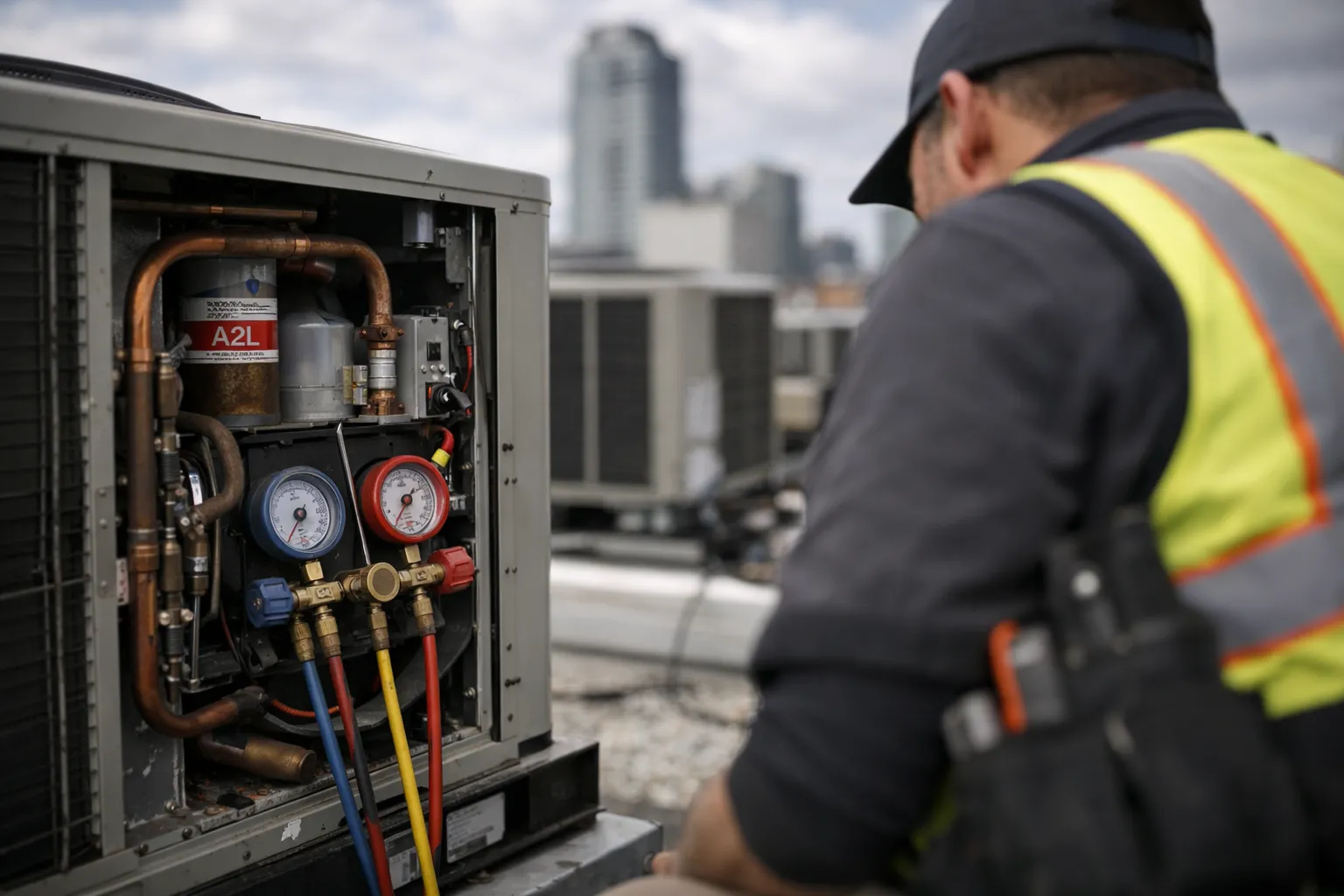
Who / What / When / Where / Why: As of October 2026, the International Code Council’s 2026 mechanical code package that tightened rooftop (RTU) rules for mildly flammable A2L refrigerants is shaping rooftop HVAC practice across the United States. The code lowers allowable design‑charge thresholds for A2Ls on rooftops, mandates leak detection and alarms for many installations, and formalizes site risk‑assessment or engineered ventilation options. These changes—adopted in the ICC 2026 cycle and being folded into state and local code adoption now—are intended to enable wider A2L use while reducing occupant and egress risk.
Context: why this update still matters in October 2026
The ICC action in the 2026 mechanical code answered a central industry tension: decarbonization pressure (phase‑down of high‑GWP HFCs) versus safety management for A2L refrigerants (R‑32, R‑1234yf, R‑1234ze and similar). By placing charge limits, detection and ventilation options in the model code, the ICC created a common safety baseline that many jurisdictions rely on when drafting state or municipal mechanical codes. That baseline is now influencing product road maps, procurement specifications, permitting requirements and insurance underwriting for commercial rooftops.
What changed — and what’s happened since August 2026
- Charge limits and presumption toward low‑charge designs. The 2026 language reduced the design‑charge thresholds that allow rooftop packages to be treated without added mitigation. Since August, OEMs and specifiers have accelerated low‑charge architectures—microchannel coils, secondary‑loop (glycol or refrigerant) HRU systems, modular multi‑split rooftop arrays and factory‑sealed reduced‑charge cartridges—to comply without site ventilation or permanent exhaust.
- Detection and alarm requirements. The code requires approved leak‑detection and alarm systems where charge exceeds reduced thresholds. Practical deployments through 2026 show an industry shift toward factory‑integrated sensor packages with BMS integration rather than add‑on detectors installed piecemeal at job sites.
- Site risk assessment formalized. Jurisdictions are interpreting the code two ways: some accept documented engineering risk assessments that justify larger charges on case‑by‑case bases; others prefer prescriptive ventilation and sensor layouts. Expect variability at the permit counter.
What’s played out in the market (real‑world signals)
Manufacturers that launched low‑charge RTU models in late 2025–2026 reported more inquiries from national property managers and supermarket chains seeking units that avoid rooftop exhaust and complex permitting. Large contractors have posted project case studies showing retrofit strategies: replacing a single large‑charge flooded‑system RTU with multiple low‑charge sealed modules to preserve capacity and simplify compliance. Controls vendors expanded catalogues of A2L‑rated electrochemical sensors and integrated alarm panels compatible with BACnet and Modbus, reducing the labor and coordination burden at installation.
Updated implications for manufacturers, contractors and owners
- Manufacturers: Product road maps now routinely include low‑charge RTU SKUs and factory‑integrated detection options. Expect shorter lead times for compliant models as supply chains stabilized in 2026.
- Contractors: Permits increasingly require refrigerant‑charge calculations reported in a code‑consistent format, detector model numbers, and either an engineered ventilation design or a signed site risk assessment. Plan for longer plan‑review cycles on borderline projects and add contingency for sensor and alarm installation in bids.
- Owners and specifiers: Packaged‑unit replacement projects have emerged as the most common trigger for A2L compliance costs; retrofit budgets should allocate for detection, wiring to alarm panels or BMS, and possible rooftop exhaust work if the risk assessment does not pass local scrutiny.
Insurance, inspection and enforcement — what to expect
By October 2026, several commercial insurers and large corporate risk managers began requesting documentation of compliance with the new model code (or local equivalent) as part of underwriting reviews for new RTU installations. Inspectors’ expectations are converging on three items: (1) refrigerant‑charge documentation tied to unit serial numbers and nameplate data, (2) clear drawings showing detector and alarm locations, and (3) a site risk assessment signed and stamped by a qualified engineer for installations that rely on engineered mitigation. Where local authorities adopt the 2026 mechanical code verbatim, enforcement is straightforward; where jurisdictions have modified the model code, contractors must confirm the local amendment language before permitting.
Concrete steps HVAC contractors should take now (Oct 2026 checklist)
- Audit your installed base and project pipeline. Produce a register of rooftop assets showing model, nominal refrigerant type, and charge. Highlight units likely to exceed local thresholds.
- Pin down local adoption status. Check your state and municipal code adoption pages (many jurisdictions publish an adoption matrix) and confirm any local amendments to ICC 2026 mechanical provisions on A2Ls.
- Standardize submittals. Create template charge‑calculation sheets, detector layout drawings and an engineer‑review checklist for site risk assessments to shorten review cycles.
- Partner with OEMs and controls vendors. Specify factory‑integrated low‑charge RTUs where possible; if retrofitting, use vendor‑approved sensor kits and documented wiring schematics to satisfy inspectors.
- Train crews and sales teams. Provide hands‑on training covering detector selection (A2L‑rated), alarm wiring, sensor placement (near condensate pans, low points/near rooftop drains, egress corridors), and permit documentation requirements.
Examples of compliant design approaches
- Low‑charge sealed modular units: Multiple sealed modules replace one high‑charge RTU, keeping individual charge below threshold while retaining capacity.
- Secondary loop packaged systems: Glycol or refrigerant secondary loops isolate refrigerant from occupied spaces; only a small primary charge remains on rooftop equipment.
- Distributed split systems: Roof‑mounted condensers paired with remote low‑charge indoor units reduce rooftop refrigerant inventory.
Impact and who it affects
Owners of large retail, grocery and multifamily portfolios, national contractors, and OEMs face the largest near‑term impacts because they operate across jurisdictions and must standardize equipment and documentation. Small contractors working locally may see slower change where jurisdictions lag model code adoption, but they still need to prepare for projects with national owners or lenders that require ICC‑2026‑compliant installations.
Reactions from the field
Across trade groups and manufacturers the reaction has been pragmatic: clearer rules reduce ambiguity for product development and bidding. Code officials have emphasized safety and predictable evaluation criteria; insurers cite documentation as the key to underwriting clarity. Some owner/operators complain about added upfront costs for detection and engineering, but many accept those costs to access lower‑GWP equipment and avoid future retrofits.
What’s next — timeline and what to watch
Through the remainder of 2026 and into 2027 expect these near‑term developments:
- Continued roll‑out of factory‑low‑charge RTU SKUs and integrated detection packages.
- Regional variance in adoption speed: check state code adoption portals for exact effective dates (many jurisdictions incorporate model code on 12–24‑month cycles, but some accelerate).
- Growing demand for standardized site‑risk assessment templates and third‑party verification services to speed permit approvals.
- Further updates to manufacturer data sheets to include code‑friendly charge reporting and installation checklists.
Frequently asked questions
Do I need a new permit if I replace an old RTU with an A2L low‑charge model?
Yes. Replacement RTUs that change refrigerant type or charge profile typically require a permit and plan review. You should submit the unit’s charge, detection layout (if applicable), and a statement of compliance with the local mechanical code or ordinance.
Can existing rooftop RTUs be retrofitted to meet ICC 2026 charge limits?
Some retrofits are possible—splitting large circuits into multiple smaller charge circuits, installing factory‑approved low‑charge cartridge modules, or implementing secondary‑loop systems are common strategies. However, retrofitting can be cost‑prohibitive compared with unit replacement depending on age and remaining life.
What type of leak detector should I specify for A2L rooftop use?
Specify detectors listed for A2L refrigerants and approved by local code officials. Most projects use electrochemical sensors or catalytic sensors specifically rated for the target refrigerant blended with a monitored alarm panel. Ensure detector placement follows the code or the manufacturer’s guidance and that detection outputs integrate with building alarms or BMS as required.
Will complying with the new code increase my insurance premiums?
Complying with the model code and providing complete documentation typically reduces underwriting friction. However, insurers may request additional documentation or third‑party verification for installations that rely on engineered mitigation rather than prescriptive ventilation. Discuss specific underwriting requirements with your broker early in the project.
Staying current to October 2026 means treating the ICC 2026 mechanical provisions as the new professional baseline: audit assets, standardize documentation, prioritize low‑charge factory solutions, and build relationships with local code officials and OEM partners. That combination will minimize project delays, control cost escalation and enable broader deployment of lower‑GWP systems with clear, auditable safety practices.