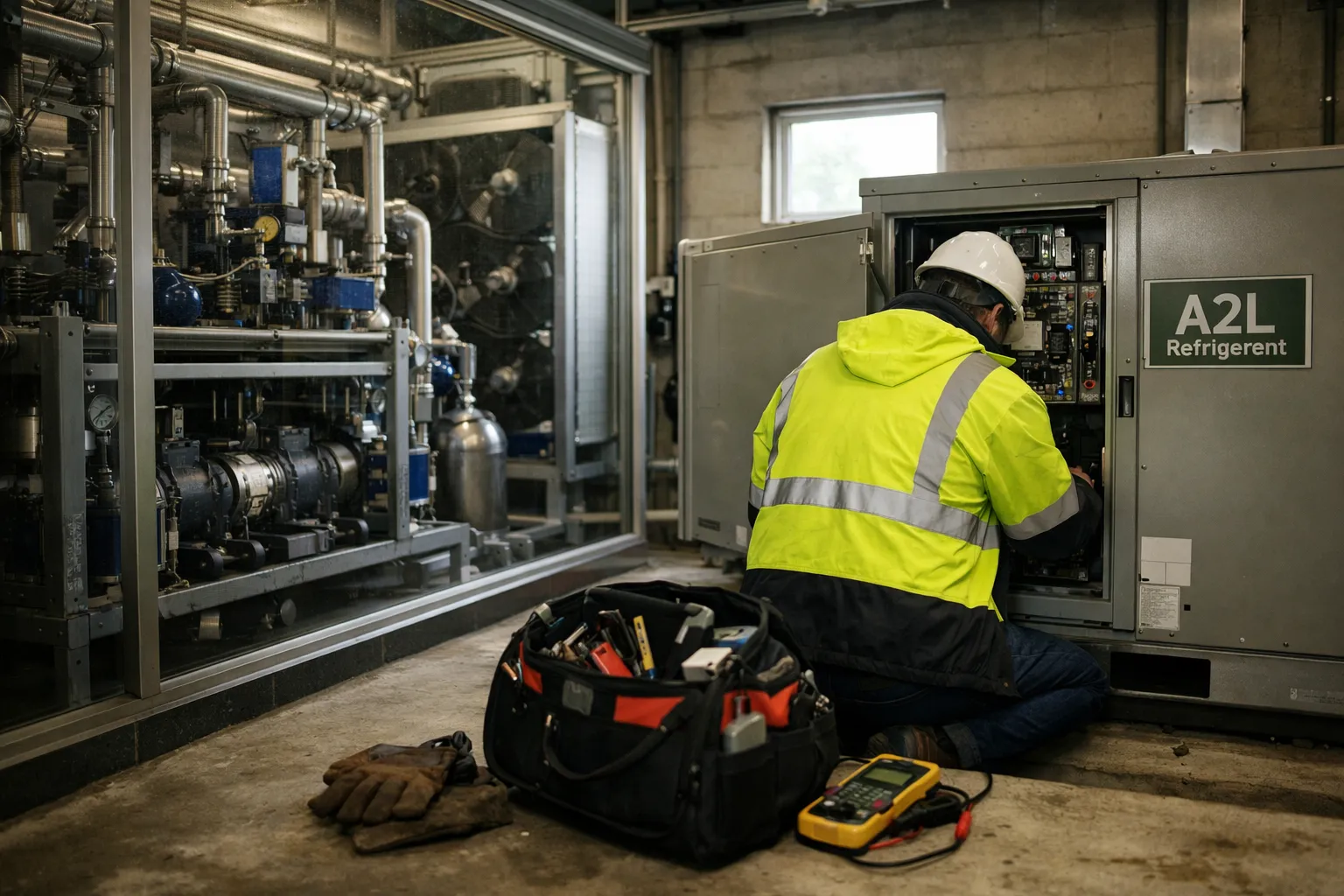
Over 2024–26 the commercial HVAC market has accelerated a structural shift in refrigerant choices. Two distinct low‑GWP pathways have emerged as front‑runners: mildly flammable A2L hydrochlorofluorocarbon replacements (R‑32, R‑454B and variants) for light‑commercial and small packaged equipment, and CO2 (R‑744) transcritical systems in supermarket and industrial refrigeration and in some cold‑climate heat‑pump applications. This analysis compares the technical, regulatory and market dynamics driving adoption of each approach, and identifies where each solution makes the most sense today.
Why the bifurcation? Regulatory and market drivers
Regulatory pressure to reduce refrigerant global‑warming potential (GWP) is the primary driver. Since the mid‑2010s, regions implementing F‑gas phase‑downs and similar measures pushed OEMs and contractors to seek lower‑GWP options. By 2024–26, manufacturers and owners face three realities:
- High‑GWP HFCs are increasingly constrained or costly to use.
- Supply chain changes and component availability favor designs around particular refrigerant families.
- Codes and standards have evolved to accommodate mildly flammable refrigerants (A2L), while CO2 systems benefit from decades of deployment in supermarket refrigeration in Europe.
The result is a market bifurcation: A2Ls for many packaged HVAC applications where modest refrigerant charges and improved energy performance are attractive; CO2 for refrigeration and larger commercial systems where the refrigerant’s negligible GWP and favorable leak‑management profile outweigh higher upfront costs or ambient‑temperature efficiency penalties.
Technical tradeoffs: efficiency, climate sensitivity, and equipment complexity
Efficiency and climate dependence
A2L refrigerants (R‑32, R‑454B, others) offer thermodynamic properties similar to common HFCs, enabling OEMs to adapt existing architectures with modest redesign. In many packaged and split‑system applications they deliver comparable or slightly better seasonal energy performance than high‑GWP predecessors, especially in mild to moderate ambient climates.
CO2 transcritical systems have different physics. At subcritical conditions CO2 is an efficient refrigerant; in transcritical operation (common in warm climates) its cycle efficiency drops unless mitigated with advanced hardware—parallel compression, ejectors, gas‑cooler economizers, or adiabatic gas coolers. These innovations have materially narrowed the performance gap in the past five years, but CO2 systems still show stronger relative performance in cold and temperate climates than in hot, humid regions.
System complexity and components
CO2 transcritical systems typically require different compressors, high‑pressure heat‑exchangers and control strategies. That raises engineering and capex complexity: gas coolers, larger piping and higher‑pressure components mean higher initial costs and different maintenance regimes. A2L systems, by contrast, allow more continuity with existing compressor and component supply chains; the main changes are in leak management, ventilation and electrical interlocks tied to flammability risk mitigation.
Safety, codes and serviceability
A2L refrigerants are classified as mildly flammable. Over 2022–2025 many building codes and equipment standards were updated to allow A2L use in larger charge sizes and in more applications, provided specific mitigation is implemented—gas detection, ventilation, separation, and certified installation practices. That regulatory evolution has been a necessary precursor for broad A2L rollout in light‑commercial HVAC and packaged rooftop units.
CO2 is non‑flammable but operates at much higher pressures; safety focus shifts to mechanical integrity, pressure relief design and training for high‑pressure systems. Technicians familiar with HFC architectures must acquire new skills for both paths: brazing and pressure testing for CO2, and flammability‑aware installation and commissioning practices for A2L.
Lifecycle emissions and refrigerant leakage
Two perspectives matter when assessing climate impact: direct emissions (refrigerant leakage) and indirect emissions (energy use). CO2’s GWP of 1 makes direct emissions negligible for GWP accounting. A2L refrigerants have GWPs in the low hundreds (for R‑454B, roughly mid‑hundreds), a large improvement over legacy HFCs but materially above CO2.
Consequently, CO2 systems are attractive where leak risk is non‑trivial—e.g., supermarket racks with many circuits—because even moderate leakage yields minimal direct climate penalty. In small packaged units with small charges, A2L’s low charge limits and best‑practice leak management can yield low lifecycle emissions when combined with high system efficiency.
Market dynamics: availability, OEM strategies, and cost trajectories
OEMs have taken markedly different strategic paths. Many split‑system and small packaged‑unit manufacturers globally have standardized on A2L refrigerants to minimize redesign effort and to maintain competitive supply chains. Meanwhile, specialist refrigeration OEMs and supermarket chains favor CO2 transcritical or cascade solutions for their negligible direct‑emissions profile and superior commissioning track record in leak‑prone operations.
Capital costs remain the key differentiator. CO2 systems generally have higher up‑front costs because of pressure‑rated components and more complex auxiliaries; over time lifecycle economics can be favorable in supervision‑intensive or cold‑climate contexts. A2L conversions often have lower CAPEX overhead and faster payback in small units due to minimal redesign and existing distribution networks. Expect continuing downward pressure on both capex and component costs as volume grows—compressor makers and controls vendors are investing accordingly.
Where each approach wins (2026 practical guide)
- A2L strengths: residential and light‑commercial split systems, small rooftop units, compact heat pumps in moderate climates, and retrofit scenarios where charge and ventilation constraints are manageable.
- CO2 strengths: supermarket and industrial refrigeration racks, warehouse refrigeration, cascade chillers in cold/temperate climates, and large‑scale systems where direct‑emissions elimination is a priority.
- Hybrid and cascade designs: in many large facilities operators are choosing cascade systems combining an A2L or HFO low‑stage with CO2 high‑stage, capturing CO2’s low‑GWP benefits where it matters while avoiding large transcritical penalties on the low‑temperature side.
Installation, workforce and supply chain implications
Adoption of either pathway creates workforce demand: A2L rollouts require updated certification for flammable refrigerant handling, while CO2 deployments require skills in high‑pressure system commissioning and specialized safety protocols. Owners and contractors must invest in training and tooling now to avoid costly delays or retrofit rework.
Supply‑chain resilience is also critical. Component standardization around a particular refrigerant improves vendor maturity and parts availability; that dynamic has accelerated A2L adoption in many packaged OEM ecosystems. For CO2, the vendor pool is smaller but deep in the supermarket segment, which helps keep life‑cycle support robust for those applications.
Outlook to 2030
By 2030 the market will likely look more segmented than homogeneous. Expect A2L solutions to dominate new installations for small and medium commercial HVAC in warm‑to‑temperate climates because of lower immediate cost and easier integration with existing architectures. CO2 will consolidate its role in commercial refrigeration and grow in district and industrial heat‑pump niches in cold climates as ejectors, parallel compression and controls continue to improve transcritical efficiency.
Policy and utility program design will shape the rate of change. Incentives that recognize lifecycle emissions and grid impacts—rather than only refrigerant GWP—will favor solutions that optimize both energy and refrigerant profiles, pushing hybrid designs and smarter controls into mainstream practice.
Conclusions
The A2L vs CO2 decision is not binary; it is application‑specific. For light‑commercial HVAC, A2L refrigerants offer a pragmatic, lower‑cost path to low‑GWP operation with modest engineering change. For supermarket and large refrigeration loads, CO2’s near‑zero direct GWP and improving transcritical performance make it the preferred long‑term choice despite higher initial investment.
For designers and contractors today, best practice is to evaluate applications against a matrix of climate, leak risk, serviceability, capex availability, and regulatory context. Where possible, pilot installations and close coordination with OEMs and utilities will de‑risk long‑term choices and reveal the most economical path to compliance and deep decarbonization.