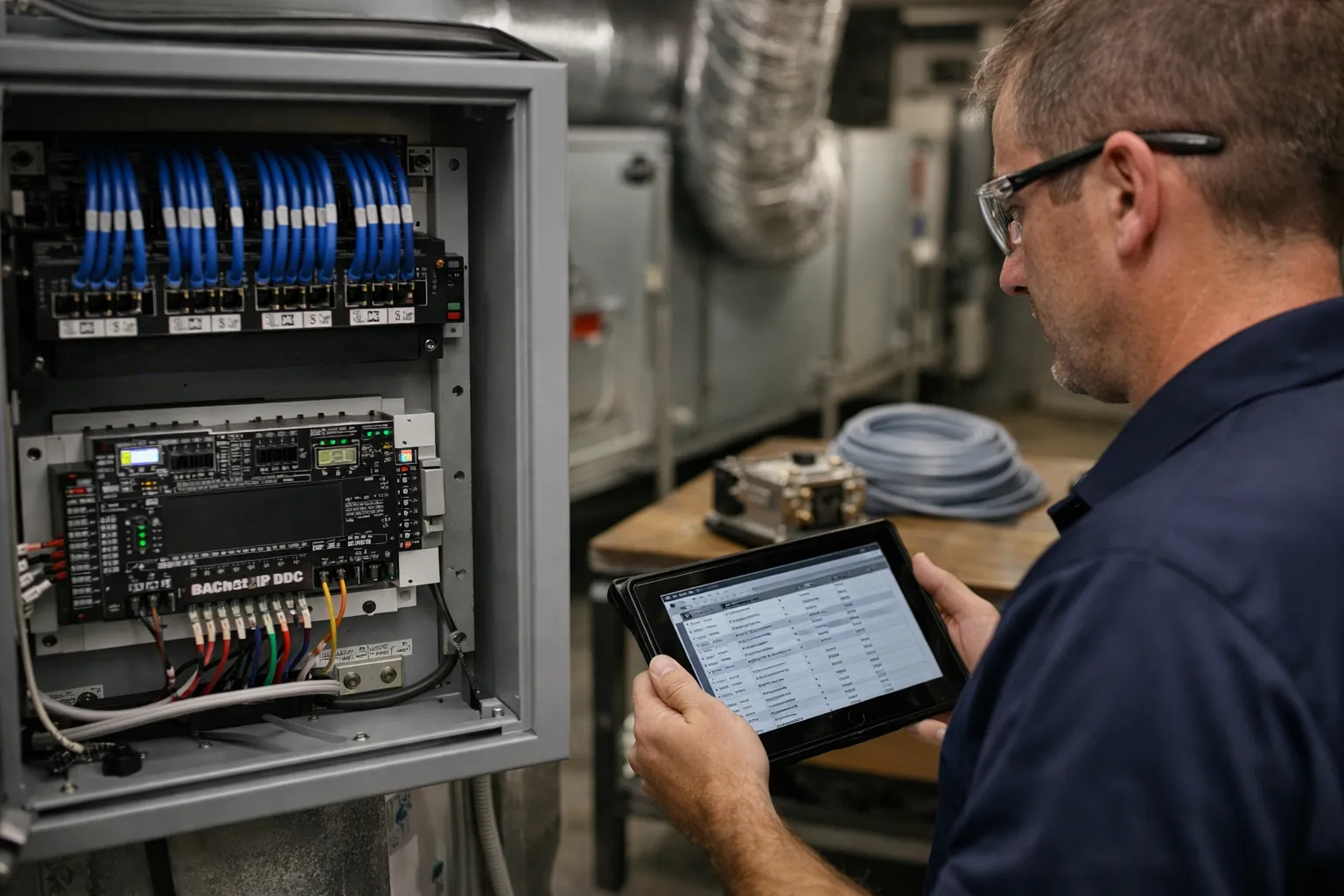
This guide walks HVAC technicians, controls contractors, and systems‑minded building owners through a complete, practical conversion from legacy pneumatic controls to BACnet/IP direct digital control (DDC). It assumes a mid‑size commercial building (roughly 30,000–120,000 ft²) with multiple AHUs, VAV boxes and pneumatic thermostats, and reflects 2026 expectations for cybersecurity and interoperability (ASHRAE 135/BACnet, IEC 62443 guidance).
Why convert now (and what you get)
- Operational visibility: real‑time trend logging, alarms and analytics for energy and comfort optimization.
- Energy savings: optimized sequences, better staging and integration with VFDs typically reduce energy and peak demand.
- Maintenance reduction: fewer air compressor cycles, elimination of leaking tubing, and remote diagnostics.
- Interoperability & future readiness: BACnet/IP is an open standard (ASHRAE 135) enabling multi‑vendor integration and cloud analytics.
- Regulatory and insurance considerations: many jurisdictions and insurers now expect segmented, secure building automation networks and documented cybersecurity practices.
Overview: The conversion approach
- Preliminary site survey and asset inventory
- Define scope and performance targets
- Procure controllers, actuators and network gear
- Install zone/upstream hardware and network segmentation
- Commission, test and validate sequences and alarms
- Handover, training and documentation
Step 1 — Detailed site survey (the mission control)
Invest time here. A thorough survey avoids surprises that inflate costs later.
- Inventory mechanical assets: AHUs, RTUs, chilled‑water coils, DX units, VAV terminals — count actuators, damper linkages, controllers and sensors.
- Map pneumatic infrastructure: tubing routes, supply pressures, aging compressors and dryer locations. Photograph panel interiors and tubing manifolds.
- Record control points: setpoints, interlocks, schedules, safeties (freeze stat, low‑flow), current pneumatic setpoint ranges (e.g., 3–15 psi).
- Identify physical constraints: space for new control panels, conduit paths, and cable runs for Ethernet and power.
- Verify BAS network readiness: existing network closets, fiber backbones, VLAN capacity, and building IT policies for control network segmentation.
Step 2 — Define scope, performance targets and constraints
Decide whether you want a phased retrofit (per floor/AHU) or a single cutover. Typical scopes:
- Zone‑level replacement only: replace thermostats with electronic room sensors and VAV controllers.
- Full AHU and zone conversion: DDC on AHU and all VAVs with integrated BACnet/IP.
- Hybrid approach: leave some pneumatic remnants and connect via gateways (temporary).
Set targets: minimum required trend points, alarm latency (e.g., 2 minutes), and energy KPIs (kWh reduction or demand shaving target). Establish allowable downtime window per AHU and tenant notification requirements.
Step 3 — Hardware selection and procurement
Key hardware elements:
- DDC controllers: wall/zone controllers for VAVs and AHU controllers with native BACnet/IP. Choose controllers with local I/O for digital/analog inputs and Modbus/BACnet gateways if needed.
- Actuators: electric modulating valve/vent damper actuators to replace pneumatic cylinders. Select spring‑return where needed for failsafe positions.
- Sensors: digital temperature/humidity/CO2 sensors with BACnet MS/TP or BACnet/IP support or wired to local I/O.
- Network gear: building automation VLAN switches (managed), firewall or edge gateway for segmented remote access, NTP server, and an on‑board time source for controllers.
- Optional: BACnet MS/TP gateways when retaining any legacy devices to minimize initial disruption.
Vendor considerations: prioritize controllers with an established BACnet Device Profiles (B‑BC/B‑AV/B‑AS), on‑device trending, and secure firmware update processes. In 2026, look for IEC 62443 compliance or supplier attestation of secure development lifecycle.
Step 4 — Network & cybersecurity design (non‑negotiable)
By 2026, building automation must meet modern security expectations. Follow layered controls:
- Network segmentation: place BACnet/IP devices on a dedicated VLAN with ACLs between IT and BAS networks.
- Firewalls and jump hosts: require a jump server or broker for remote vendor access; disable direct controller exposure to the internet.
- Authentication & encryption: use TLS/VPN for remote sessions; employ role‑based accounts; enforce strong passwords and certificate management.
- Logging & monitoring: centralize BAS logs and SNMP traps to your SIEM or at minimum store trend/alarm histories on a secure server for 90+ days.
- Standards & guidance: align with IEC 62443 and NIST SP 800‑82 recommendations for industrial control systems.
Step 5 — Installation: practical, low‑risk sequencing
Recommended phased cutover minimizes occupant disruption:
- Start in an unoccupied or low‑priority zone to validate installation procedures.
- Install field controllers and actuators but leave legacy pneumatics energized as a fallback (parallel wiring where possible).
- Bring BACnet/IP network online, assign static IPs or reserved DHCP, and register devices in the BMS directory.
- Commission point‑to‑point IO before disconnecting pneumatics: confirm sensor readings, command/feedback accuracy, and actuator stroking ranges.
- Transition control: after validation, switch sequences to DDC and isolate pneumatic supply. Remove or safely decommission air compressors and tubing only after verifying full functionality.
Step 6 — Commissioning and testing (make it measurable)
Commissioning is where project value is realized. Use a formal plan and acceptance criteria.
- Point testing: verify each input and output using an I/O checklist (sensor tolerance ±0.5°C, actuator travel %).
- Sequence verification: run AHU and VAV sequences under different load conditions — occupied/unoccupied, heat/cool transitions, economizer operations.
- Alarms and overrides: simulate sensor failures and ensure alarms arrive at the operator console and any escalation paths (SMS/email) function.
- Trend validation: enable at least 48 hours of high‑resolution trending (5–15 second samples for key points) and verify data integrity.
- Performance test: measure before/after energy use on a comparable week to quantify baseline improvement where feasible.
Acceptance checklist (minimum)
- All devices documented in BAS register with device instance numbers and locations.
- Network zone and firewall rules documented and approved by IT.
- Commissioning report with pass/fail for every control point and sequence.
- Operator and vendor accounts provisioned with documented credentials and MFA on remote access.
Training, documentation and handover
Deliverables the building owner should receive:
- As‑built wiring diagrams, point lists, device certificates and firmware versions.
- Operation manuals and sequence descriptions for each AHU/VAV.
- Training session(s) for facilities staff: at least one on‑site walkthrough and one hands‑on session using the jump server for remote access and trend retrieval.
- Maintenance plan: actuator lubrication/replacement schedule, spare parts list, firmware update policy.
Budgeting and timeline (realistic ranges)
Costs vary widely by building complexity, but use these 2026‑era benchmarks for planning:
- Zone‑only conversions (thermostats + 10–30 VAVs): $8,000–$30,000 per zone block (10–30 VAVs) depending on sensor and actuator quality.
- Full AHU + VAV retrofit for a mid‑size building (5–12 AHUs, 50–200 VAVs): $75,000–$350,000 total including network gear, commissioning and training.
- Network & cybersecurity implementation: $5,000–$30,000 depending on firewall, VLANs, logging and SIEM integration needs.
- Typical project timeline (phased): 8–20 weeks from purchase order — 2–4 weeks for survey/design, 6–12 weeks for lead times and deployment, 1–4 weeks commissioning per phase.
Note: lead times for controllers and actuators can be 6–12 weeks in 2026; plan procurement early.
Example ROI snapshot (illustrative)
Mid‑size office with 8 AHUs and 80 VAVs converts to BACnet/IP. Improvements realized:
- Energy reduction: 8–12% on HVAC energy through better scheduling and staging.
- Maintenance savings: eliminated compressor maintenance and fewer thermostat repairs saves ~$8,000–$15,000/year.
- Payback: with a $180,000 installed cost and conservative annual savings of $25,000, simple payback ~7 years (varies by utility rates and incentives).
Common pitfalls and how to avoid them
- Underestimating pneumatic complexity — map tubing and manifold runs thoroughly to avoid hidden salvage costs.
- Ignoring IT/OT coordination — get IT signoff on network architecture early to prevent rework.
- Skimping on commissioning — incomplete sequences yield unpredictable comfort and energy outcomes.
- Poor documentation — ensure as‑built drawings and device lists are delivered; they’re worth their weight in gold in year two.
Final checklist before commissioning
- All field wiring labeled and tied to as‑built drawings.
- Device instances and BACnet addresses assigned and registered.
- VLANs and firewall rules in place; jump server tested.
- Trend logging enabled for required points for at least 48 hours.
- Operator training scheduled and materials delivered.
Closing: practical next steps for readers
If you manage a building with legacy pneumatics, start with a targeted pilot: convert one AHU and its zones to validate vendor selection, commissioning protocols and IT coordination. Document time and costs carefully — the pilot is the best hedge against larger rollout surprises. Prioritize cybersecurity from day one; in 2026, a secure BACnet/IP deployment is as important as the controllers themselves.
Appendix — Key references
- ASHRAE 135 (BACnet) — interoperability standard
- IEC 62443 series — industrial control cybersecurity
- NIST SP 800‑82 — guide to ICS security