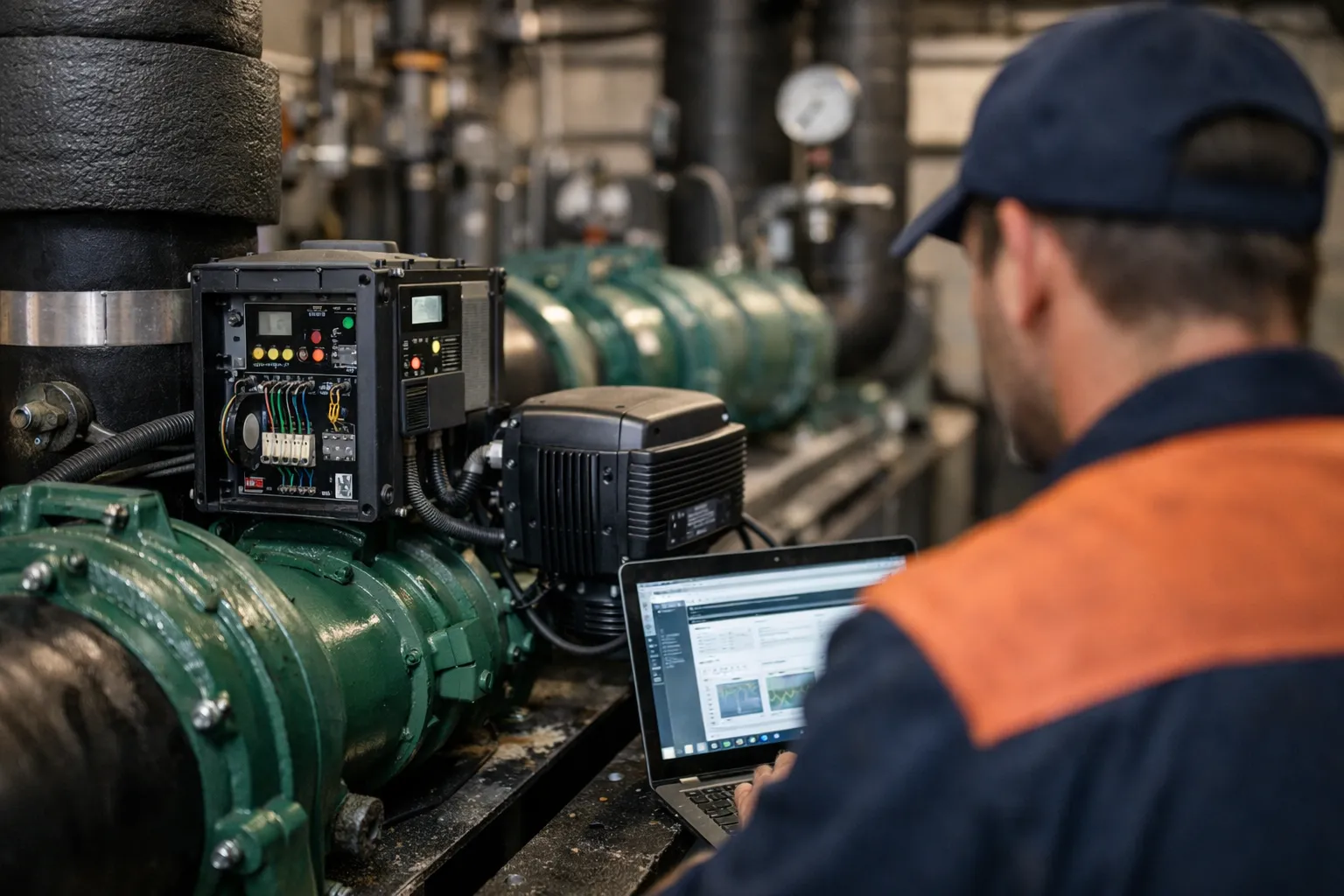
Retrofitting chilled‑water pumps with variable‑frequency drives (VFDs), electronically commutated motors (ECMs) or other modern motor‑drive solutions remains one of the highest‑value efficiency upgrades for facility engineers and HVAC systems enthusiasts. This September 2026 update adds recent field practice, technology developments, commissioning expectations and compliance considerations so you can deliver reliable savings and meet today’s utility and cyber requirements.
Who this guide is for and what it covers
This guide is written for HVAC systems enthusiasts, facility engineers, controls contractors and commissioning providers working on commercial or institutional chilled‑water plants (typical scale: 50–1,000+ tons). It updates the practical 10‑step workflow for centrifugal pump retrofits and adds 2026‑era guidance on:
- New motor/drive technologies and when to choose them (AFE drives, PM motors, ECMs)
- Sensorless flow estimation and edge/cloud analytics
- Harmonics, IEEE 519 considerations and utility expectations in 2026
- Cybersecurity and commissioning requirements now commonly requested by owners and utilities
- ROI sensitivity to energy price, demand charges and common 2026 rebate structures
Prerequisites and context
Before planning a retrofit, assemble the usual baseline documentation: hydraulic drawings, pump curves, motor nameplates, BAS points list, and recent electrical studies. Add these 2026‑era prerequisites:
- Confirm utility incentive requirements and M&V (measurement & verification) protocol—many utilities now require IPMVP‑style metering (Option A/C) and pre‑approval.
- Request the facility’s short‑circuit and harmonics study or schedule one if multiple new VFDs will be installed.
- Build a cyber risk checklist aligned with NIST guidance (NIST SP 800‑82 for ICS) and CISA best practices for industrial control systems.
Why retrofit? The opportunity in numbers (unchanged physics, updated context)
Pumping often accounts for 15–30% of chilled‑water plant electrical use. Because hydraulic power scales roughly with the cube of speed, modest speed reductions produce outsized energy savings—e.g., a 20% speed reduction yields roughly 49% less shaft power (0.8³ ≈ 0.512). In 2026, operator value also includes reduced demand charges, less mechanical wear, and improved fault detection via connected drives and edge analytics.
10-step retrofit workflow (updated for 2026)
-
Step 1 — Baseline assessment and metering
1) Meter for at least two weeks during representative occupied schedules; 4–8 weeks is better for seasonal capture. Required measurements:
- Motor input power (kW) and line current (A) with temporary power loggers
- Suction and discharge pressure and ΔP across the pump
- System flow or chilled‑water ΔT and supply/return temperatures to confirm load
- Record operating modes (lead/lag sequences, bypass valve positions)
2) When pursuing incentives, use utility‑approved metering and follow IPMVP principles for baseline normalization. Export logged data for later comparison with post‑retrofit trends.
-
Step 2 — Hydraulic survey and system curve
Plot head vs. flow using measured points. In 2026 you can also use vendor‑supplied sensorless flow estimation in combination with a single reference flow meter to validate the system curve—this reduces temporary metering cost but still requires at least one verified flow point. Identify control valves, bypasses, minimum‑flow requirements and hidden throttling that will affect part‑load behaviour.
-
Step 3 — Decide retrofit approach: VFD vs. motor replacement vs. full pump swap
Options and 2026 considerations:
- VFD on existing motor: cost‑effective if the motor/pump are in good mechanical condition. Modern VFDs with sensorless controls and embedded edge analytics add operational value beyond energy savings.
- Replace motor with ECM or permanent‑magnet (PM) motor plus drive: PM and ECM tech have improved in 2024–26; they give better part‑load efficiency but require careful compatibility checks (thermal limits, VFD control method and NPSH implications).
- Full pump resizing: If the pump is grossly oversized, swapping to a smaller pump sized for the measured system curve often gives the best lifecycle return—combine with a VFD for flexibility.
Model expected operating points with the measured system curve and include demand‑charge impacts and possible utility rebate in your financial model.
-
Step 4 — Select VFD and electrical components
Key 2026 drive specifications:
- Rated above motor FLC with margin for site faults
- Low harmonic technology or Active Front End (AFE) option—AFE drives are more common in projects with multiple VFDs or sensitive electronic loads
- Built‑in PID, sensorless flow or pump‑curve libraries for faster commissioning
- Integrated cybersecurity features (user roles, secure firmware update mechanisms, logging)
- Communications: BACnet/IP, Modbus TCP and native MQTT/OPC UA for cloud/edge telemetry if owner requires analytics
Include maintenance bypass contactors and verify short‑circuit current ratings and protective device coordination with the electrical engineer.
-
Step 5 — Sensors and control architecture
2026 sensor and control practices:
- Pressure transducers: place on straight, low‑turbulence taps; redundancy on critical plants is increasingly common
- Flow measurement: full‑bore mag meters remain the gold standard for permanent metering; ultrasonic clamp meters are useful for temp checks. Consider a single permanent flow meter plus sensorless estimation in other locations.
- Temperature: 3‑wire RTDs in insulated pockets for reliable ΔT monitoring
Control strategies:
- ΔP setpoint reset (20–50% reset range commonly used)—now often combined with model‑based setpoint selection from edge analytics
- Cascade schemes for variable primary/variable secondary plants with lead/lag and minimum flow protections
- Flow‑based control where distribution precision is required (e.g., research labs)
-
Step 6 — Mechanical and piping considerations
Follow original best practices and add these 2026 refinements:
- Install permanent test ports and flanges to enable future temporary metering without shutdown
- Verify instrumentation straight‑run requirements; modern mag meters often require 3–5D upstream but follow the manufacturer
- Minimum flow protection: use a pilot‑operated bypass or VFD‑enforced minimum speed; include temperature or flow interlocks for safety
- Document as‑found alignment, vibration baseline and piping stresses—store in your CMMS or asset management system for trend analysis
-
Step 7 — Electrical installation and harmonics mitigation
Harmonics considerations in 2026:
- Ask the utility whether voltage distortion limits or penalties apply. IEEE 519 remains the standard for evaluating harmonic distortion at the point of common coupling—aim for voltage THD ≤5% where practicable and follow IEEE 519 tables for specific limits.
- Mitigation options: AFE drives, 12‑ or 18‑pulse rectifiers, tuned or broadband harmonic filters, or facility‑level active harmonic filters.
- Measure harmonics after installation; include harmonic measurements in the electrical acceptance test.
-
Step 8 — Control programming, BAS integration and cyber hygiene
Programming checklist (2026 additions in bold):
- Soft start, ramp limits, and PID tuning
- Loss‑of‑flow, low ΔT and dry‑run protections
- Expose key points to BAS and to any cloud analytics platform: commanded speed, actual speed, kW, current, pressure, flow, temperature and alarms
- Implement role‑based access control on drives and gateways; disable unused services and default accounts. Follow NIST SP 800‑82 and CISA recommendations for ICS segmentation and VPN access controls.
-
Step 9 — Commissioning and performance validation
Required acceptance tests (updated):
- Pump curve verification: measure head and flow at multiple speeds and compare to manufacturer curve
- System curve confirmation and operating point mapping across load range
- ΔP reset validation and demonstration of ΔT constraints
- Electrical acceptance: motor current, THD at PCC, inrush, thermal checks
- Cyber acceptance: verify role‑based users, logging, firmware levels and secure communications
- Factory Acceptance Tests (FATs) or witnessed remote FATs are now commonly requested for larger projects—include these where procurement requires vendor commissioning evidence
Document pre‑ and post‑retrofit kWh and demand comparisons using the same measurement points and normalization factors (temperature, chiller loading). Use IPMVP methodologies for formal M&V if required by incentives.
-
Step 10 — Operations, maintenance and continuous optimization
Operations and maintenance in 2026 emphasize data‑driven operations:
- Train operations on new sequences, alarms and cybersecurity practices (password/role management)
- Enable trending dashboards for kW, flow and ΔT; set automated alerts for drift that suggests fouling, valve changes or sensor failure
- Schedule periodic PID retune and vibration inspections; use predictive analytics from drive telemetry to plan bearing or coupling maintenance
Practical ROI example (updated for Sept 2026)
Facility: 600‑ton chilled‑water plant with 4 pumps (two primary, two secondary). Baseline average pumping load during occupied hours: 200 kW.
Retrofit: VFDs on four pumps, ΔP reset and basic analytics. Modeled average pump power reduces to 95 kW—savings 105 kW during occupied hours.
- Occupied hours: 250 days × 12 hrs = 3,000 hrs/yr
- Annual energy saved = 105 kW × 3,000 hrs = 315,000 kWh
- Energy price sensitivity: at $0.12/kWh savings = $37,800/yr; at $0.16/kWh savings = $50,400/yr
- Include demand charge impact: if retrofit reduces peak demand by 50 kW and demand charge = $15/kW‑mo, additional annual savings ≈ $9,000
- Installed cost (VFDs, sensors, controls, commissioning) = $110,000; utility rebate (typical upfront incentive) = $20,000 net cost = $90,000
- Simple payback (energy only) ranges: 2.4–4.0 years depending on energy/demand prices and rebates; include longer horizon for full lifecycle ROI
Key point: run a sensitivity analysis with current local energy and demand charges and any available incentives. Document conservative assumptions (lower bound savings) for owner approval.
Common pitfalls and how to avoid them
- Leaving an oversized pump in place without resizing: adding a VFD helps but may not be the lowest lifecycle cost—model resizing when oversizing is significant.
- Poor sensor installation: noisy pressure taps or poorly installed RTDs create unstable control—follow manufacturer installation practices and add filtering where needed.
- Neglecting harmonics and utility coordination: can produce nuisance trips or penalties—perform a harmonics study when adding multiple drives.
- Missing minimum flow protection: insufficient minimum flow can cause recirculation damage—use mechanical bypass or VFD‑enforced minimums.
- Ignoring cybersecurity: default credentials, open remote ports and unpatched firmware create risk—implement project cyber acceptance tests.
- No post‑installation monitoring: savings evaporate without ongoing performance trending—deploy dashboards and automated alerts.
Pro tips
- Consider Active Front End (AFE) drives on projects with multiple VFDs or where harmonics are a known problem—AFEs reduce incoming distortion and can return regenerative energy when configured for bi‑directional applications.
- Use one verified flow meter and validated sensorless estimation in other branches to lower instrumentation cost while maintaining control fidelity.
- Include firmware‑level configuration backups and store them in a version‑controlled repository tied to CMMS work orders.
- Specify vendor support for remote firmware updates and factory remote diagnostics as part of the contract—this accelerates troubleshooting after handover.
- Document acceptance criteria clearly in the contract: energy baselines, allowable drift, harmony limits (THD), and cyber controls.
FAQ
Do I always need a permanent flow meter?
No. For many buildings a single permanent full‑bore flow meter on a representative branch plus sensorless flow estimation on other pumps provides the required control fidelity and lowers cost. For critical distribution systems (e.g., labs, hospitals) install permanent meters on each branch where precise control and verification are required.
How should I handle harmonics concerns with several new VFDs?
Start with a harmonics impact assessment baseline. If total installed non‑linear load is significant, specify AFE drives, 12/18‑pulse rectification or facility‑level active harmonic filters. Measure THD at the point of common coupling after installation and include remedial measures in the contract if limits are exceeded. Coordinate with the utility when necessary.
Are ECMs or PM motors worth it for large chilled‑water pumps?
ECMs and PM motors have improved and can offer higher part‑load efficiency, but their suitability depends on pump size, duty cycle and thermal characteristics. For large centrifugal pumps, careful vetting of motor thermal limits, drive control compatibility and lifecycle serviceability is required. Often the most cost‑effective first step is a VFD on an existing motor, with motor replacement evaluated when there is clear payback.
What cybersecurity steps are now required for pump retrofits?
Owners increasingly require: network segmentation for control systems, role‑based access on drives, disabling unused services, secure firmware update processes, and logging/auditing of critical actions. Follow NIST SP 800‑82 and CISA industrial control recommendations. Include cyber acceptance tests in commissioning.
How do utilities typically require M&V for incentives in 2026?
Most utility incentive programs require pre‑ and post‑installation measurement that follows a recognized M&V protocol (often IPMVP). Expect requirements for data resolution (15‑minute or hourly), normalization factors (weather, production hours), and documentation of baseline methodology. Pre‑approval of the M&V plan before installation is common.
Closing checklist (2026)
- Baseline energy and system curve documented with verifiable metering
- Selected VFD/motor meets electrical, harmonic and cyber requirements
- Sensors sized and located per manufacturer guidance with at least one verified flow meter
- Minimum flow protection and mechanical bypass installed
- BAS integration, secure communications and remote diagnostics defined
- Commissioning plan includes electrical, hydraulic, cyber and harmonic acceptance tests
- Operations training, dashboards and an M&V plan for post‑retrofit verification
Retrofitting chilled‑water pumps with modern drives and controls remains a high‑impact project in 2026. The difference today is that buyers expect data, cyber hygiene and harmonic accountability as part of the package. Start with a strong baseline, match equipment to measured system behavior, require rigorous commissioning and embed monitoring—those practices turn theoretical savings into sustained operational value.