Overview
The refrigerant transition that gained momentum under the AIM Act has moved from planning into execution. As of July 2026, contractors and facility owners face a mixed fleet of legacy HFC systems, growing volumes of mildly flammable A2L equipment in residential and light commercial segments, and targeted rollouts of CO2 and hydrocarbon architectures in refrigeration niches. This update explains what has changed since March 2026, why it matters now, and what practical steps technicians, contractors and owners should take in the next 12–24 months.
Background: what brought us here
The American Innovation and Manufacturing (AIM) Act set a legally binding HFC phasedown that has driven manufacturers and suppliers to accelerate new refrigerant roadmaps. Between OEM product strategies, state and local code evolution, and corporate decarbonization commitments, 2024–2026 became a period of rapid commercialization for several alternatives rather than a single industry pivot.
By early 2026, the industry had already settled into a multi‑path transition model: A2L refrigerants (such as R‑32 and R‑454B and A2L‑rated blends) became the primary successor in residential mini‑splits and many heat pumps; nonflammable, lower‑GWP blends and refrigerant‑optimized packaged units continued to serve parts of the commercial rooftop market; and CO2 transcritical and hydrocarbon systems remained the preferred approach for particular supermarket and cold‑chain applications. The core drivers remain: reducing global‑warming potential (GWP), retaining or improving efficiency, and managing safety and installation constraints for flammable options.
Data and evidence: what's new in mid‑2026
- OEM rollouts accelerated. Throughout 2025 and into 2026, most major residential OEMs increased shipments of A2L‑native outdoor units for the U.S. market. That has reduced lead times for A2L equipment in many regions compared with late 2024.
- Tooling and parts availability stabilized but remains segmented. Several manufacturers now offer A2L‑rated recovery units, hoses and manifolds, and some aftermarket suppliers have released conversion kits. Nonetheless, many smaller distributors report inventory variation by region, so shops servicing mixed fleets still need duplicate tool sets.
- Code adoption and clarifications accelerated in some states. Since early 2026, a number of states and municipalities have updated local codes or issued interpretations that clarify allowable A2L charge sizes, ventilation requirements and electrical separation needs. Where codes remain silent, AHJ (authority having jurisdiction) guidance still drives installation acceptance on a case‑by‑case basis.
- Insurer and general contractor expectations tightened. Several large GC firms and insurers now require documented A2L training and equipment lists for contractors bidding on projects that specify flammable refrigerants.
- Incentives are influencing choices. Utility and state rebate programs that launched in 2024–2025 increasingly favor low‑GWP systems with measured efficiency gains, improving the lifecycle case for replacement over retrofit in many commercial projects.
Multiple perspectives: manufacturers, contractors, owners
Manufacturers report that designing compressors, metering devices and controls for specific refrigerants reduces warranty and service friction. Many OEMs now ship systems with refrigerant‑specific commissioning routines embedded in service apps.
Contractors describe a split market: residential service calls increasingly involve factory‑approved A2L units with field technicians trained on new safety protocols, while rooftop and packaged unit work still often involves nonflammable blends or legacy HFCs. Smaller shops note capital strain from buying duplicate recovery machines and stocking multiple refrigerant cylinders.
Owners and facility managers balance retrofit economics against disruption risk. For mid‑life rooftop units with long remaining service life and small refrigerant charges, owners often delay replacement and instead budget for staged upgrades and increased leak monitoring. For aging systems near end of life, replacement with A2L‑native equipment frequently offers the best lifecycle value when rebates and efficiency gains are included.
Service‑level implications and updated best practices
Practically, the technical and business implications have sharpened since March 2026. New or reinforced best practices include:
- Fleet audit and tagging. Do a building‑by‑building inventory now. Tag equipment with refrigerant type, charge size, oil type and OEM retrofit guidance. Digital records reduce risk when staffing changes.
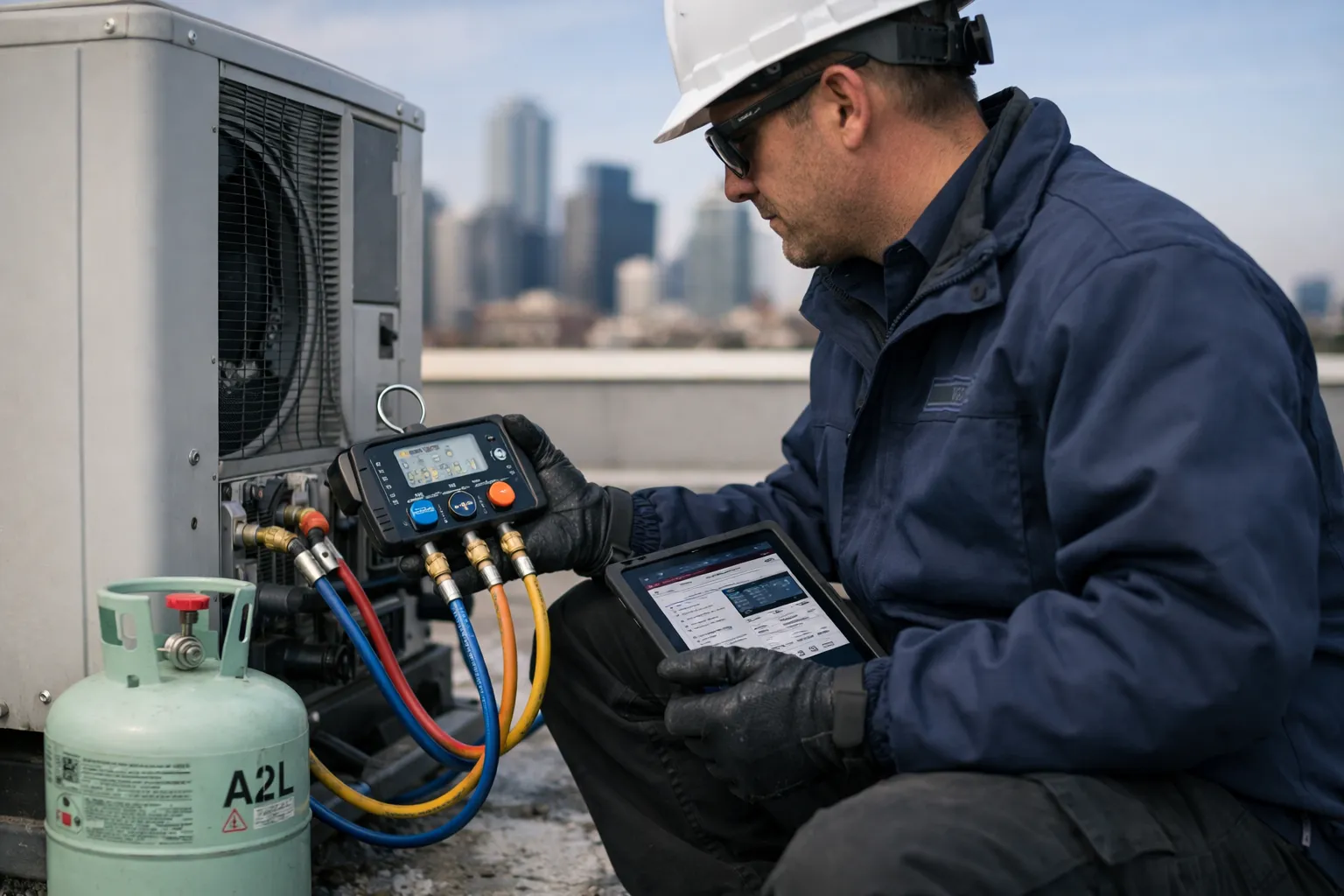
- Invest in A2L‑rated tooling on a priority basis. Prioritize A2L‑rated recovery machines, hoses, scales and gas detectors. For mixed‑fleet shops, maintain separate hoses and clearly labeled cylinders to avoid cross‑contamination and compliance problems.
- Formalize hot‑work and ignition control procedures. Implement written policies that include purge procedures, lockout/tagout, combustible‑gas monitoring and temporary ventilation verification for jobs involving A2Ls.
- Update insurance and subcontract language. Before bidding on A2L projects, confirm insurer coverage and list certified staff and equipment in contracts. Many owners now require documented A2L training as a precondition.
- Rely on manufacturer commissioning apps but verify fundamentals. OEM service software increasingly automates refrigerant‑specific commissioning sequences; technicians should use these tools while retaining competency in P/T relationships and manual verification procedures.
Retrofit economics and realistic pathways—what's changed
The essential retrofit calculus hasn’t changed, but the inputs have become clearer:
- Drop‑in retrofits are still limited. Compatibility problems (oil miscibility, pressures, component sizing, controls and warranties) remain the most common reason OEMs recommend replacement.
- Partial and staged approaches are more documented. For residential mini‑splits, manufacturers now publish clearer pathways for reusing indoor units with new A2L‑rated outdoor condensing units where factory procedures allow. For rooftop units, staged chiller retrofits (compressor modules first, controls later) are increasingly practiced.
- Replacement increasingly has a favorable lifecycle case. Falling equipment premiums for A2L‑native systems, combined with targeted rebates and anticipated tighter HFC quotas, mean owners who plan 10‑year lifecycles often find replacement more economical than retrofit.
Supply chain and market signals to monitor now
- Regional routing matters. Refrigerant and spare‑part lead times still vary by geography—shops should plan ordering windows by region and keep critical spares for core customer segments.
- Component specialization is rising. Expect more compressors and controls optimized for specific refrigerants; buying forward‑compatible platforms can reduce retrofit risk.
- Refrigerant pricing volatility remains a factor. HFC quota tightening and increased demand for substitutes can produce short‑term price swings—factor variable refrigerant cost into lifecycle models and service call quotes where appropriate.
Implications: what this means for readers
For technicians: invest in A2L training and A2L‑rated PPE and tools now; document certifications to maintain access to projects. For contractors: consider specializing in one refrigerant pathway (A2L service or CO2 refrigeration) and form alliances to cover mixed‑fleet needs. For owners: treat refrigerant choice as a systems decision that includes controls, ventilation, lifecycle cost and regulatory risk, not just refrigerant GWP.
Outlook: what to watch through 2027
- Further local code harmonization. Expect more AHJs to publish A2L guidance and to adopt ASHRAE/industry clarifications during 2026–2027.
- Market consolidation by application. A2Ls will likely dominate residential and light commercial heat pumps; nonflammable blends will persist where code or owner preference dictates; CO2/hydrocarbons will keep expanding in supermarket and cold‑chain niches.
- Professionalization of service. Insurer and GC requirements will push documented training and equipment lists toward becoming standard bidding requirements in many markets.
Action checklist for July 2026
- Complete a refrigerant inventory and tag assets digitally.
- Purchase at least one A2L‑rated recovery machine and gas detector if you serve residential/light commercial markets.
- Enforce written hot‑work and ignition controls; train crews on purge and ventilation procedures.
- Engage OEMs early on retrofit advisories and keep manufacturer service apps updated.
- Factor incentives, refrigerant price risk and expected code changes into replacement vs. retrofit analyses.
Multiple viewpoints summarized
The transition is not a single technical problem but a market reformation: OEMs see product clarity and optimized platforms as the solution; contractors are balancing capital investments with demand; owners seek predictable lifecycle outcomes. Those who prepare—through audits, training and a clear service strategy—are positioned to capture the higher‑value work that accompanies equipment replacement and controls upgrades.
Looking forward
Through 2027 the industry will continue sorting by application. The immediate opportunity for HVAC professionals is to convert uncertainty into a structured plan: decide which refrigerant paths you will master, invest in the right tools and training now, and use documented lifecycle analysis to help owners make defensible decisions. The refrigerant shift is a sustained market realignment—preparation will determine who prospers.
Which refrigerant should I choose for a small commercial rooftop unit?
There’s no single answer. Choice depends on local code, allowable charge size, OEM equipment availability, efficiency goals and owner risk tolerance. In many markets, owners prefer nonflammable lower‑GWP blends until A2L code clarity exists; where A2L is accepted, A2L‑native replacements often offer better efficiency and long‑term supply alignment.
Do I need separate recovery cylinders for A2Ls?
Yes. Use cylinders rated and labeled for A2L service and avoid cross‑contamination. Maintain clear labeling and handling protocols; many insurers and OEMs expect separate cylinders for different refrigerant families.
How quickly should a contractor buy A2L‑rated equipment?
Prioritize purchases based on your customer mix. If most calls are residential mini‑splits or light commercial heat pumps, buy A2L‑rated recovery and detection equipment now. If your work is primarily large chillers or industrial refrigeration, consider specialized investments in CO2/hydrocarbon service tools instead.
Will incentives make replacements cheaper than retrofits?
Sometimes. Utility and state rebates often tilt the lifecycle equation toward replacement, particularly when equipment is near end‑of‑life. Always run an incentive‑inclusive lifecycle cost analysis rather than comparing only upfront costs.