Overview
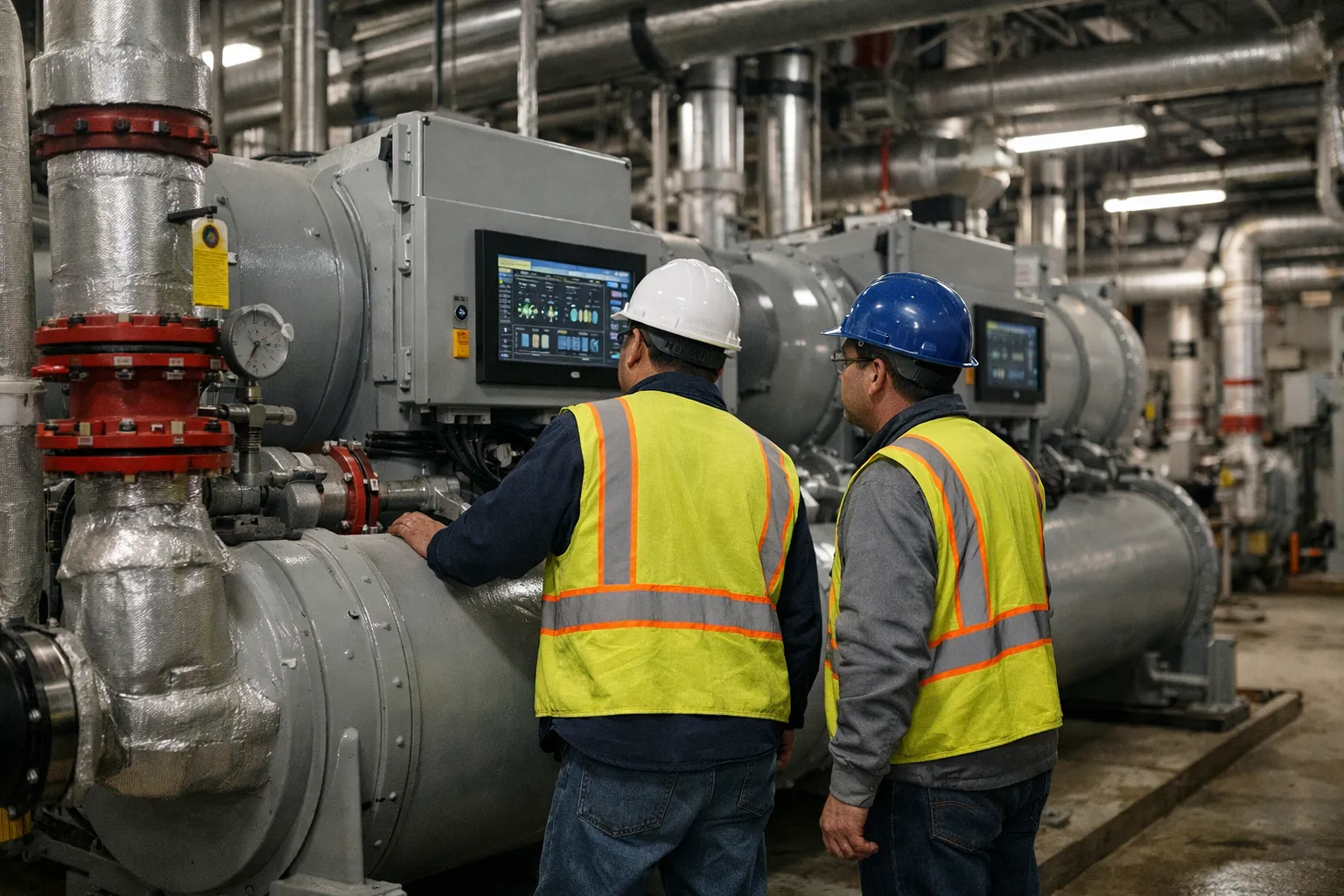
Hospitals remain one of the most demanding building types to electrify because of continuous occupancy, high domestic hot‑water (DHW) loads, stringent infection‑control ventilation, and critical resiliency requirements. Two approaches still dominate in 2026: centralized high‑temperature heat‑pump (HTHP) plants that replace central boilers with large water‑loop heat pumps, and distributed air‑source heat pumps (ASHPs) that decentralize heating and cooling across zones or buildings. This update summarizes what has changed since mid‑decade, synthesizes new industry data, and gives practical guidance for HVAC teams making decisions now.
Background — what’s changed since early pilots
Through 2024–2026 the market has moved from proof‑of‑concept pilots to early mainstream deployments. Key shifts include:
- Manufacturers scaled HTHP product lines to support sustained 80–95°C water delivery at larger capacities, improving compressors and controls for hospital loads.
- Wider adoption of lower‑GWP refrigerants (including A2L blends) and revised installation guidance in many jurisdictions, which reduced material cost and sped permitting for larger heat‑pump plants.
- Expanded federal and state incentives—driven in part by the Inflation Reduction Act and state electrification programs—lowered effective capital costs for electrification projects, especially for centralized solutions that can access resilience and decarbonization funding.
- More operational data from demonstration projects—particularly from utility‑sponsored pilots and DOE Buildings Office demonstrations—has clarified seasonal performance, thermal storage benefits, and maintenance implications.
Comparison framework and updated assumptions
To keep comparisons practical, this update retains the original normalized model: a 150,000 ft² urban hospital campus. Key assumptions (updated where industry data allows):
- Peak winter heating (sensible): ~600 kW.
- Annual DHW: ~450 MWh (high continuous needs for sterilization, kitchens, laundry).
- Cooling: central chillers continue to serve summer loads; electrified heating and DHW are the focus.
- Distribution piping and plant redundancy options are sized to hospital risk tolerances (N+1 minimal).
Field data through 2025–2026 show modest improvements to seasonal COPs because of inverter drives, better controls, and refrigerant choices. Reasonable operational ranges now used by many design teams are:
- Centralized HTHP supply (80–95°C): seasonal COPs typically 2.5–3.2 across temperate-climate heating seasons when paired with heat recovery and smart controls; lower during extreme cold but often offset by thermal storage.
- Distributed ASHPs for space heating (low‑temp hydronic or terminal units): seasonal COPs often 3.2–4.8, depending on climate and terminal temperature.
- DHW from distributed ASHPs: effective system COPs decline when booster heating or cascade systems are required to reach 60–75°C, often falling to 1.8–2.8 unless purpose‑built high‑temp water heaters are used.
Data and evidence — what recent projects and studies show
Data from utility pilots, manufacturer case studies, and DOE‑sponsored demonstrations through June 2026 point to these practical outcomes:
- Fuel switching and emissions: For hospitals with large DHW demand, centralized HTHP retrofits are consistently delivering the largest combustion‑fuel reductions—commonly 70–90% less natural gas use compared with boiler baselines—because they avoid combustion for high‑temperature water. Distributed ASHP strategies often leave some boiler capacity for DHW, reducing the percent fuel‑switch.
- Grid flexibility and markets: Centralized plants with thermal storage have been more successful accessing demand‑response and capacity compensation in ISO markets because of predictable, centralized dispatchability. Aggregated distributed ASHP fleets have accessed programs as well, but require advanced controls and third‑party aggregation services to reach the same market value.
- Lifecycle economics: As manufacturing scale reduced HTHP equipment premiums in 2025–26, lifecycle analyses in multiple climate zones increasingly show HTHP paybacks of 4–10 years when incentives and the value of avoided boiler maintenance/fuel contracts are included. Without incentives, distributed ASHPs still often offer lower near‑term capital and faster phased deployment.
- Operational reliability: Central plants with properly implemented N+1 redundancy, refrigerant leak detection, and on‑site thermal storage have demonstrated robust emergency performance in pilot hospital installations, including short‑term islanding during grid outages when combined with backup generation. Distributed ASHPs continue to score well for localized redundancy but impose higher coordination burdens on facility management.
Multiple perspectives — what stakeholders are saying
Facility engineers: Many facilities teams prefer centralized HTHP when they have experienced central‑plant staff and face large DHW needs; they cite simplified spare parts, centralized controls, and easier integration with backup generation.
Design consultants and commissioning specialists: They emphasize early, detailed DHW hourly modeling and controls integration. Several independent commissioning firms now recommend hybrid designs (central HTHP for DHW + low‑temp distributed ASHPs for selective space heating) where phased retrofits or building layout make full centralization impractical.
Procurement and finance leads: Grant and incentive administrators note that resilience metrics (e.g., hours of thermal storage, islanding capability) materially increase funding eligibility. Where funds cover a higher share of capital, centralized HTHP business cases strengthen.
Implications for project teams
What this means for HVAC teams in July 2026:
- DHW is the deciding factor. If DHW accounts for a large portion of thermal load (as in many hospitals), centralized HTHP will likely deliver the greatest emissions reduction and the simplest single‑loop distribution. For hospitals with limited DHW demand or segmented buildings, distributed ASHPs remain viable.
- Factor in incentives and resilience grants early. Many utility and state programs now explicitly reward thermal storage and firm, dispatchable electrified loads. Project economics can flip if these funds are secured early in design.
- Design for redundancy and degraded modes. For central HTHP plants, require N+1 compressor and pump redundancy, dual‑path distribution where feasible, and 2–6 hours of hot‑water storage sized to local grid reliability assumptions. For distributed ASHPs, set explicit spare‑unit percentages and service‑level agreements.
- Plan workforce development and controls. Centralized HTHPs shift skill needs toward large‑scale refrigeration plant operations and refrigerant safety (A2L competence). Distributed strategies increase logistics for parts and multi‑vendor servicing. In both cases, modern controls and cyber hygiene are essential for safe market participation.
- Consider hybrid deployments. Hybrid strategies—central HTHP for DHW and heat recovery, distributed ASHPs for selective low‑temperature space heating—are increasingly common and can balance capital timing, clinical risk tolerance, and retrofit phasing.
Practical recommendations — updated best practices
- Run hourly DHW and space‑heating models early. DHW load shape typically determines whether centralized HTHP is worth the premium.
- Quantify resilience needs as dollars and hours. Use metrics like required hours of thermal autonomy and acceptable clinical risk if the central plant is offline; let those numbers drive storage sizing and redundancy requirements.
- Engage utilities and incentive administrators during schematic design. Projects that align with utility demand‑response objectives or qualify for resilience grants secure funding and better market participation terms.
- Specify refrigerant management and safety training. Require contractor certification for A2L refrigerants, leak detection, and emergency procedures in procurement documents.
- Use staged or hybrid procurement for large campuses. Phased deployments let campuses test central HTHP modules on a building or wing before full conversion while preserving the option to consolidate later.
Conclusion
By July 2026 the tradeoffs described in the original analysis remain valid, but market evolution has reduced some of the historical penalties for centralized HTHP adoption. Improved product availability, lower equipment premiums, clearer refrigerant pathways, and more generous incentives have moved centralized HTHPs from niche to mainstream for hospitals with substantial DHW loads. Distributed ASHPs still offer compelling options for phased retrofits, segmented campuses, or facilities that lack central‑plant staffing. The best immediate action for project teams is to model actual hourly DHW and heating loads, engage incentives and utility programs early, and design explicit redundancy and thermal‑storage strategies to align decarbonization with clinical resilience.
FAQs
Is a centralized HTHP plant always the lowest‑emission option for hospitals?
Not always—but for hospitals with large DHW loads, centralized HTHPs typically eliminate combustion for high‑temperature water and therefore achieve the largest on‑site fuel switching. In hospitals with limited DHW demand or where boilers are retained for redundancy, hybrid or distributed approaches can deliver substantial emissions savings too.
How much thermal storage should we consider for a central HTHP plant?
Common sizing in recent demonstrations is 2–6 hours of hot‑water storage, sized to provide short‑term islanding and flatten peak power. The optimal size depends on local grid reliability, demand‑response participation goals, and budget—model multiple scenarios during design.
What refrigerant safety considerations matter most in 2026?
Lower‑GWP A2L refrigerants are widely used in new HTHP and ASHP products. Projects must include contractor A2L training, leak‑detection systems, alarm integration with building management, and compliance with the latest local code updates. Specify refrigerant management plans and servicing protocols in procurement documents.
Can distributed ASHP fleets participate in capacity markets?
Yes—if aggregation, telemetry, and centralized orchestration are provided. Aggregators and third‑party controls are increasingly used to pool distributed assets for demand‑response and capacity auctions, but the value stream often requires investment in controls and cyber‑security.
Should hospitals plan for a single approach or keep flexibility?
Flexibility is valuable. Many hospitals in 2025–26 adopted staged or hybrid strategies—committing to central HTHP for DHW while deploying distributed ASHPs where retrofit sequencing, physical constraints, or budget timing make it sensible. Early modeling lets teams choose a path that preserves optionality.