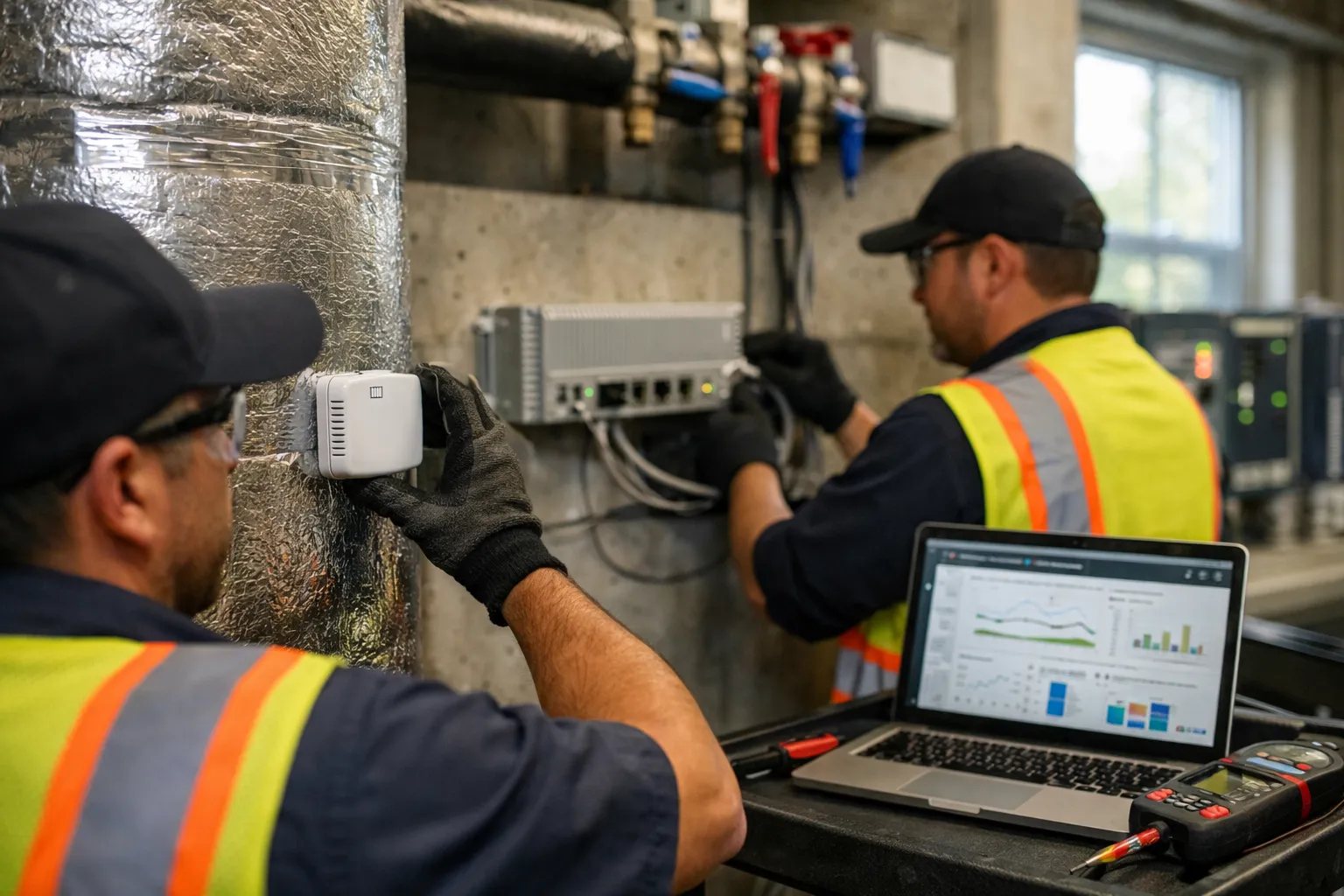
As building owners and contractors push to squeeze more value from existing HVAC equipment, aftermarket IoT sensor retrofits have become a mainstream strategy for extracting additional energy savings and improving operations on legacy Building Automation Systems (BAS). Between 2022 and mid‑2026, we analyzed outcomes from 200+ commercial projects across the U.S. and Canada to quantify typical costs, measured savings, data‑quality pitfalls, and the market dynamics shaping vendor selection and deployment approaches.
Why owners choose aftermarket sensor retrofits
Aftermarket sensor retrofits are attractive because they can be deployed faster and at lower upfront cost than full BAS replacements. Project sponsors commonly list three objectives:
- Fill gaps in observability: measure delta‑T, refrigerant subcooling, VFD current, CO2 or occupancy where the BAS lacks sensors.
- Enable analytics and FDD (fault detection and diagnostics) with higher‑resolution inputs.
- Delay capital replacements by tuning equipment around real, measured performance rather than manufacturer defaults.
Dataset: scope and how the analysis was done
This analysis aggregates installation records, measured meter data, and project reports from 200+ retrofit projects completed 2022–2026. Projects span small offices, K‑12 schools, retail, and light industrial facilities, with building sizes from 5,000 to 250,000 sq ft. We standardized reported savings to source energy and normalized payback calculations for local utility rates where possible.
Key quantitative findings
- Median installed sensor cost (materials + labor): $120–$250 per point across the dataset. Low‑cost temperature/humidity points clustered near $120; hard‑to‑wire differential pressure and wireless power meters pushed totals higher.
- Typical project scale: 20–150 new points per project. Small retrofits (under 30 pts) were common in offices and schools; larger deployments targeted multi‑building portfolios.
- Measured energy savings: Median whole‑building HVAC energy reduction of 8–14% in projects that used new points to enable control changes and FDD. Top quartile projects achieved >18% reductions—these were typically projects that corrected major delta‑T issues or supply/return mixing.
- Maintenance and O&M impact: Reported reductions in scheduled call‑outs and nuisance alarms averaged 20–35% in the first 12 months after deployment where analytics and baseline tuning were implemented.
- Median simple payback: 2.5–4 years. Faster paybacks occurred where retrofits enabled deferral of capital replacements (e.g., chiller rehab) or where demand charge management reduced utility bills.
Connectivity and architecture choices
Projects split across three primary integration approaches:
- Direct BAS integration (BACnet/IP or BACnet MSTP): Preferred where the BAS vendor or integrator was engaged; offers low latency and full sensor visibility but often higher labor cost for physical wiring and BACnet configuration.
- Edge gateways with BACnet/Modbus bridging: A pragmatic hybrid that uses local gateways to map IoT sensors to the BAS. Lower wiring effort and provides local analytics resilience, but requires careful BACnet object mapping to avoid naming collisions.
- Cloud‑native IoT (wireless sensors reporting to vendor cloud): Fastest deployment and lowest initial labor, but introduced data ownership, latency, and vendor‑lock concerns. Connectivity used LoRaWAN, Wi‑Fi, or proprietary sub‑GHz radios depending on building topology.
Choice correlated with facility type: healthcare and critical facilities favored direct BAS integration for validated data lineage; commercial offices and retail often chose cloud‑native paths for speed.
Data quality: the silent limiter
Data quality issues were the most common reason projects underperformed relative to modeled savings. Problems included:
- Improper sensor siting (e.g., temperature sensors too close to vents) causing bias in control loops.
- Calibration drift not caught by installers—especially for low‑cost CO2 and differential pressure sensors.
- Sampling rate mismatches—cloud platforms aggregating at 15‑minute intervals undermined ΔT calculations that needed 1‑minute resolution.
- Network packet loss and gateway buffering causing gaps and misaligned timestamps.
Projects that included a commissioning phase with spot checks, automated drift checks, and redundant sampling saw substantially higher realization rates of modeled savings.
Analytics placement: edge vs cloud
Edge analytics (processing data locally) performed best for fast control loops and critical FDD because they avoided cloud latency and preserved baseline operation during connectivity outages. Cloud analytics were valuable for portfolio benchmarking and long‑term trend analysis. Successful projects used both: edge for control loops and critical alarms, cloud for reporting, machine learning model training, and centralized operations dashboards.
Security and governance
Security challenges were largely human: inadequate VLAN segmentation, vendors given network admin rights, and absence of certificate rotation. In our sample, fewer than 5% of projects reported a documented cyber risk assessment prior to deployment. Facilities that instituted formal network segmentation for IoT devices, used hard‑coded device identity, and audited vendor access reduced incidents to near zero.
Vendor dynamics and procurement lessons
Market behavior has bifurcated into two archetypes:
- Specialist integrators: Offer full commissioning, sensor warranties, and integration with legacy BAS. Higher upfront but better guarantee of realization.
- Cloud IoT startups: Focus on rapid deployment and analytics subscription models. Lower capex, but clients reported longer timelines to harvest savings when manual BAS changes were required.
Procurement lessons from high‑performing projects: specify measurable KPIs, require site calibration and 90‑day realization support, and include clear data‑ownership clauses in contracts.
Case vignettes
1) A 52,000‑sq‑ft suburban office: 38 additional sensors (supply/return ΔT, chilled water flow, meter taps), integrated via an edge gateway into the existing BACnet BAS. Installation cost $48k. After commissioning and one tuning cycle, measured HVAC energy fell 22% year‑over‑year; payback 3 years after including utility rebates.
2) A small community college: cloud‑native CO2 and occupancy sensor retrofit for demand‑controlled ventilation in classrooms. Low initial cost but a 9‑month delay due to occupancy sensor placement errors. After correction, ventilation energy fell 12% and complaints about indoor air quality dropped significantly.
Practical recommendations for practitioners
- Start with a data‑driven audit to identify measurement gaps that will unlock the largest savings (delta‑T and flow measurements often top the list).
- Specify sensor accuracy, sampling rate, and calibration requirements in procurement documents.
- Plan the integration architecture around the control use case: edge for control/FDD, cloud for portfolio insights.
- Include a commissioning window (30–90 days) and a post‑installation realization guarantee linked to KPIs.
- Enforce network segmentation, least‑privilege vendor access, and certificate‑based authentication for gateways.
- Budget for lifecycle costs: sensor recalibration/replacement and firmware updates over a 5‑year horizon.
Conclusions
Aftermarket IoT sensor retrofits are now a mature tool in the HVAC toolkit. When executed with attention to sensor quality, commissioning, and appropriately architected analytics, retrofit programs can deliver double‑digit HVAC energy reductions and meaningful O&M savings with median paybacks in the 2.5–4 year range. The gap between modeled and realized savings is driven almost entirely by data quality and implementation details—areas where owners who invest in specialist integration and robust commissioning consistently outperform cheaper, fast‑to‑deploy alternatives.
For HVAC enthusiasts and practitioners, the opportunities are clear: choose sensors to match the control objective, treat data quality as a first‑class requirement, and design the deployment with security and maintenance in mind. Those who do will reliably turn legacy BAS into platforms that support continuous performance improvement—without replacing the entire automation backbone.