Cloud-hosted building automation systems (BAS) promise faster rollouts, continuous feature updates and centralized analytics. But in 2026 the widescale commercial deployment of cloud-first BAS has revealed an uncomfortable truth for many owners and facility teams: vendor lock‑in is now a primary lifecycle risk. This analysis examines how lock‑in forms, its operational and financial impacts, and pragmatic strategies owners and integrators can use to limit exposure or migrate without prohibitive cost or downtime.
How vendor lock‑in materializes in cloud BAS
Lock‑in is rarely a single point failure. It emerges from the interaction of technical choices, business models and contracts. Key mechanisms include:
- Proprietary data models and APIs — Vendors expose telemetry, alarm and control interfaces through cloud APIs that map to vendor-specific object models. Without a standard mapping (e.g., to Project Haystack or Brick), extracting usable data is difficult.
- Edge device dependence — Many cloud BAS solutions require vendor-signed edge gateways or controllers that run proprietary firmware, encrypt data to vendor clouds and refuse third‑party firmware.
- Subscription and licensing structures — SaaS pricing tied to histories, device counts or analytics features leads to recurring charges that reflect not just service but continued access to data.
- Integrated analytics and ML — Value-add services (anomaly detection, fault diagnostics) are trained on aggregated customer data; transferring that capability to another vendor is nontrivial.
- Contractual barriers — Data residency clauses, API throttling terms, or IP ownership language can obstruct porting historic data or models.
Market dynamics in 2026
Since 2023 the BAS market shifted to cloud-first delivery. Major controls OEMs and cloud-native startups both moved to subscription models, and utility programs increasingly reimburse cloud-enabled performance monitoring. That expansion increased short-term adoption but also amplified lock‑in risk: owners are now buying continuous services rather than discrete hardware and software.
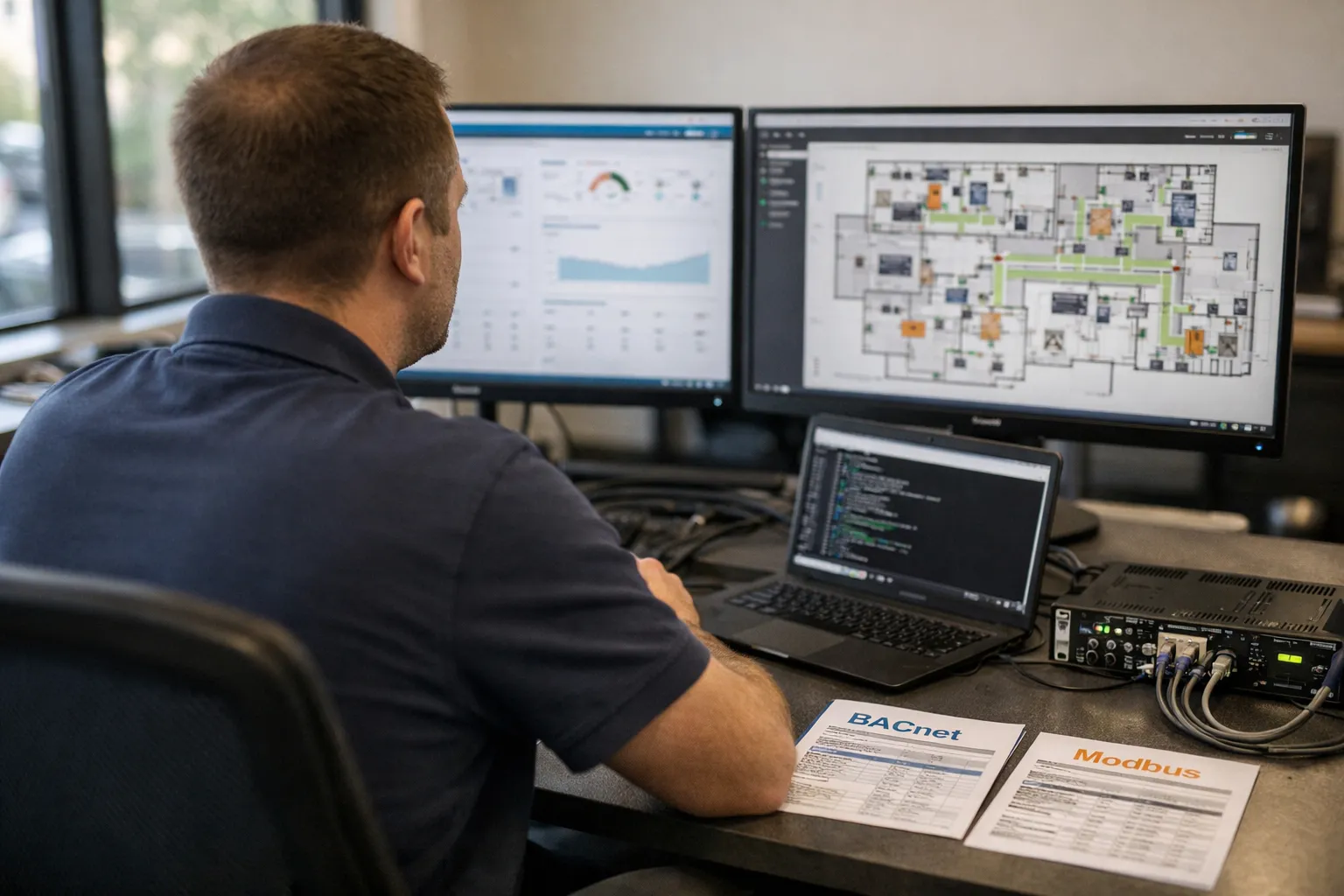
At the same time, open-standards activity accelerated. Adoption of Project Haystack, Brick Schema and standardized telemetry formats has improved; yet deployment fragmentation persists. Many legacy systems still expose BACnet/IP or Modbus over local networks while cloud vendors push different schemas into their platforms. The result is a hybrid landscape where interoperability depends on well-executed integration work rather than plug‑and‑play standards.
What lock‑in costs — operationally and financially
Lock‑in manifests in three measurable ways for owners and service providers:
- Ongoing higher operating expense — Subscription fees, premium analytics charges and vendor maintenance agreements compound over years. In many cases the recurring cost over a 10‑year horizon exceeds original implementation spend.
- Reduced competitive service options — Proprietary edge devices and closed APIs limit third‑party service providers who could offer lower-cost analytics or maintenance, raising service costs and lowering market supply.
- Migration and stranded asset risk — Migrating away from a cloud vendor often requires replacing edge hardware, retooling integrations and investing in data extraction and model retraining. Those are real capital costs—and some installed edge controllers are intentionally hard to reuse.
Owners should treat these as lifecycle costs, not merely procurement price differences. The total cost of ownership (TCO) for a cloud‑centric BAS must include projected subscription fees, expected hardware refresh cycles (which may shorten under vendor-specific firmware lifecycles), and the cost of historical data extraction should a migration be required.
Technical pain points: data, control and resilience
From a technical perspective, three pain points recur:
- Historical data portability — Time-series, event, and labeled sequence data are essential for model-based FDD (fault detection & diagnostics). If a vendor stores this in proprietary formats or restricts exports, rebuilding models elsewhere is costly.
- Local control continuity — Dependence on cloud authorization introduces resilience concerns: network outages, vendor cloud incidents or contract disputes can interfere with critical HVAC control unless local fallbacks exist.
- Semantic mismatch — Different vendors label points, zones and equipment differently. Without a semantic translation layer, analytics and visualization break, and manual remapping becomes a costly friction point during migration.
Practical migration strategies
For owners facing lock‑in or seeking to avoid it, practical strategies fall into preventative procurement moves and reactive migration tactics.
Procurement guardrails (preventative)
- Specify open data export — Require machine‑readable bulk export of historical telemetry and alarm data in commonly used formats (CSV, Parquet, or time-series DB snapshots) as a contractual deliverable.
- Mandate open semantic tagging — Contractually require Project Haystack or Brick-compliant tagging at device and point level during handover.
- Insist on local control guarantees — Ensure controllers can continue deterministic control locally without cloud connectivity and that control logic is accessible for third‑party maintenance.
- Shorter trial and migration windows — Negotiate initial pilot periods with the right to terminate and extract full data sets at no penalty.
Reactive migration approaches
- Protocol bridging and middleware — Deploy a translation layer that maps proprietary API outputs to an open time-series backend (InfluxDB, Timescale) and applies semantic mapping with Haystack/Brick. This approach avoids immediate edge replacement but depends on the vendor exposing sufficient API endpoints.
- Edge reconfiguration and phased controller replacement — Replace edge gateways in phases with controllers that support both the incumbent cloud and an open stack, allowing parallel operation until cutover.
- Data-only migration — If the incumbent vendor will not support long‑term service, extract historical datasets to train new analytics models. Expect engineering overhead to retag and normalize data.
- Hybrid co-existence — Run both systems in parallel for a defined period, validating analytics and control parity before decommissioning the incumbent platform.
Checklist for HVAC owners and facility teams
Before selecting or renewing a cloud BAS, use this checklist:
- Can the vendor export all historical telemetry, alarms and trends in bulk? In what formats and frequencies?
- Are edge controllers physically replaceable with third‑party firmware or controllers? Does the controller vendor use signed firmware locks?
- Does the BAS support semantic tagging (Haystack/Brick) natively or via a transformation layer?
- Is local deterministic control guaranteed during cloud or network outages, and is the fallback documented and testable?
- What is the vendor’s stated data retention policy, and who owns the metadata and derived models?
- Can analytics/ML models be exported or retrained with on-premises snapshots of the data?
When migration is unavoidable: budgeting and timeline realities
Expect migrations to be multi‑quarter projects for medium-to-large campuses. Key budget drivers are controller replacement, integration engineering, data normalization and model retraining. Owners should budget not only capital for replacements but also one‑time engineering fees and parallel operations during cutover. Where possible, seek vendor credits or cooperative transition support as part of contract exit negotiations.
Conclusion: design for portability, treat cloud as a service, not a trap
Cloud BAS platforms deliver real operational value, but the 2026 landscape demonstrates that value can come with hidden lifecycle costs if owners accept closed architectures. Portability should be a first-class requirement: insist on open data, local control, semantic tagging and contractual export rights. When migration becomes necessary, plan for translation layers, phased edge replacement and data normalization. For owners and integrators who bake portability and contractual protections into procurement, the cloud becomes a flexible tool; without those protections, it can become a costly and sticky trap.