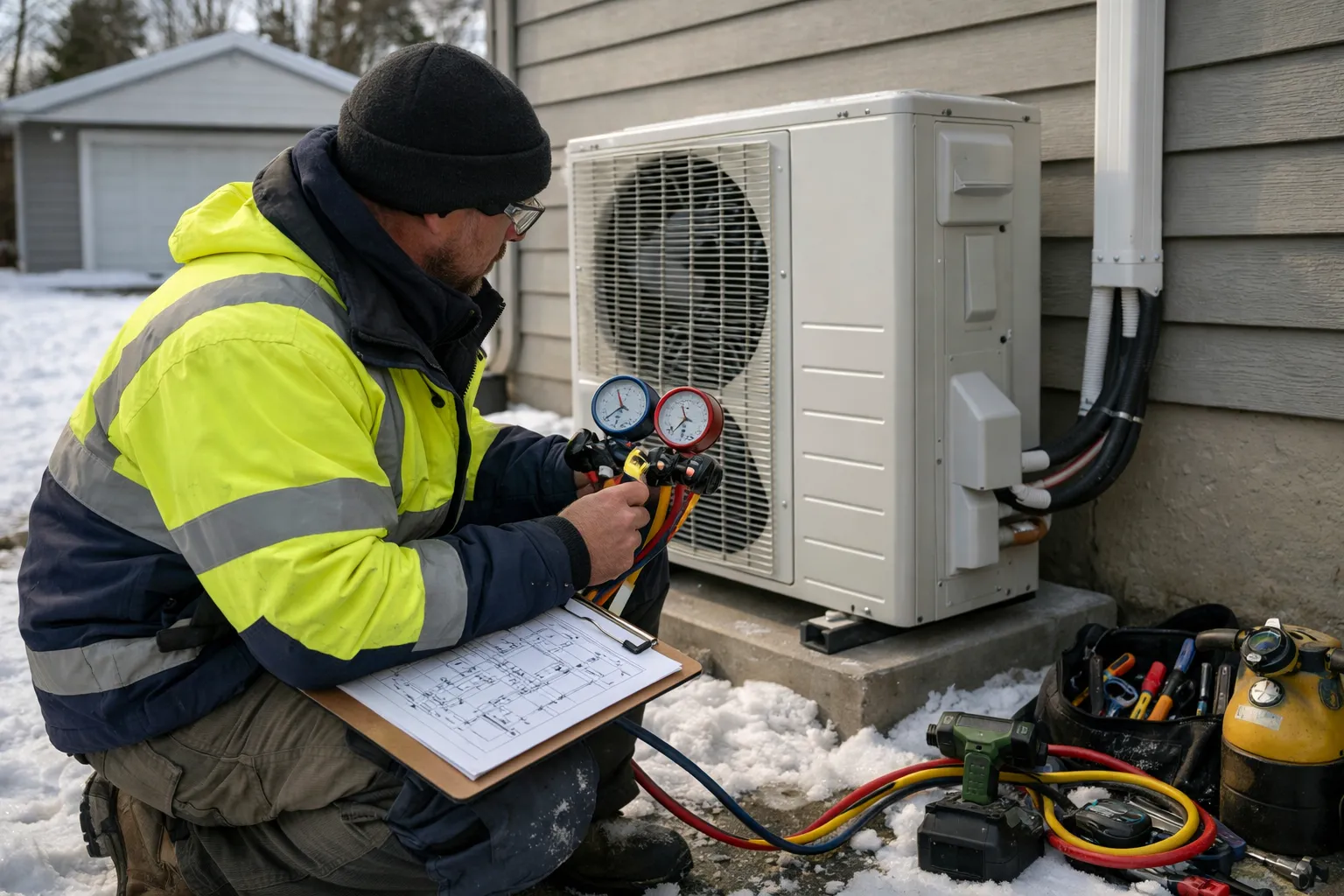
This updated June 2026 guide walks the HVAC‑savvy reader through converting a residential gas‑fired forced‑air furnace to a cold‑climate air‑source heat pump (ASHP). It retains the original step‑by‑step focus on planning, equipment selection, field procedures, and commissioning while adding 2026‑era developments: wider A2L adoption and evolving AHJ requirements, improved low‑temperature performance and factory long‑line options, increased incentive and demand‑response programs, and the expectation of integrated cloud diagnostics. If you are an installer, contractor, or experienced DIYer planning a conversion, this article gives the actionable details you need right now.
Prerequisites and context — what to know before you start
Short summary of what matters in 2026:
- Cold‑climate ASHPs now commonly publish capacity and COP down to −15°C (5°F) or lower; manufacturers claim improved capacity retention versus models available in 2022–2024.
- A2L (mildly flammable, lower‑GWP) refrigerants are the market standard for many residential units; AHJs increasingly require documented A2L training and jobsite procedures.
- Federal and state incentive programs, plus many utilities, continue to accelerate electrification. Check DSIRE, your utility portal, and manufacturer rebate pages for mid‑2026 offerings.
- Grid programs and time‑of‑use (TOU) tariffs are more common; plan controls that enable demand response or load shifting to reduce operating cost and qualify for incentives.
Step 1 — Pre‑retrofit assessment (site survey)
Why this step matters: accurate inputs prevent undersizing, callbacks, and unhappy homeowners.
- Perform a Manual J load calculation (updated envelope data). Use current insulation R‑values, window U‑factors, airtightness (blower door results if available), and occupancy patterns. In 2026, many jurisdictions and utilities expect a documented Manual J (or software equivalent) to qualify for rebates.
- Run a Manual D/duct analysis. Measure duct leakage and static pressure. ASHPs deliver different sensible/latent behavior than furnaces; return leaks make heat pumps work harder. Aim to reduce total leakage to 10–15% of system airflow where feasible.
- Electrical service review for whole‑house electrification. Consider concurrent loads: EV chargers, electric water heaters, induction ranges. Many installers now plan a 200 A or larger service for full electrification. Contact the utility early for meter upgrades and potential incentive coordination.
- Decide on the gas appliance strategy. Options remain the same: remove and decommission, leave as staged backup (dual‑fuel), or temporarily cap the gas line. New in 2026: some AHJs require written decommissioning plans and photos for incentive closure.
- Document site constraints for long‑line and noise. Factory long‑line (pre‑charged) options and longer warranty line lengths are increasingly available — measure for feasible line lengths and elevation changes ahead of specification.
- Permits and A2L compliance. Confirm local AHJ rules on A2L refrigerant handling, indoor charge limits, and required documentation or certificates for technicians. Many jurisdictions now require a certificate of compliance noting the refrigerant type and charge weight on final permit paperwork.
Step 2 — Equipment selection (what's changed in 2026)
Recent trends you should factor into selection:
- Capacity at design temp and published low‑temp tables. In 2026 most manufacturers publish detailed capacity/COP tables to −15°C or −20°C and provide software tools to map capacity to local design temps. Select a unit whose published capacity at the local design temperature approaches the Manual J load or establish a clear staged hybrid plan.
- Factory‑charged long‑line and pre‑assembled panels. More models now offer factory pre‑charged long‑line assemblies and improved leak‑reducing fittings. These reduce field brazing on A2L systems and speed installation—confirm warranty terms for long‑line lengths.
- Refrigerant and safety class. R‑32 and R‑454B/C remain common A2L choices. Verify charge limits for indoor appliances and that the selected equipment's service ports, valves, and tools are compatible with A2L requirements.
- Integrated controls and grid features. Manufacturers increasingly ship units with built‑in demand‑response, TOU optimization, and secure cloud telemetry. If the homeowner is on TOU or enrolled in utility load‑control programs, select equipment that supports secure APIs or standard DR signals (OpenADR, or vendor-specific integrations).
- Ducted versus ductless and hybrid architectures. For intact, reasonably efficient duct systems, a ducted cold‑climate split or packaged unit is typically the most direct replacement. For poor ducts consider ductless heads in targeted rooms or a hybrid approach combining a ducted heat pump with zone heads.
- Serviceability matters more. In 2026 service technicians and AHJs expect clear component labeling, accessible service shutoffs, and manufacturer remote diagnostic capabilities to speed field troubleshooting.
Step 3 — Electrical and mechanical preparations
New 2026 considerations and checklist items:
- Coordinate utility upgrades and load studies early. Utilities increasingly require load studies for large conversions. If planning simultaneous EV charger installs or electric water heating, bundle the utility request to avoid staged upgrades.
- Install a dedicated circuit and external disconnect per NEC and manufacturer specs. Where A2L equipment is present, ensure local disconnect placement follows AHJ guidance for safe servicing.
- Condensate management with freeze protection. Heat pumps create significant condensate in winter; use insulated, heat‑traced drains or electric condensate pumps where drains run through unconditioned spaces.
- Prepare line‑set penetrations and minimize length. Longer line sets reduce capacity and may void warranties. When factory long‑line is not used, plan for brazing procedures that comply with A2L practices (minimize indoor brazing; use nitrogen purge, certified brazers).
- Duct sealing and airflow upgrades as a prerequisite. In mid‑2026 it's routine to include a pre‑installation duct test (blower door + duct test) and a scope for sealing to contract documents. Consider adding return improvements or a dedicated fresh air inlet if ventilation was previously tied to furnace operation.
Step 4 — Installation highlights and field checks
What installers should be checking in 2026:
- Mounting, clearances, and snow management. Level pad, elevated mounting for snow loads, and guard for drifting are still required. For coastal or high‑salinity sites choose corrosion‑resistant bases and consider protective coatings.
- Match coils, confirm blower capability, and target CFM. Typical target remains roughly 350–450 CFM per nominal ton depending on application; follow manufacturer guidance and verify by measurements.
- A2L refrigerant charging and leak testing. Use A2L‑rated electronic leak detectors, pressure‑test with dry nitrogen, and follow manufacturer charge‑by‑weight procedures and required service logs. Minimize indoor charge and avoid indoor brazing unless AHJ approved and following strict safety protocols.
- Controls wiring and sequencing. Implement the chosen dual‑fuel/lockout strategy, defrost logic, and DR/TOU integration. On systems with cloud connectivity, enroll the device and validate secure firmware levels and access controls before turning over to the homeowner.
- Combustion appliance decommissioning. If removing the furnace, provide photos and paperwork of gas cap‑off, vent removal, and electrical disconnection per local code; many incentive programs require evidence before releasing funds.
Step 5 — Commissioning checklist (expanded for 2026)
Commissioning in 2026 emphasizes data capture, cybersecurity, and performance validation:
- Verify refrigerant charge, pressures and superheat/subcool. Use manufacturer charts at measured indoor airflow and outdoor temp. For inverter units measure performance across a range of operating points where feasible.
- Measure airflow and duct static pressure. Capture register CFM and verify against design. Use thermal imaging to identify cold spots and poorly performing registers.
- Force and observe defrost cycles. Validate proper termination, assess energy penalty, and ensure the system returns to heating mode reliably.
- Exercise staging, lockouts, and demand‑response settings. Simulate outdoor temp thresholds, trigger emergency heat, and verify DR messages or TOU logic operate as configured. Record setpoints chosen for homeowner documentation.
- Record electrical current and inrush where practical. Capture manufacturer‑recommended amp draws and compare to breaker/wire limits.
- Enable and validate remote monitoring and security. Enroll unit in cloud service, confirm data telemetry (COP, runtimes, alarms), and change default passwords. Many utilities now require telemetry for performance‑based rebates, so provide owners with data access instructions.
- Provide homeowner training and a commissioning report. Include measured CFM, amp draws, refrigerant weight, control setpoints, expected warm‑up behavior, and basic troubleshooting steps. Document warranty registration and incentive paperwork steps.
Step 6 — Post‑installation monitoring, tuning and program participation
Early operation reveals tuning needs and potential for cost reductions:
- Log energy, COP and comfort metrics for the first winter. Installers should collect at least one winter's data (or encourage homeowners to share it) to validate sizing assumptions.
- Tune control strategies. If short‑cycling or poor temperature recovery appears, adjust minimum run times, stage thresholds, or differential setpoints. For dual‑fuel, refine the lockout temperature based on actual fuel prices and measured heat pump COP.
- Participate in demand‑response and TOU optimization. If eligible, enroll the homeowner in utility programs that reward load shifting; many programs now pay small recurring credits for smart ASHP participation.
- Plan firmware and remote diagnostics as part of maintenance. Manufacturers release firmware updates to improve algorithms and defrost control — include firmware checks in annual service visits.
Practical 2026 examples and field decisions
Example 1 — New England cold‑snap strategy: A contractor in Maine sized a cold‑climate ducted split to cover ~85% of the Manual J at −15°C and kept the existing furnace as backup. They programmed furnace lockout at −12°C with automatic priority for the furnace only if the heat pump could not sustain indoor setpoint after a 15‑minute persistent drop. The owner enrolled in the utility's winter demand‑response program, which provided a small monthly credit when the system accepted brief pre‑cooling or temp setbacks during grid events.
Example 2 — Mountain home with long run: In Colorado a house had a 45‑ft vertical elevation and a 75 ft line‑set requirement. The installer used a factory‑charged long‑line kit certified by the manufacturer and added a suction accumulators and crankcase heater per guidance. They documented the factory long‑line length in the warranty package and used remote telemetry to validate capacity at −18°C during commissioning.
Regulatory, safety and refrigerant notes (mid‑2026)
What to expect from AHJs and regulators:
- Many jurisdictions now require documented A2L training for technicians and signed charge‑management procedures on the job file. Always carry proof of technician A2L certification on site.
- Indoor charge limits and ventilation requirements vary; verify allowable charge for indoor fan coils and closet installations before specifying unusually large indoor units.
- Refrigerant reporting: include refrigerant type, charge weight, and serial numbers in the final job dossier for future servicing and compliance with incentive requirements.
Common pitfalls in 2026 and how to avoid them
- Undersizing by rule‑of‑thumb. Avoid: run a Manual J and use manufacturer low‑temp capacity tables. Compensate for duct losses if sealing is not feasible.
- Neglecting electrical interactions. Avoid: plan for concurrent electrification loads and communicate with the utility early to avoid last‑minute service upgrades.
- Poor handling of A2L refrigerants. Avoid: use certified techs, A2L‑rated detectors, minimize indoor brazing, and follow manufacturer procedures.
- Skipping commissioning data capture. Avoid: log CFM, amp draws, refrigerant weight, and defrost cycles; these data prevent callbacks and are often required for rebates.
Pro tips
- Use a home energy baseline: capture at least one year's pre‑conversion utility bills when possible to quantify savings post‑retrofit.
- Prefer factory long‑line options for challenging runs—they reduce indoor brazing risk for A2L refrigerants and often extend warranty coverage.
- Design for serviceability: leave clear access to service valves, wiring, and filter changes and label everything including DR endpoints and firmware versions.
- Combine incentives and financing: many manufacturers and local programs now offer point‑of‑sale financing paired with rebates to lower upfront costs.
Maintenance and long‑term operation
- Seasonal: clean coils, replace filters, inspect condensate traps. Check firmware annually.
- Annual: verify refrigerant charge, airflow and electrical connections; confirm defrost algorithm performance over several cold cycles.
- Data‑driven: review cloud telemetry for COP, runtimes and alarms; use it to target preventive maintenance before comfort degrades.
Final checklist before handover
- Provide Manual J and equipment selection documentation to the owner.
- Close permits and attach refrigerant documentation to permit paperwork where required.
- Deliver a commissioning report with measured CFM, amp draws, refrigerant weight, and control setpoints; include photos of gas cap‑off or furnace removal if applicable.
- Register warranties, enroll the owner in monitoring, and provide clear instructions for DR/TOU enrollment if they qualify.
Why this matters in June 2026
Heat pump technology and market infrastructure have matured substantially by mid‑2026. Installers now must balance tighter A2L handling protocols, richer telematics, and broader electrification scopes. Done correctly, a conversion unlocks lower on‑site combustion emissions, alignment with utility decarbonization programs, and improved operational savings—but the margin for error has tightened. This guide focuses on the practical, verifiable steps that reduce risk and deliver reliable winter comfort.
Common questions
Do I have to replace my gas furnace when installing a heat pump?
No. Many homeowners keep the gas furnace as a staged backup (dual‑fuel). That approach reduces upfront cost and provides reliability in extreme cold. If you retain the furnace, design the control strategy to prevent inefficient simultaneous operation and document the lockout temperature and logic. If decommissioning the furnace, follow AHJ permit requirements for gas cap‑off and submit photos and paperwork as many incentive programs require evidence.
How do A2L refrigerants change installation practice?
A2L refrigerants (e.g., R‑32, R‑454 family) require certified handling procedures: A2L‑rated leak detectors, minimized indoor brazing, proper ventilation/charge limits indoors, and documented technician training. Check local AHJ requirements for certificates and ensure the job dossier lists refrigerant type and charge weight for future servicing.
What size heat pump should I select for a cold climate?
Size to the Manual J heat load and compare to the manufacturer's published capacity at the local design temperature (e.g., −15°C/5°F). If you cannot match 100% of peak load economically, plan for staged backup (furnace or resistance) and document the expected percent coverage at design temp (commonly 70–100%). Avoid rule‑of‑thumb sizing—use published low‑temp capacity tables.
Are there incentives or programs I should know about in 2026?
Yes. Federal, state, and utility incentives remain significant in mid‑2026. Programs may include point‑of‑sale rebates, performance‑based rebates requiring telemetry, tax credits, or utility demand‑response payments. Check DSIRE, your state energy office, and local utility portal for current offers and their documentation requirements before installation.
What's the most common cause of poor winter performance and how do I prevent it?
Poor ductwork and insufficient airflow are the top field issues. Prevent problems by conducting a pre‑installation duct test, sealing leaks, verifying blower capability, and measuring register CFM during commissioning. Addressing ducts often yields larger performance gains than upsizing equipment alone.