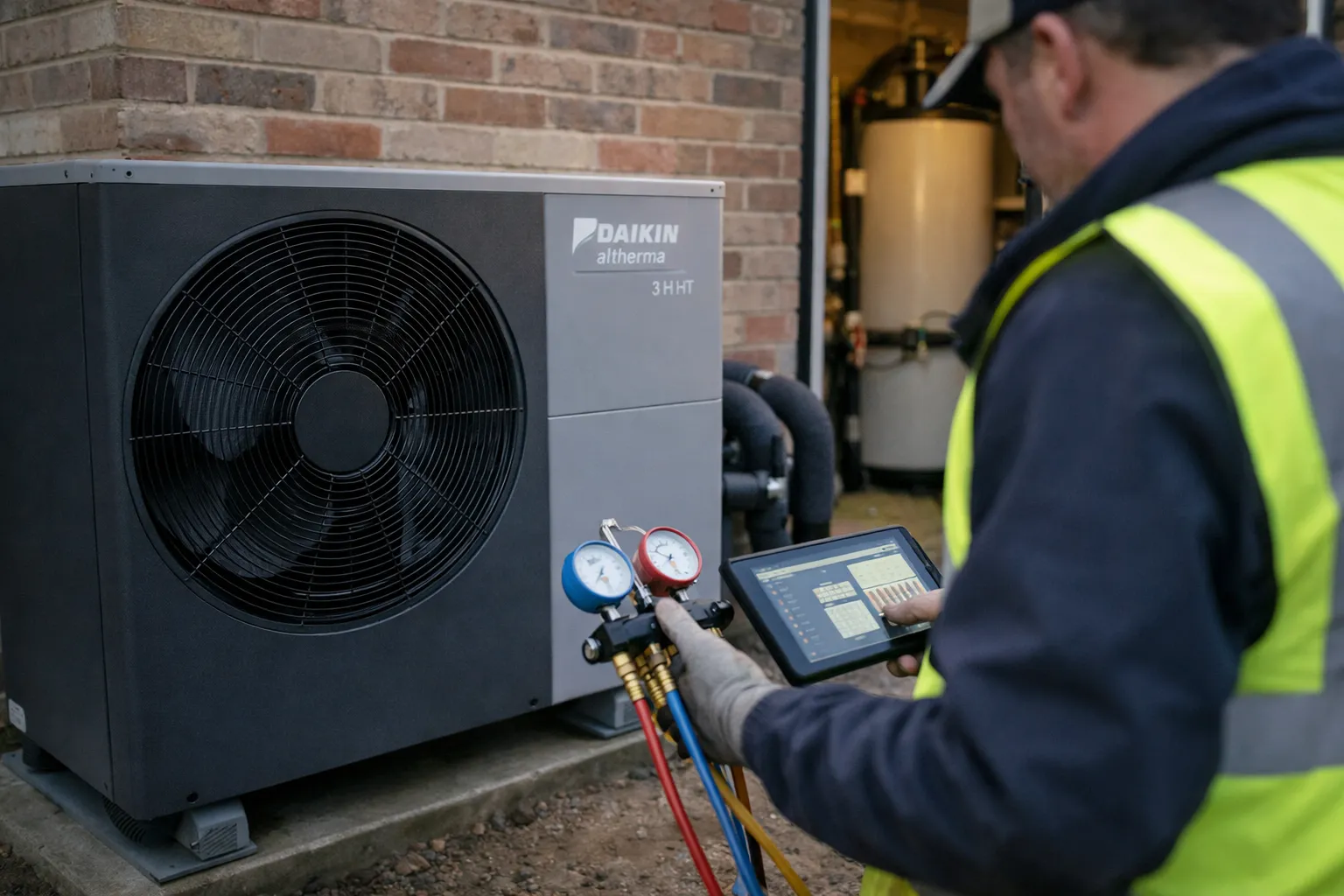
High‑temperature air‑to‑water heat pumps are now a mainstream option for retrofits that must keep existing radiators or older distribution systems. Daikin’s Altherma 3 H HT Monobloc is one of the better‑known entries targeted at those scenarios. This review examines its design, field performance, controls, installation realities, pros and cons, and the types of projects where it makes sense in 2026.
What is the Altherma 3 H HT Monobloc?
The Altherma 3 H HT Monobloc is Daikin’s factory‑sealed outdoor air‑to‑water heat pump engineered to deliver higher supply temperatures than conventional air‑source units. “High‑temp” in this family typically means capability to supply domestic heating systems up to roughly 60–70 °C without a separate booster heater, making it attractive for radiator retrofits and hydronic systems that cannot be down‑rated easily.
Key features
- Single‑package monobloc: compressor, controls and charge are outside, leaving only hydronic plumbing to the indoor system.
- High‑temperature capability: designed to meet higher supply temperatures for legacy radiators or industrial hot‑water demands.
- Integrated controls with remote connectivity: Daikin’s cloud/service tools and local BMS interfaces for monitoring and setpoint integration.
- Modulation across multiple capacity steps to improve part‑load efficiency and reduce short cycling.
- Hydronic integration: factory options for built‑in or recommended buffer tanks, and compatibility with cascade or hybrid boiler setups.
Field performance and efficiency
In real installations the Altherma 3 H HT performs as expected for a high‑temperature air‑source heat pump: it can supply elevated flow temperatures but with the familiar tradeoff of reduced coefficient of performance (COP) as temperature rise and ambient cold increase. Owners should expect:
- Competitive COPs at moderate conditions (COPs in the mid‑2 to low‑3 range at 55–60 °C supply, depending on ambient temperature and exact model/trim).
- Noticeable performance degradation in very cold ambient temperatures below −5 °C; in such climates owners must plan for backup heat or oversized units.
- Good part‑load behavior due to modulation; part‑load seasonal performance factors (SPFs) improve when the system is well‑sized and accompanied by proper buffering and control strategies.
These are consistent with other high‑temp air‑to‑water units on the market. The Altherma tends to lean toward conservative control logic that prioritizes maintaining setpoint over squeezing absolute peak COP—useful in retrofit contexts where occupant comfort is the priority.
Controls, connectivity and commissioning
Daikin supplies an updated control stack that includes web/cloud connectivity and local interfaces for building automation. For HVAC enthusiasts and contractors this means:
- Access to setpoints, schedules and diagnostics remotely via Daikin’s cloud services.
- Modbus/Modbus‑TCP and other third‑party BMS integration options on many models, simplifying system‑level coordination.
- Preconfigured commissioning sequences, but installers still need to tailor flow rates, pump control, and defrost parameters for optimal field behavior.
Proper commissioning matters: flow rates, buffer volumes, and anti‑short‑cycling logic materially affect performance. Where possible, incorporate system‑level monitoring to track seasonal performance and refrigerant‑circuit diagnostics.
Installation realities and serviceability
As a monobloc, the Altherma simplifies refrigerant handling on site, which reduces service risks and installation cost. Still, there are practical considerations:
- Space and noise: the outdoor unit is physically sizable and generates typical outdoor fan and compressor noise. Site selection must meet setback and setback sound criteria for urban installations.
- Hydronic compatibility: systems with small radiators or undersized emitters will need distribution upgrades or supplemental boosting to deliver comfort at lower flow temperatures.
- Buffer tanks and mixing: to protect compressor cycles and to smooth supply conditions to older systems, spec a buffer or mixing circuit. Daikin provides guidance on minimum buffer volumes by capacity.
- Cold‑climate strategies: in areas with long, very cold seasons, consider hybridization with an auxiliary boiler or cascade configurations to preserve efficiency and reliability.
Pros and cons — quick checklist
- Pros: True high‑temp capability for retrofits; monobloc reduces on‑site refrigerant work; robust control and BMS integration; conservative controls favor stable comfort.
- Cons: Lower COP at elevated supply temps versus low‑temperature heat pumps; larger footprint and acoustic signature than mini‑splits; still may require hydronic upgrades in many retrofit scenarios.
Who should specify the Altherma 3 H HT?
Good candidates:
- Residential and light‑commercial retrofits where existing radiator networks require supply temperatures substantially above typical low‑temp heat pump output.
- Projects seeking a sealed refrigerant package to minimize field refrigerant handling and reduce installation complexity.
- Systems where building owners prefer proven controls, remote diagnostics and vendor support for commissioning and service.
Less suitable:
- New construction designed for low‑temperature distribution — there, lower‑temp heat pumps yield better seasonal efficiency.
- Very cold climates without planned hybrid backup where long cold snaps are common; the economics and resilience of standalone high‑temp ASHPs are marginal under extreme conditions.
How it stacks up against alternatives
Compared with low‑temperature air‑to‑water heat pumps, the Altherma trades some seasonal efficiency for broader retrofit applicability. Compared with gas or oil boilers, it reduces onsite combustion emissions and can leverage decarbonized grid electricity, but total lifecycle carbon benefits depend on local grid mix and backup fossil use. For buildings that cannot accept distribution changes, the Altherma is one of the most practical electrification tools available.
Verdict and specifying tips
Daikin’s Altherma 3 H HT Monobloc is a practical, well‑engineered option for high‑temperature hydronic retrofits. Its monobloc architecture simplifies installation, and the control suite supports modern integration needs. It is not a silver bullet—project teams must plan for lower COPs at high supply temperatures, ensure adequate hydronic distribution, and consider buffer and hybrid strategies in cold climates.
Specifying tips:
- Model to annual load, not peak momentary heat loss; sizing for reasonable part‑load operation improves SPF.
- Include a buffer tank and mixing valve to protect compressor cycling and adapt to radiator systems.
- Design controls that allow for staged backup heat and clear defrost strategies; log data for first winter to tune sequences.
- Confirm local refrigerant regulations and service network readiness before specifying in areas with rapid refrigerant policy changes.
For HVAC enthusiasts and specifiers evaluating electrification pathways in 2026, the Altherma 3 H HT Monobloc belongs on the shortlist when retrofit constraints demand higher supply temperatures and a sealed, factory‑tested refrigerant package.