Overview — What we’re reviewing
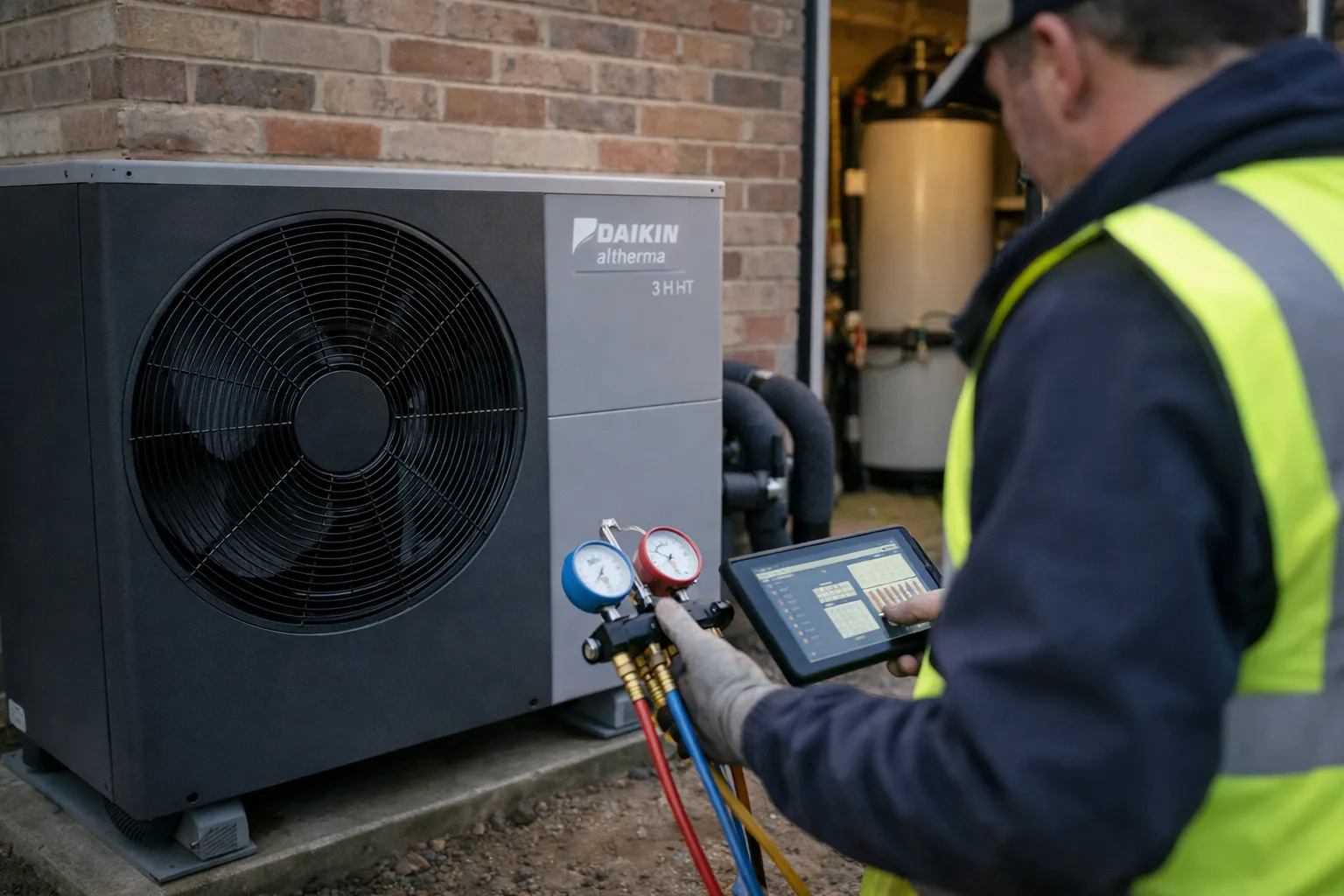
The Daikin Altherma 3 H HT Monobloc is a factory‑sealed outdoor air‑to‑water heat pump built to deliver higher flow temperatures (suitable for many radiator systems) while keeping refrigerant handling offsite. This November 2026 update revisits the product’s hardware, recent firmware and market developments, real‑world performance trends through 2024–26, installation lessons learned, updated cost expectations, and when it still makes sense versus alternatives.
Key specs at a glance
- Type: Monobloc air‑to‑water heat pump (outdoor refrigerant circuit, indoor hydronic connection)
- Typical use case: High‑temperature retrofit (radiators, existing DHW loops)
- Capacity brackets commonly offered: small to medium residential (nominal packages typically cover ~6–16 kW capacity bands; confirm model for exact kW)
- Controls: factory controls with cloud connectivity, BMS interfaces (Modbus/Modbus‑TCP on many models)
- Installation: hydronic-only refrigerant-free inside; buffer/mixing recommended
Background — who makes it and who it’s for
Daikin is a global HVAC manufacturer with broad heat‑pump and VRF portfolios. The Altherma 3 H HT Monobloc sits in its high‑temperature range aimed at residential and light‑commercial retrofits where owners prefer to retain existing radiators or hot‑water distribution without a full emitter upgrade. Since the product’s initial market push, adoption has been strongest in regions with subsidy programs for building electrification and in markets where installers prefer sealed refrigerant packages.
Features analysis — what’s new in 2026
- Controls and grid integration: From 2024–26 the industry shifted toward smarter grid‑aware controls. The Altherma’s control stack now commonly supports vendor cloud scheduling and basic demand‑response integration with tariffs and third‑party EMS platforms. Practical result: many systems can time thermal production around cheaper or lower‑carbon hours.
- Improved low‑temperature behavior: Daikin and competitors have rolled incremental firmware and compressor control changes that improve capacity retention at cold ambient temps (better inverter ramping and adaptive defrost). These changes help reduce reliance on fossil backup during short cold snaps, but do not eliminate the physical COP penalty of high supply temperatures.
- Refrigerant and regulatory context: Global F‑gas and low‑GWP policies have accelerated manufacturer product‑planning. By late 2026, many suppliers are offering lower‑GWP options across their ranges; however, the specific refrigerant for any given Altherma 3 H HT model should be confirmed on the product label and in project spec sheets, because allowable refrigerants and national rules vary.
- Hydronic options: Daikin’s recommended system layouts now more strongly emphasize buffer tanks, thermostatic mixing, and point‑of‑use TRVs (thermostatic radiator valves) to maximize occupant comfort while protecting compressor cycles.
Field performance and efficiency — updated expectations
The core performance tradeoffs remain unchanged: a high‑temperature heat pump can deliver radiator‑suitable flow temperatures, but COP declines as supply temperature and outdoor cold increase. Updated practical guidance:
- Expect realistic COPs in the mid‑2s to low‑3s when operating at 55–60 °C supply under moderate ambient conditions; seasonal performance depends heavily on how often the unit operates at elevated supply temps.
- Modern control and inverter advances have improved part‑load SPFs modestly versus early 2020s units; gains are most visible when systems are sized to favor longer part‑load runs and when buffer volumes or thermal stores are used.
- Cold‑climate performance has improved via adaptive defrost and control tweaks, but in regions with extended periods below −10 °C plan for hybridization (boiler backup or cascade units) or slightly oversizing to protect comfort and resilience.
Installation realities and serviceability — what installers report in 2026
- Monobloc benefit: the sealed outdoor refrigerant circuit continues to simplify site compliance and reduce on‑site refrigerant work and leak risk.
- Noise and siting: the outdoor footprint and acoustic signature remain important constraints in dense urban infill. Use manufacturer decibel data and local setback rules during site selection; vibration‑isolating pads and acoustic enclosures are common mitigations.
- Buffer sizing and mixing: industry practice in 2026 commonly uses rule‑of‑thumb buffer volumes of roughly 10–15 liters per kW of heat pump capacity to avoid short cycling; always confirm with Daikin’s model‑specific guidance.
- Commissioning and controls tuning: proper flow‑rate setup, pump staging, outdoor reset curves, and defrost tuning materially influence seasonal performance. Expect to log and retune controls after the first winter; remote monitoring makes this practical for most contractors today.
- Service network and training: the installer workforce is still scaling. In many markets Daikin and industry groups expanded training since 2023; confirm certified local support before specifying.
Pricing and value — Nov 2026 perspective
Equipment and installed costs vary by market, capacity and project complexity. As a practical yardstick for Western Europe in late 2026 (confirm local quotes):
- Equipment‑only list prices for commonly used Altherma 3 H HT capacities (small residential bands) typically range in the low‑to‑mid thousands of euros; higher‑capacity units and ancillary modules are priced higher. (Always request current list prices from Daikin distributors.)
- Turnkey installed systems — including buffer tank, mixing, controls integration and commissioning — commonly run from roughly €13,000 to €25,000 for typical single‑family retrofit projects in Western Europe, depending on distribution upgrades required. Projects with significant radiator work or complex DHW integration can exceed that range.
- Warranty and service terms: standard manufacturer warranties cover parts and control electronics; extended compressor warranties are commonly available when the system is registered and covered under a maintenance contract — verify exact terms at point of sale.
Value proposition: the Altherma reduces onsite combustion emissions and can leverage lower‑carbon grid electricity. Payback depends on local energy prices, available subsidies/incentives, and whether the project avoids costly radiator upgrades. Seek local subsidy details (national electrification grants, tax credits) before sizing the business case.
Pros and cons — updated checklist
- Pros: Reliable monobloc architecture; proven for radiator retrofits; improved controls and grid‑aware features by 2026; reduced on‑site refrigerant handling; established service ecosystem in many markets.
- Cons: Inherent COP penalty at high supply temps; may still require radiator/upgrading for optimal comfort and efficiency; outdoor footprint and noise limits in dense urban locations; warranty and refrigerant considerations vary by market and model.
Who should specify the Altherma 3 H HT Monobloc?
Best fits:
- Residential and light‑commercial retrofit projects where replacing or re‑sizing emitters is impractical or cost‑prohibitive.
- Clients who prioritize sealed‑refrigerant equipment to minimize on‑site refrigerant handling and to simplify code compliance.
- Projects that can incorporate buffer volume, weather compensation, and staged backup for resilience in cold snaps.
Less suitable:
- New builds designed around low‑temperature distribution; a low‑temp heat pump with oversized emitters will generally give better seasonal performance.
- Regions with long, sustained extreme cold unless hybrid backup or cascade designs are included.
Alternatives to consider (brief)
- Mitsubishi Electric Ecodan High‑Temp offerings: strong dealer network in several markets; competitive for radiator retrofits with different control philosophies.
- Viessmann/Bosch high‑temperature models: often packaged with strong DHW integration and well‑documented hybrid control options.
- Low‑temperature heat pumps + emitter upgrades: where you can afford radiator replacement or underfloor heating, these options typically deliver higher seasonal efficiency and lower operating costs.
Verdict
Through 2026 the Daikin Altherma 3 H HT Monobloc remains a leading practical choice for electrifying buildings that must retain higher‑temperature hydronic distribution. Firmware and controller improvements have nudged performance upward and made integration with tariff and demand‑response services easier, but the fundamental physics remain: higher supply temperatures lower COP. Specify it when the project constraints demand a high‑temp solution, plan for buffer and mixing circuits, confirm refrigerant and warranty details for your market, and budget for a commissioning and first‑winter tuning period.
What is the typical buffer tank size for Altherma 3 H HT installations?
Industry practice in 2026 commonly uses 10–15 liters of buffer volume per kW of installed heat‑pump capacity as a starting point to prevent short cycling. This is a rule‑of‑thumb; confirm Daikin’s model‑specific minimums and adjust for system dynamics, DHW demands, and control strategies.
Do I need a hybrid boiler with this unit in cold climates?
Not always, but in regions with prolonged temperatures below −10 °C or where uninterrupted comfort is essential, hybridization (condensing boiler or electric resistance backup) is prudent. Improved controls can delay and minimize backup usage, but plan for backup in project economics and control sequences for resilience.
Has Daikin changed refrigerants for the Altherma 3 H HT by 2026?
Manufacturers have been adjusting refrigerant choices in response to evolving F‑gas and low‑GWP policies. Daikin’s product lines have evolved too, but refrigerant types can vary by capacity and regional model—always verify the refrigerant listed on the unit datasheet and with your distributor before specification.
How important is commissioning for seasonal performance?
Crucial. Proper flow rates, outdoor reset curves, antifrost sequencing, and anti‑short‑cycling settings materially affect efficiency and comfort. Log water and power data through the first winter and retune controls rather than accepting factory defaults.