
Overview
We revisited the ecobee Smart Thermostat Premium for August 2026 to reflect recent grid programs, interoperability progress, and changing installer experience. The Premium remains ecobee’s top consumer model: a Wi‑Fi thermostat with built‑in voice, room sensors, and integrated indoor‑air‑quality (IAQ) trend reporting designed for homeowners who want room‑by‑room comfort and practical IAQ nudges without moving into commercial building controls.
- Type: Wi‑Fi smart thermostat with on‑device voice, remote SmartSensors, and IAQ trend monitoring
- Key draws: included SmartSensor, clear glass display, sensor‑weighting logic, and broad HVAC compatibility
- Best fit: Houses with uneven rooms, heat‑pump staging needs, or owners who value IAQ visibility + participation in utility programs
- Typical price (Aug 2026): US$249–$299 for the thermostat; SmartSensors commonly US$59–$99 each depending on promotions and bundles
Background
ecobee still occupies the practical middle ground between low‑cost smart thermostats and professional building controls: reliable HVAC wiring support, a mature remote‑sensor strategy, and an app designed for households. Since mid‑2025 three market shifts have increased the Premium’s potential — and also its conditionality:
- Utility and grid‑interactive programs expanded into more U.S. territories in 2025–2026, making enrollment credits and rebates more widely available.
- Public concern about wildfire smoke and indoor pollutants remains elevated; more homeowners look for IAQ signals from everyday devices.
- Interoperability standards (Matter/Thread) have progressed into broader device support, raising longevity questions for single‑vendor ecosystems.
Those trends change the Premium’s ROI depending on whether you actually enroll in utility programs, deploy multiple SmartSensors, and anticipate keeping the device for several years.
Features Analysis
Hardware, display, and daily use
The Premium’s glass display and bold UI remain practical advantages: clear icons, large fonts and visible status help families and installers quickly assess operating mode and fan status. For troubleshooting—especially during seasonal HVAC adjustments—the visible operating state saves time compared with hidden, menu‑driven interfaces.
SmartSensors: where the value accumulates
ecobee’s SmartSensor strategy continues to be the principal differentiator in everyday comfort. Since winter 2025 manufacturers have pushed modest sensor price promotions; as of August 2026 you can often find single sensors for US$59–$79 in bundles. Practical guidance:
- Start by thinking in terms of problem rooms, not square footage. One extra sensor often fixes an upstairs/downstairs complaint; two to four sensors are typical for most 2–4 bedroom homes.
- Mount sensors at seated head height away from exterior walls and registers. Use sensor weighting for sleep/away profiles instead of a single averaged reading.
- Track results for 2–4 weeks before adding more sensors—many comfort issues are resolved by adjusting weighting and schedules rather than continuously adding hardware.
HVAC compatibility and installation realities
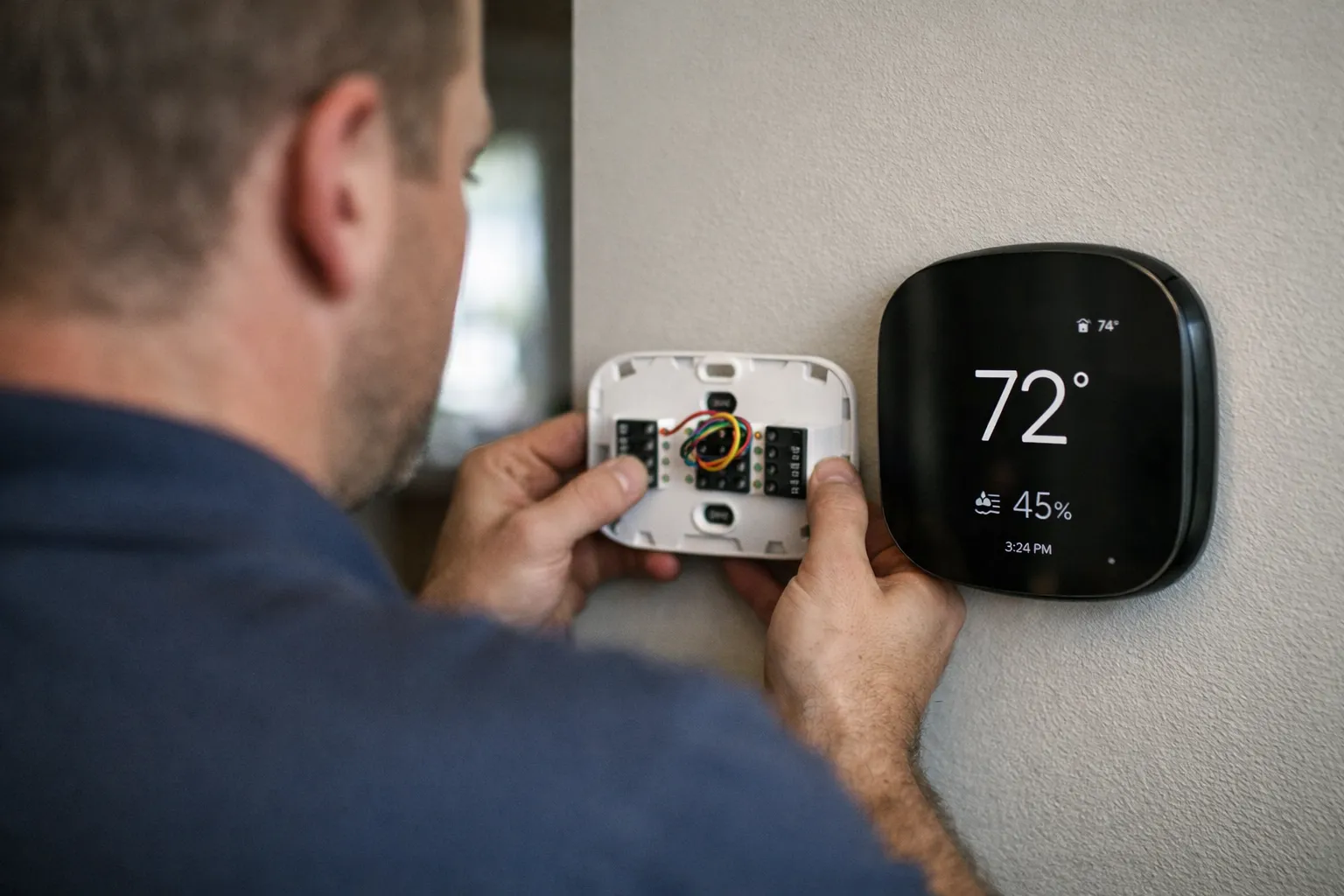
The Premium supports common residential systems including conventional forced‑air, multi‑stage systems, and heat pumps with aux heat. That said, installers and experienced DIYers report that wiring complexity remains the main friction point. Two common cost drivers:
- Lack of a C‑wire or nonstandard terminal labeling on older equipment—expect to pay US$100–$250 if you hire a pro to add or adapt wiring.
- Accessory devices (humidifiers/dehumidifiers, ventilators, zoning dampers) often require additional configuration that pushes installers beyond a standard thermostat swap.
Document your existing control wiring (label wires, take photos) before you swap devices—doing so reduces shop time and surprises.
IAQ monitoring—practical, not diagnostic
The Premium’s IAQ sensors are still directional: they flag trends in PM, humidity and VOC‑related indicators rather than providing lab‑grade concentrations. In 2026 that role is more useful because many homeowners use IAQ nudges to decide whether to ramp filtration, run ventilation, or buy a dedicated monitor. If persistent poor readings appear, purchase a calibrated PM2.5 or CO2 meter before making health decisions.
Smart‑home integration and standards
Matter and Thread support has progressed through 2025–2026; ecobee’s platform now works more predictably in mixed ecosystems than two years ago, but the practical impact depends on your broader smart‑home choices. For HVAC owners, reliable automations—sensor weighting, geofencing and schedule behavior—still matter more than voice or novelty integrations. If you plan to lean into Matter devices, check current compatibility and firmware notes before buying.
Energy features and utility programs
From an ROI perspective, the Premium’s financial case often hinges on utility incentives. By mid‑2026 many utilities offer rebates (commonly US$50–$150) for smart thermostats and additional enrollment credits or bill credits for demand‑response participation. These programs materially change payback calculations; in some territories a rebate plus a seasonal credit can reduce net cost by 30%–60% over two years. Always confirm program terms and opt‑out rights before enrolling.
Pros and Cons
Pros
- Best‑in‑category sensor strategy for multi‑room comfort when sensors are used thoughtfully.
- Clear, practical UI saves time for households and installers during setup and troubleshooting.
- IAQ trend visibility that nudges behavior during smoke or humidity events.
- Broad HVAC compatibility for most residential systems when installation is correct.
Cons
- Total system cost: adding 2–3 sensors and professional installation can push out‑the‑door costs into the US$350–$500 range.
- Wiring risk: complex heat‑pump staging and accessory control still often need a technician.
- IAQ limits: thermostat sensors are trend indicators; they’re not a substitute for dedicated, calibrated IAQ instruments.
Pricing / Value
As of August 2026 the Premium commonly retails for US$249–$299. SmartSensors are frequently priced between US$59–$99 depending on bundles and promotions. Add professional installation if you lack a C‑wire or have multi‑stage equipment—plan US$100–$250 depending on local labor. Remember to subtract any utility rebate or enrollment credits when you calculate net cost.
How to evaluate value (practical):
- Add purchase cost + projected sensor and install costs.
- Subtract known rebates and enrollment credits (check your local utility website).
- Estimate the dollar value of avoided discomfort or service visits—be realistic and conservative.
- Decide whether the Premium solves a persistent, costly problem (uneven sleeping areas, staging issues) without expensive mechanical work—if yes, ROI is reasonable.
Who It’s For
- Homeowners with two‑story or uneven thermal profiles who want targeted room comfort without ductwork changes.
- Heat‑pump households that need better staging logic and sensor‑driven occupancy control—provided wiring is verified or a pro is hired.
- Households in smoke‑prone or high‑humidity areas that want integrated IAQ trend visibility in daily controls.
- Smart‑home users who prioritize reliable automations and sensor weighting over novelty voice features.
Alternatives
- Google Nest Learning Thermostat (current gen): Elegant design and tight Google ecosystem ties; simpler sensor strategy—ecobee still leads for weighted multi‑sensor setups.
- Resideo/Honeywell Home T‑Series (T9/T10 variants): Installer‑friendly hardware commonly used by contractors; practical for complex systems with pro setup.
- Wyze Thermostat / budget models: Lower upfront cost for even‑temperature homes where sensors and advanced staging aren’t required.
Verdict
The ecobee Smart Thermostat Premium remains one of the most practical high‑end residential thermostats in August 2026 for homeowners who need a sensor‑driven approach to comfort and useful IAQ nudges. Its real‑world value depends on two things: whether you deploy at least one additional SmartSensor and whether you can access local utility rebates or enrollment incentives. If your home is thermally even, you don’t plan to use sensors, or you can’t access local incentives, cheaper alternatives will deliver most of the basic savings.
Recommendation: Consider the Premium if you have persistent room‑by‑room comfort problems or IAQ concerns that matter to you. Before buying, check your utility rebate and demand‑response terms, verify wiring, and plan a short monitoring period after installation to tune sensor weighting rather than immediately buying more hardware.
Frequently asked questions
Do I need a C‑wire for the ecobee Smart Thermostat Premium?
In most cases yes—the Premium expects a stable low‑voltage power source. ecobee provides guidance and some bundles include power‑adapter options, but if you don’t have a C‑wire or your HVAC control panel uses nonstandard terminals, expect either a small adapter or a technician visit. For heat pumps and accessory controls, professional wiring is commonly recommended.
How many SmartSensors will I actually need?
Start by identifying problem rooms. For many 2–3 bedroom homes, the included sensor plus one additional sensor resolves the most painful complaints. Larger or multi‑zone homes often benefit from three to four sensors. Monitor for 2–4 weeks after initial setup and tweak weighting before purchasing more sensors.
Are the IAQ readings reliable for health decisions?
No—treat the thermostat’s IAQ outputs as trend indicators. They’re useful for prompting ventilation or filter upgrades, but if you need diagnostic‑grade PM2.5, CO2, or VOC data for health decisions, buy a dedicated calibrated monitor.
Will enrolling my thermostat in a utility program hurt comfort?
Most utility programs limit interventions to short, modest setpoint shifts during peak events and allow event opt‑outs. If you’re highly sensitive to temperature changes, read program terms carefully; many programs include financial incentives that offset the inconvenience for most participants.
Has Matter/Thread support changed the value proposition?
Matter/Thread progress through 2025–2026 has improved cross‑vendor interoperability, which reduces lock‑in concerns for some buyers. For HVAC control and sensor weighting, platform reliability matters more than voice or lighting integrations—so confirm current firmware compatibility if you plan a Matter‑centric smart home.