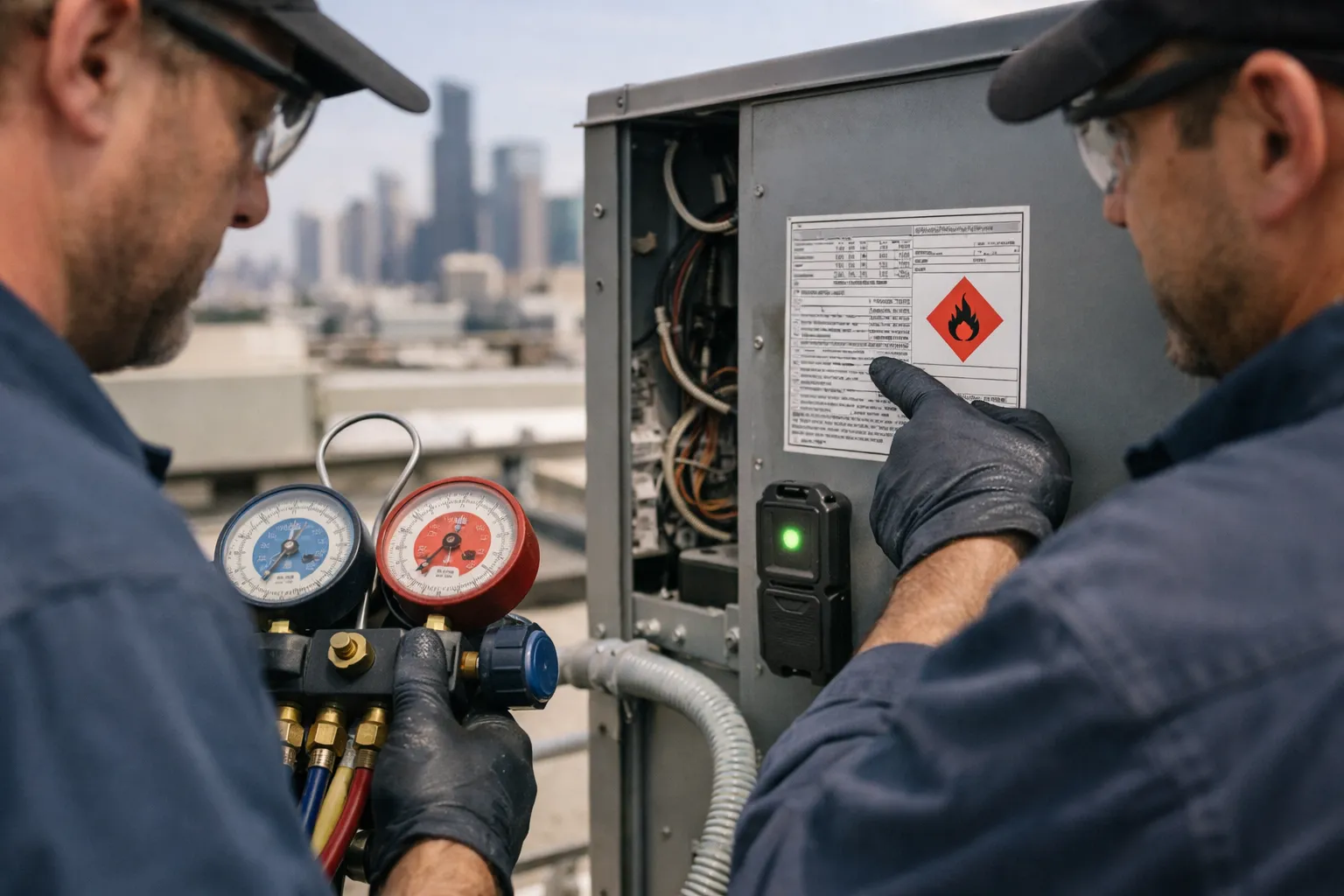
Who: commercial HVAC contractors, OEMs, building owners, AHJs and insurers.
What: an update on the continuing, uneven U.S. transition to mildly flammable, low‑GWP “A2L” refrigerants (e.g., R‑454B, R‑452B and similar blends) for commercial rooftop units, heat pumps and chillers.
When: November 2026 — summarizing developments from late 2024 through 2026.
Where: nationwide, with pronounced variance among states and municipalities.
Why: A2Ls reduce lifecycle greenhouse‑gas emissions compared with legacy HFCs and are a practical compliance route under federal phasedown goals; but their mild flammability requires updated codes, permitting and field practice.
Context: why this still matters in 2026
Adoption of A2L refrigerants remains central to industry decarbonization plans and to compliance with phasedown policies shaping HVAC manufacturing and procurement. ASHRAE 34 continues to classify A2L blends as Group A2L (lower toxicity, mild flammability), and practical deployment depends on concurrent updates to mechanical, fire and electrical codes plus clarified AHJ interpretations.
What’s changed since August 2026
- Manufacturing momentum: Major OEMs have expanded commercial product lines with factory‑charged A2L options or modular, field‑convertible platforms. That has increased equipment availability for new builds, although retrofit‑specific A2L kits remain more limited in scope.
- Permitting clarity but not uniformity: Several larger jurisdictions published AHJ guidance templates and checklists in 2025–2026 that reduced initial permit turnaround by standardizing required documentation (charge tables, ventilation calculations, technician certifications). However, many mid‑sized and smaller jurisdictions still lack clear written guidance, maintaining inconsistent review outcomes.
- Training scale‑up: Vendor and trade association programs scaled up A2L hands‑on and virtual training; third‑party credentialing options expanded to include moduleized assessments for leak detection, ventilation testing, and hot‑work control. Uptake is uneven—contractors in early‑adopter states report near‑universal certification, while many regions still show limited technician coverage.
- Insurance and underwriting: Insurers have begun publishing conditional endorsements for A2L installations—often requiring continuous leak detection, verified ventilation, and documented commissioning. These endorsements reduced blanket refusals but increased pre‑installation documentation requirements.
Specific, actionable developments and examples
On projects completed in 2025–2026, common patterns emerged:
- Early AHJ engagement cut permit review time by weeks where permit offices maintained written A2L checklists; projects that did not submit complete technical packages saw multiple resubmissions and stop‑work risks.
- Charge‑reduction engineering—using multiple smaller circuits, secondary glycol loop chillers, or remote condensers—was applied in close to half of retrofit projects that otherwise exceeded local charge limits, according to contractor reporting across several regional consortia.
- Continuous electrochemical and metal‑oxide sensor networks with cloud monitoring became standard for high‑occupancy facilities; these systems are increasingly tied to insurer requirements as part of conditional coverage language.
Why the patchwork persists
Three forces keep the landscape fragmented:
- Model code cycles and local adoption lag. Model codes (ICC, NFPA) and standard updates move on multi‑year cycles; jurisdictions adopt them on different timetables and with local amendments.
- AHJ risk‑management divergence. Local AHJs balance fire, mechanical and building code objectives differently—some opt for prescriptive acceptance of OEM documentation, others require site‑specific risk assessments.
- Variable training density. Where technician certification and documented experience are common, AHJs are more comfortable issuing permits; where certified personnel are scarce, AHJs tend to apply conservative restrictions.
Practical recommendations — what to do on jobs now
The following are concrete steps HVAC professionals and building owners should take on commercial projects today:
- Submit a full technical package with permit applications. Include OEM charge tables, ventilation and flammability risk calculations, material compatibility data, technician credentials, continuous‑monitoring plans and commissioning checklists.
- Engage the AHJ before procurement. Get a written determination on allowable refrigerant groups, charge limits, and required mitigations (e.g., ventilation, explosion‑venting, ignition‑source controls).
- Design for reduced charge density. Evaluate multi‑circuit systems, secondary loops or remote condensing to keep per‑enclosure charges below restrictive thresholds.
- Standardize detection and remote monitoring. Install continuous leak sensors tied to automated alarms and remote telemetry. These systems shorten AHJ and insurer approval cycles and materially reduce response time to leaks.
- Document training and SOPs. Keep technician A2L credentials current and on‑file; use jobsite safety plans that list hot‑work controls, spark‑proof tooling, ventilation verification and emergency response steps.
- Talk to insurers early. Obtain pre‑installation confirmations and, if required, a conditional endorsement that lists verifiable mitigations to maintain coverage.
Impact and who is affected
Owners of retail centers, schools, multi‑tenant office buildings and hospitals face the most immediate operational decisions because of occupancy consequences and insurer scrutiny. Contractors and design firms must invest in engineering to meet differing local limits. Manufacturers will continue to broaden A2L‑ready portfolios, but market penetration will track code adoption and retrofit complexity.
Reactions from the field
Field engineers report that projects with pre‑approved AHJ letters and documented continuous detection systems pass inspections with markedly fewer conditions. Conversely, projects that rely on end‑of‑job mitigation retrofits face schedule slippage and higher costs. Insurers say they are open to conditional coverage when objective verification—such as sensor telemetry and commissioning test data—is made available.
What to watch next
- Model code updates and the next ICC cycle expected in 2027–2028, which will shape broader harmonization.
- Expansion of standardized AHJ checklists and permit templates—watch for state building departments to publish model forms through 2027.
- Broader insurer market acceptance as claims data (or lack thereof) accumulates; insurers will refine endorsement language based on loss experience tied to A2L use.
Frequently asked questions
Are A2L refrigerants allowed everywhere in the U.S. now?
No. A2Ls are increasingly accepted for new commercial equipment in many jurisdictions, but not uniformly. Approval depends on local code adoption, AHJ interpretations and project‑specific factors, such as charge amount and occupancy.
What documentation should I include with a permit application?
Provide the OEM’s A2L charge tables, ventilation calculations, detailed piping and mechanical drawings showing circuit segmentation, technician certifications, continuous leak‑detection plans, and a commissioning checklist with accept/reject criteria.
Can retrofit projects simply swap in A2L refrigerants?
Rarely without modification. Retrofits often bump into local charge limits or require ventilation and ignition‑control upgrades. Engineering to reduce charge density or adopt secondary loops is commonly necessary.
How should insurers be involved?
Engage insurers early. Many will issue conditional endorsements that specify required mitigations—continuous detection, verified ventilation, documented commissioning—to maintain coverage for A2L installations.
What training should technicians have?
Technicians should complete vendor and industry A2L handling courses covering leak detection, ventilation testing, hot‑work protocols, electrical bonding/grounding practices and emergency response. Maintain documented credentials and job‑specific SOPs on site.