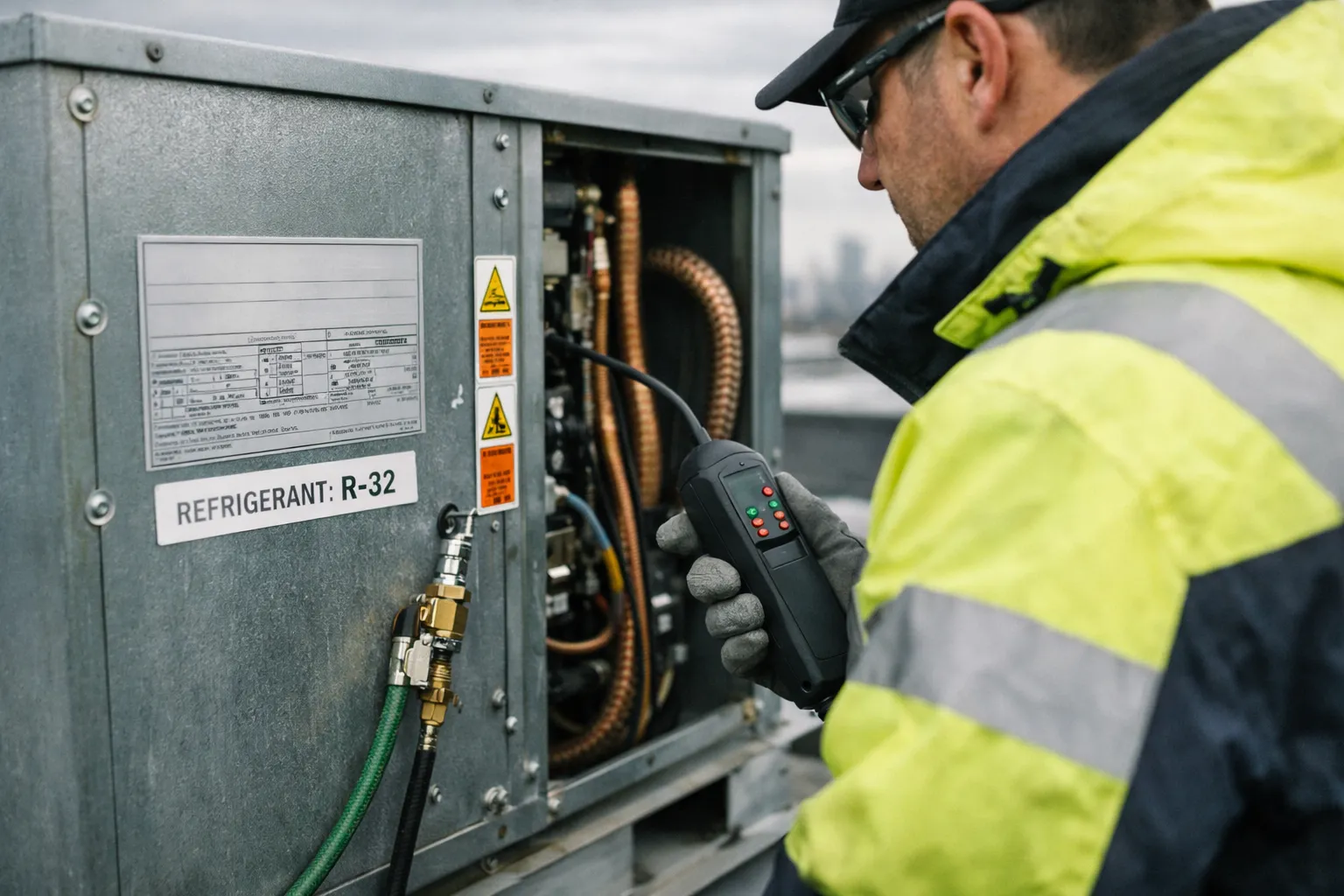
Who: HVAC technicians, contractors and facility managers working on commercial rooftop units, packaged systems and equipment rooms.
What: An updated, practical guide to handling A2L (mildly flammable, low‑GWP) refrigerants in commercial HVAC as of July 2026.
When & Where: July 2026 — U.S. commercial projects and jurisdictions where factory‑charged A2L equipment and dedicated A2L models have moved beyond pilots into mainstream project specifications.
Why this matters: A2L refrigerants (examples: R‑454B blends and R‑32) offer materially lower global‑warming potential versus legacy HFCs, but they require disciplined safety practices, approved equipment and up‑to‑date permitting to manage mild flammability risks.
Context: how we got here and why July 2026 is a turning point
Since early 2025 the HVAC supply chain accelerated development of A2L‑capable commercial products. By mid‑2026 a clear pattern emerged: more OEMs are shipping factory‑charged packaged systems, AHRI member manufacturers publish A2L service bulletins, and local authorities are issuing repeatable permitting pathways rather than ad‑hoc approvals. That alignment — manufacturers, standards committees and AHJs — has shortened the timeline from pilot projects to routine specification of A2L options on many design bids.
This shift reflects two driving forces. First, climate and efficiency policy continues to push down refrigerant GWP in commercial equipment; A2Ls commonly cut GWP by 60–90% compared with R‑410A. Second, manufacturers prefer factory charging and closed‑loop testing to reduce on‑site refrigerant handling and associated risk.
Key developments since April 2026
- Factory‑charged commercial models moved from selective release to broader regional availability in Q1–Q2 2026; several national distributors report consistent shipments into healthcare and education projects.
- Major OEMs have published A2L service and retrofit policies. Those bulletins commonly prohibit field conversion of R‑410A packaged systems to A2L refrigerants unless the OEM explicitly approves the unit and issues a retrofit kit and procedure.
- Standards bodies — notably ASHRAE committees and UL/CSA working groups — continued refining test methods for component qualification, ventilation requirements and charge‑limit methods; AHJs are increasingly adopting those references in local code interpretations.
- Training programs expanded: vendor‑specific A2L courses, combined hot‑work and ventilation modules, and updated emergency response briefings are now regularly offered through manufacturers and trade associations.
What this means for technicians — updated, actionable guidance
Technicians will see more factory‑charged A2L equipment and must update daily work habits accordingly. Four practical implications:
- Site verification before touching refrigerant circuits. Always check the unit dataplate and the OEM service bulletin. Factory labels and documentation identify A2L service. If documentation is missing, delay work until the refrigerant is confirmed.
- Hot‑work and brazing controls are stricter. Use NFPA 51B hot‑work permits and confirm ventilation rates specified by the manufacturer. Avoid oxygen‑rich brazing atmospheres; when purging with nitrogen, follow OEM purge‑out procedures to keep flammable mixture levels below ignition thresholds.
- Right‑rated tools and detectors. Use intrinsically safe or explosion‑protected leak detectors and gas sensors rated for A2L mixtures and for the applicable electrical classification (for example, equipment acceptable in Class I, Division 2 or Zone 2 locations). Standard HFC‑only identifiers are inadequate.
- Training + documentation equals defensible practice. Ensure technicians have completed OEM A2L modules, understand confined‑space controls for equipment rooms, and carry updated emergency and shutdown procedures on site.
Practical checks before you start work
- Confirm refrigerant identity on the unit dataplate and cross‑check the OEM service bulletin or product manual.
- Verify the jobsite hot‑work permit, confirm required ventilation (manufacturer may specify air changes per hour or ppm thresholds) and ensure gas‑detection consoles are operational.
- Use A2L‑rated leak detectors and purge procedures; do not attempt field retrofits unless the OEM provides an approved kit.
- Coordinate electrical lockout/tagout and ensure controls (including ventilation interlocks) conform to NEC and local AHJ expectations for potentially flammable gases.
Codes, approvals and retrofit boundaries — what AHJs and owners are doing
Across jurisdictions, the consistent pattern is caution plus clarity: A2Ls are permitted where code language and AHJ interpretation provide specific charge limits, ventilation and detection requirements. Key points for contractors:
- Factory‑charged units often receive streamlined acceptance because OEM factory processes are easier for AHJs to evaluate than field‑charged systems.
- Many AHJs require leak detection and automatic ventilation interlocks in enclosed equipment rooms; open‑air rooftop packaged units may be treated differently depending on rooftop enclosure, rooftop parapet and occupancy.
- Retrofitting R‑410A packaged equipment to an A2L is widely discouraged and, in most cases, prohibited by OEM warranty terms unless a manufacturer retrofit path exists.
Market and procurement updates
Specifiers increasingly include A2L options on RFPs for new construction and major replacements. Procurement teams should:
- Itemize A2L‑specific costs: training, intrinsically safe detectors, upgraded ventilation controls and AHJ plan approvals.
- Request OEM service bulletins and retrofit policies during bid evaluation to avoid later warranty disputes.
- Track parts‑of‑record: compressors, controls and sensors are sometimes different or have higher ratings for A2L service.
Incident prevention and emergency response
Although A2L refrigerants are classified as mildly flammable, incidents remain uncommon when systems are installed, commissioned and maintained per manufacturer guidance. Practical prevention steps that facility teams should adopt:
- Continuous or scheduled leak detection in enclosed spaces and ducted plenums tied to building automation or safety interlocks.
- Automatic ventilation interlocks that prevent system start until safe gas concentrations are confirmed.
- Clear, accessible emergency response plans and shut‑offs for first responders that identify refrigerant hazards and equipment locations.
Preparing your crew: a July 2026 checklist
- Audit your fleet to identify factory‑charged A2L units, A2L‑ready assets and equipment explicitly incompatible with A2L retrofits.
- Enroll technicians in OEM A2L training and refresh EPA Section 608 certification and NFPA hot‑work awareness.
- Upgrade leak detection, refrigerant identifiers and hot‑work PPE to A2L‑rated items and ensure electrical classification compatibility.
- Engage AHJs early on projects to confirm local code interpretations and expedited permitting steps.
Impact: who is affected and how
Technicians, contractors, facility managers and project specifiers will see immediate impacts: modest up‑front costs for training and equipment, fewer field‑charging jobs as OEMs move to factory charging, and clearer permitting timelines on projects where AHJs accept A2L references. For building owners, the long‑term benefit is lower lifecycle GWP and often competitive efficiencies — provided systems are installed and maintained to the new safety baseline.
Reactions from the field
Service managers report that crews who complete vendor A2L modules are more confident and finish commissioning faster because factory‑charged systems reduce on‑site refrigerant handling. Local AHJs say repeatable permit checklists and manufacturer documentation have reduced plan review time compared with the early pilot phase in 2025.
What to watch next
- Ongoing ASHRAE and UL/CSA work on component qualification and simplified charge‑limit calculation methods.
- More OEM retrofit kits or manufacturer‑approved conversion paths for specific models (expect these to be narrowly scoped and strictly documented).
- Expanded third‑party training accreditation for A2L handling and emergency response through trade associations during late 2026.
Do I still need EPA Section 608 certification to work on A2L systems?
Yes. EPA Section 608 certification remains required for technicians who service or handle refrigerants. In addition, seek OEM A2L‑specific training and manufacturer service bulletins for model‑specific procedures.
Can I convert an existing R‑410A rooftop unit to A2L?
Generally no. Most OEMs and many AHJs discourage or prohibit converting R‑410A rooftop units to A2L refrigerants. Only follow a manufacturer‑approved retrofit kit and written approval from the OEM and the local AHJ.
What leak detection and PPE should I use?
Use intrinsically safe or explosion‑protected leak detectors and gas sensors rated for A2L mixtures and the electrical classification of the space (e.g., Class I Division 2 or Zone 2). For brazing and hot work use NFPA 51B permits, flame‑resistant PPE and ensure ventilation meets manufacturer requirements.
How do AHJs typically treat factory‑charged A2L equipment?
Many AHJs accept factory‑charged equipment more readily because the OEM controls charging and testing. Still, AHJs commonly require documentation: product manuals, factory charge records, leak‑detection plans and ventilation interlock details.
Bottom line: July 2026 is the moment to move from pilot caution to standardized practice. Technicians who verify refrigerant identity, adopt A2L‑rated tools, complete vendor training and coordinate with AHJs will service A2L systems safely and with fewer surprises.