
Overview
Two of the most-cited names in premium central cooling—Carrier’s Infinity 26 and Trane’s XV20i—remain flagship variable‑speed condensers for homeowners who want whisper‑quiet, low‑swing comfort. This June 2026 update focuses on what’s changed since spring: wider adoption of A2L refrigerants, deeper dealer A2L certification, firmware refinements that materially affect humidity and defrost behavior, and shifting incentives that make heat‑pump alternatives more attractive for many buyers.
- Product type: Top-tier inverter‑driven (variable‑speed) split‑system condensers
- Positioning: Premium part‑load comfort, low noise, improved humidity control when paired with communicating indoor components
- Best matched with: Variable‑speed indoor blower, manufacturer‑communicating controls, and documented commissioning
- Deciding factors (June 2026): Refrigerant nameplate and dealer A2L readiness, firmware revision and update process, local parts availability, and total installed commissioning scope
Background
Carrier and Trane continue to dominate the high‑end North American residential market. Since the AIM Act and SEER2/EER2 test transitions were implemented, manufacturers accelerated changes in refrigerant platforms and control software. As of mid‑2026, most manufacturers ship their highest‑efficiency condensers with lower‑GWP A2L blends rather than legacy HFCs; this has become the operational baseline, not an optional future. For buyers, the condenser is still one component of a system—match the indoor equipment and controls, and insist on professional commissioning.
Target audience: HVAC‑savvy homeowners, designers, and installers who value consistent comfort, low sound, and predictable long‑term service over simple sticker SEER figures.
Features Analysis
1) Modulation and part‑load comfort
Both units are engineered to run long at low capacity, which reduces short cycling and improves latent removal. In practice, the difference now lies primarily in software tuning and how well the outdoor unit coordinates with communicating indoor devices. Since spring 2025 both manufacturers have released firmware that smooths low‑speed behavior; homeowners are now seeing fewer brief low‑speed surges and more consistent off‑peak operation.
2) Communicating controls and ongoing firmware
Firmware is no longer an afterthought. Carrier and Trane pushed multiple firmware revisions in 2025–2026 to refine humidity profiles, adaptive compressor modulation, and defrost sequencing (the latter important where systems are heat pumps or when A2L charge procedures differ). Ask for the unit’s firmware revision at purchase and confirm whether the dealer will register the product for ongoing updates. For luxury installs, insist that firmware status be documented on the commissioning report.
3) Refrigerant reality: A2L, service workflows, and regional differences
By June 2026, A2L refrigerants (low‑GWP, mildly flammable blends such as R‑454B and similar approved chemistries) are widely used in high‑efficiency condensers. This reduces climate impact but changes service logistics:
- Require the exact nameplate refrigerant on your written quote and final invoice.
- Confirm the dealer’s A2L training credentials—manufacturers and independent bodies (for example, NATE and OEM‑delivered A2L courses) now publish training rosters; ask for technician certificates.
- Verify the dealer’s A2L tool inventory: A2L‑rated leak detectors, nitrogen regulators, dedicated recovery equipment or approved recovery alternatives, and documented ventilation procedures for service bays and attics.
- Expect that remote rural markets may still have longer lead times for A2L‑specific parts and refrigerant cylinders; urban and suburban centers are well‑stocked.
4) Humidity control and commissioning
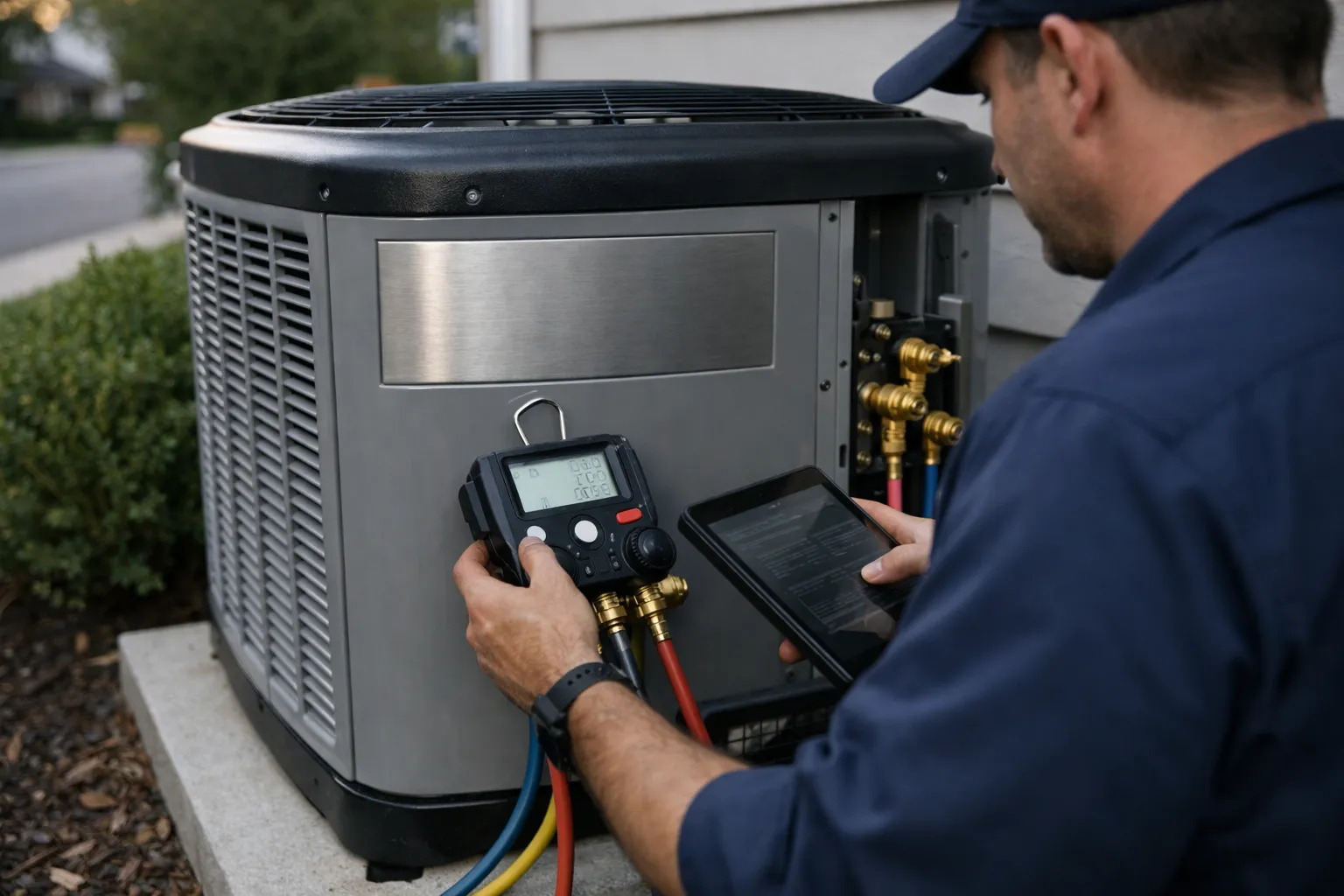
Humidity control remains a differentiator. Carrier’s Infinity ecosystem continues to emphasize humidity‑centric modes (smart dehumidification, dehumidify + airflow staging), while Trane’s platform leans on diagnostic clarity that helps technicians troubleshoot latent problems in the field. Regardless of brand, performance is contingent on precise commissioning: accurate Manual J load, duct static pressure measurement, verified airflow at the coil and critical registers, and refrigerant charge verification by manufacturer‑prescribed method (subcooling/charge by weight or pressure/temperature tables depending on the equipment).
5) Sound, siting, and real‑world performance
Both condensers remain among the quieter options, but installation details matter more than small spec‑sheet dBA differences: concrete pad isolation, anti‑vibration mounts, line‑set supports that prevent structure‑borne noise, and avoiding sound‑reflective alcoves are decisive. Ask for a night‑time low‑speed sound demonstration after commissioning and request recorded dBA measurements if quiet is a priority.
6) Diagnostics, telemetrics, and service models
Cloud‑enabled diagnostics are mature enough to be useful. Both manufacturers offer dealer portals with fault histories and trend data when connected. The luxury outcome is proactive service and less downtime—provided the dealer actively monitors and interprets the data. Request the dealer’s remote‑monitoring policy and escalation SLA in writing.
Pros and Cons
Carrier Infinity 26
- Pros: Advanced humidity management inside the Infinity ecosystem; refined low‑speed modulation with recent firmware updates; clear factory pathways for dehumidification strategies.
- Cons: Full benefit requires a matched Infinity air handler/thermostat and thorough commissioning; A2L service demands documented dealer competency; premium installed cost can be absorbed by necessary ductwork fixes.
Trane XV20i
- Pros: Robust modulation and diagnostic depth; strong field service where Trane‑specialist dealers operate; firmware and telemetric tools emphasize field troubleshooting.
- Cons: As with Carrier, performance gains depend on matched indoor equipment and certified technicians; confirm refrigerant supply and regional parts availability.
Pricing / Value (June 2026)
Installed pricing remains regionally variable but has generally stabilized since 2025 as supply chains normalized for A2L components. Typical all‑in premium system installs in June 2026 (condenser + matched coil or air handler, variable‑speed indoor blower, communicating thermostat, and documented commissioning) generally fall in these ranges:
- Carrier Infinity 26 system installs: roughly $15,000–$26,000
- Trane XV20i system installs: roughly $14,500–$25,000
Those ranges assume standard access and a single‑system replacement. At these price points, demand specific deliverables: Manual J, AHRI match certificate (or OEM equivalent), measured external static pressure, verified airflow readings, refrigerant charge documentation (method and final readings), firmware revision, and a written labor warranty. If ducts are substandard, allocate a portion of the budget to duct sealing, return improvements, and ventilation—those investments often produce larger comfort improvements than an incremental condenser upgrade.
Who It's For
Choose Carrier Infinity 26 if humidity control is a priority in your climate and you will commit to the Infinity communicating ecosystem with a Carrier‑certified dealer who will manage firmware and commissioning.
Choose Trane XV20i if you have access to a Trane specialist with strong diagnostic discipline who will use telemetrics and field data to tune performance and troubleshoot latent issues.
Consider a heat pump instead where incentives and climate make sense. Federal tax credits and expanding state/utility rebates increasingly favor electrification; in many regions a high‑efficiency heat pump will deliver comparable cooling comfort and add winter heating capability with strong running‑cost and incentive advantages. Verify local program rules before finalizing.
Alternatives
- Lennox SL28XCV: Comparable modulation and indoor comfort when properly sized; dealer networks can be more limited in some regions.
- Daikin Fit and multi‑split heat‑pump options: Useful where yard siting or noise mandates require side‑discharge or compact form factors.
- Mitsubishi / Fujitsu ductless and multi‑split heat pumps: High‑quality cold‑climate heat‑pump alternatives for zone control and electrification incentives.
Verdict
June 2026 verdict: Carrier Infinity 26 and Trane XV20i remain capable, luxury‑tier variable‑speed condensers. The largest practical differences now are refrigerant strategy and dealer readiness. With A2L refrigerants mainstream and firmware updates materially improving behavior, the most dependable route to “quiet luxury” is to buy the installer as much as the unit. Require nameplate refrigerant disclosure, documented A2L training and tools, verified commissioning (including firmware revision), and a dealer commitment to remote monitoring or a clear service SLA. Do that, and either system can deliver the steady, effortless comfort discerning homeowners expect.
FAQ
Do I need the brand’s communicating thermostat to get the benefits?
Yes. Most advanced modulation, humidity coordination, and full diagnostic visibility require a fully communicating indoor‑outdoor‑thermostat ecosystem. Confirm the AHRI match (or OEM equivalent) and make sure the thermostat is included in the contract scope.
Should I be concerned about A2L refrigerants?
Be informed, not alarmed. A2L refrigerants significantly lower GWP but require specific service practices and technician training. Before purchase, get the exact refrigerant name on the quote and written confirmation that your dealer and service plan cover A2L‑rated procedures and tools.
Is buying a top‑tier condenser a mistake if my ducts are old?
Not necessarily—but it may be the least cost‑effective path. Variable‑speed systems are sensitive to airflow and static pressure. If ducts are leaky or undersized, prioritize duct sealing, return improvements, and commissioning tests. Ask for static pressure and airflow measurements and a remediation plan as part of the proposal.
Do incentives change the calculus between a cooling‑only AC and a heat pump?
Yes. Federal tax credits and many state/utility rebates increasingly favor full electrification and heat pumps. In many regions, a high‑efficiency heat pump may qualify for better incentives than a cooling‑only condenser; check local program rules before deciding.
What should I demand to verify proper commissioning?
At minimum: Manual J load calculation, AHRI (or OEM) match documentation, measured external static pressure, verified supply airflow (CFM), refrigerant charge verification per manufacturer procedure, firmware revision recorded, and a commissioning report you keep.