Introduction — What you’ll learn and who this is for
This updated June 2026 guide walks HVAC system enthusiasts and practitioners through converting an existing commercial steam heating plant to a low‑temperature hydronic system (typical supply 120–160°F). You’ll get a practical, step‑by‑step assessment and design workflow, updated equipment and control recommendations that reflect 2026 market and policy trends, and commissioning checklists that use modern tools (IoT sensors, predictive controls). This guide is for mechanical contractors, facility engineers, and design engineers planning a phased retrofit or full replacement in small‑ to mid‑size commercial buildings.
Prerequisites and context you should know first
- Baseline data required: boiler nameplate capacities, record of operating pressures, steam/condensate piping drawings, trap inventory, and historical fuel/electric bills for at least 12 months.
- Why timing matters now (2026): utility electrification programs and federal/state incentives (including tax credits under recent federal programs) continue to increase the financial case for electrified plants and modular heat pumps. Manufacturer offerings for large commercial air‑to‑water and ground‑source heat pumps have improved capacity and low‑ambient performance since 2024, making hybrid or full‑electric conversions more viable.
- Codes and standards to check: local adoption of the 2021/2024 IECC, updated mechanical codes, and local electrification or building performance mandates. Also consult the latest ASHRAE Handbook chapters on hydronics and steam and your authority having jurisdiction (AHJ) before removing fuel‑burning equipment.
Why convert steam to low‑temperature hydronics in 2026?
Reasons remain consistent with prior practice, but the near‑term economics and technology mix have shifted:
- Improved occupant comfort and precise zone control using low‑temperature emitters and modern controls.
- Lower distribution and radiation losses with insulated hydronic piping at 120–160°F vs steam at 5–15 psig.
- Compatibility with high‑efficiency condensing boilers, modular electric boilers, and commercial heat pumps (air‑to‑water and geothermal).
- Reduced routine maintenance (steam traps, flash steam vents, boiler blowdown) and simpler water chemistry management for closed hydronic systems.
- Stronger policy and incentive environment for electrification, plus rapidly maturing heat‑pump products for commercial loads.
Initial assessment: targeted audit checklist
Before design begins, do a compact, evidence‑based audit. Gather the following:
- Plant documentation
- Boiler make/model, rated input and output (MBH), typical operating pressure and setpoints, fuel type, and stack/flue arrangements.
- Number of boilers, sequencing logic, and any recent repairs or derates.
- Distribution mapping
- Sketch main risers, one‑pipe or two‑pipe layouts, condensate return paths, flash steam vents, and trap locations/types. Photograph accessible traps and riser tagplates.
- Load inventory
- List all emitters: radiators, convectors, unit heaters, steam coils, DHW preheat, and process uses. Note any nameplate BTU ratings or measure heat output using infrared thermography during operation to estimate emitter performance.
- Operational measurements
- Record typical steam pressure during occupied hours, condensate temperatures, and recent fuel usage (therms or MBtu) for the heating season.
- Trap and riser testing
- Trap testing with portable ultrasonic or acoustic trap testers identifies leaking traps and tells you how much piping or riser work will be required.
- Space use and schedules
- Gather occupancy schedules and zone setbacks; this informs control strategies and potential for demand response participation.
Red flag items that change strategy
- Permanent process steam, sterilization, or humidification loads that cannot be cut — consider a hybrid approach.
- Extensive, inaccessible vertical risers or hazardous-material encasements (asbestos) — increases cost and may favor localized heat exchangers.
- Historic radiators with preservation constraints — plan for conversion kits or fan‑assisted retrofits rather than full removal.
Conversion strategy options — choose by risk, budget, and timeline
Pick the approach based on your audit and project goals:
- Full hydronic replacement: Remove steam emitters; install fin‑tube, fan coils, or unit ventilators with new hydronic mains. Best for long‑term efficiency and electrification.
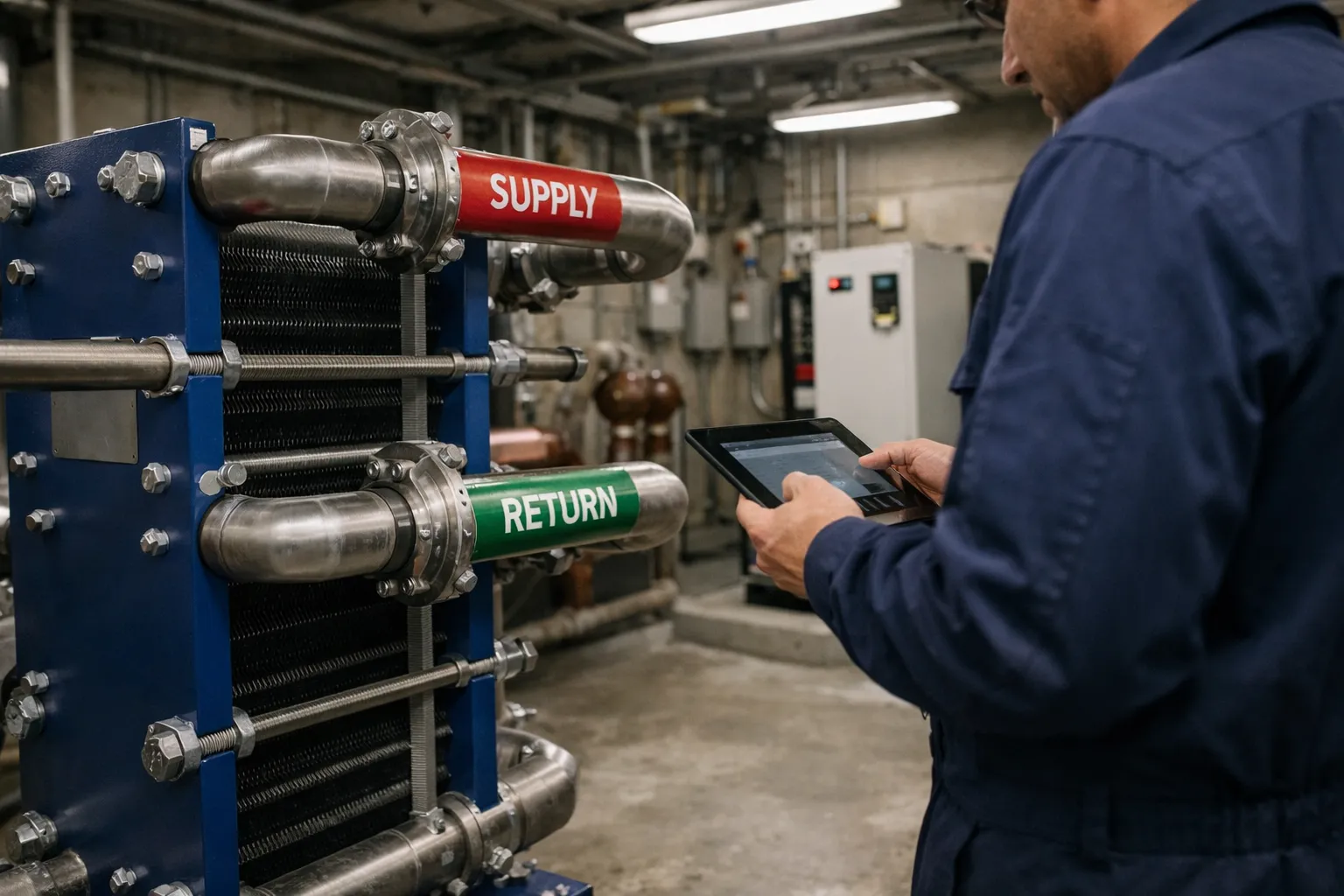
- Hybrid via heat exchangers: Retain steam plant for remaining steam needs and install steam‑to‑water plate heat exchangers to feed a modern low‑temp hydronic loop. Minimizes interruption and capital expense. Common choice in 2024–2026 municipal projects.
- Phased decoupling: Step down steam pressure and use intermediate heat exchangers while progressively converting zones. Useful when complete boiler removal must be deferred for budgetary or permit reasons.
Key design steps — practical, sequential guide
-
Calculate hydronic heating loads
Convert each steam emitter rating to hydronic Btu/hr. Use the standard hydronic flow formula:
Q (Btu/hr) = 500 × GPM × ΔT
Example: a convector rated 6,000 Btu/hr. With design ΔT = 20°F, required flow = 6000 ÷ (500×20) = 0.6 GPM. Sum emitter loads to create zone loads and whole‑plant peak load.
-
Size the hydronic plant
Sum zone loads to get peak Btu/hr. Select plant capacity and configuration:
- For condensing boilers target return temps 140°F to capture condensing efficiency gains. For long‑term electrification, size heat pumps to serve a majority of peak load with boilers or electric resistance as backup.
- Consider modular plant sizing (multiple smaller units) to achieve redundancy and staged efficiency. Common practice is to size for 80–110% of peak depending on redundancy goals and thermal storage options.
-
Decide distribution topology and piping
Prefer reverse‑return or primary/secondary piping to simplify balancing. Use variable‑speed ECM circulators with integrated pressure‑control or VFDs to minimize pumping energy. Insulate new mains to current code levels (typically R‑3 to R‑6 for mechanical rooms) and prevent unintended thermal gain in occupied plenums.
-
Emitter selection and retrofit options
Choices depend on aesthetics, space type, and budget:
- Perimeter zones: fin‑tube convectors or low‑profile fan coils (improved control and airflow).
- Interior zones: fan coils or unit ventilators tied to central supply for ventilation integration.
- Historic radiators: consider hot‑water conversion kits, internal heat exchangers, or fan‑assisted radiator retrofits when preservation is required.
-
Controls, zoning and modern strategies
2026 best practice includes:
- Zone thermostats with setback schedules and integrated occupancy sensors where appropriate.
- Outdoor reset as baseline, augmented by predictive weather‑forecast based reset or model predictive control (MPC) for large systems to reduce cycling and improve comfort.
- Integration with cloud‑capable BMS for remote monitoring, fault detection & diagnostics (FDD), and demand response participation.
-
Water quality, expansion and air management
Design a closed, pressurized system with:
- Properly sized expansion tanks (precharge checked on site) and make‑up water arrangements with backflow prevention.
- Air separators, dirt separators, and automatic air vents sized for system flow. Add magnetic separators upstream of fine control valves where corrosion products are expected.
- Documented chemical treatment plan and accessible sample ports for routine testing.
-
Condensate handling if retaining steam
If using steam‑to‑water exchangers, design condensate return and neutralization per code. Include flash recovery where possible and ensure proper pump capacity for condensate lift.
Equipment checklist (2026 market considerations)
- Modulating condensing boilers sized for low return temps, or modular electric boilers for full‑electric systems
- Commercial air‑to‑water heat pumps with low‑ambient performance (consult manufacturer data for COP at design conditions)
- Plate‑and‑frame or brazed‑plate heat exchangers (if hybrid)
- ECM variable‑speed circulators with VFDs or integrated pressure compounding
- Air separators, dirt separators, magnetic filters and automatic vents
- Expansion tanks sized to system volume and design pressure
- Flow meters and wireless submeters for zone verification and ongoing energy attribution
- Digital thermostats, outdoor reset controllers, and BMS gateways with cloud telemetry
Commissioning and verification — updated methods
Commissioning validates performance and captures lessons for operation:
- Piping pressure test: hydrostatic test per code before insulation.
- Flush, fill and treat: power‑flush debris removal, then fill with treated water. Use on‑line chemical injection for larger systems and record initial conductivity, pH and inhibitor concentration.
- Air removal and thermography: purge high points, use air separators and verify via infrared thermography to find cold spots in fin‑tube runs.
- Flow verification with wireless meters: verify GPM using existing valves, ultrasonic clamp‑on meters or in‑line flowmeters; log data to the BMS for trending.
- Control calibration and FDD baseline: calibrate outdoor reset, zone setpoints and establish FDD rules in the BMS. Capture a 48–72 hour baseline run to tune predictive control routines.
- Efficiency and energy check: compare measured fuel or electrical input to modeled output. Use meter data and submetering to separate DHW, distribution and space heating loads.
Common pitfalls and how to avoid them
- Under‑sized piping or pumps: design conservatively and verify flow during commissioning; don’t rely solely on nominal valve markings.
- Poor air management: install adequate air separators and purge points; use magnetic and dirt separators to protect control valves.
- Assuming one‑for‑one radiator replacement: vintage radiators rarely deliver the same output at lower water temps—measure and adjust emitter selection accordingly.
- Neglecting water treatment: even a closed hydronic system needs corrosion inhibitors and periodic testing to prevent premature failure.
- Permitting and venting missteps: coordinate with AHJs early—decommissioning boilers and altering flues often require witnessed inspections.
Pro tips — advanced ideas that pay off
- Install wireless submeters on critical zones during commissioning to provide immediate ROI visibility and ease balancing.
- Consider thermal storage (buffer tanks) when pairing heat pumps with existing boilers to reduce short cycling and improve COP.
- Use model‑predictive control (MPC) for buildings with large thermal mass or variable occupancy; even modest MPC implementations reduce fuel use and peak demand.
- Document and digitize as‑built drawings and O&M manuals in the cloud for facility staff access and warranty tracking.
Typical schedule and updated budget considerations (2026)
A phased approach minimizes occupant disruption. Typical sequencing and realistic durations:
- Audit and preliminary design: 2–6 weeks
- Detailed design and permitting: 4–10 weeks (permits may take longer in jurisdictions with updated electrification rules)
- Procurement: 4–8 weeks depending on modular equipment availability
- Selective demolition and piping: 2–12 weeks depending on asbestos abatement and access
- Equipment set and piping: 4–12 weeks
- Commissioning and training: 2–4 weeks
Budget guidance: hybrid heat‑exchanger projects commonly range from 30–60% of a full hydronic replacement, but costs vary with access, hazard remediation, and emitter replacement choices. Factor incentives and tax credits into your capital plan — many projects in 2024–2026 saw meaningful improvement in payback when leveraging utility rebates and federal/state programs.
Incentives, codes and safety (2026 notes)
In 2026, the policy landscape favors electrification and efficiency. Practical steps:
- Check federal tax credits and state incentives for heat pumps and energy upgrades; utilities often have prescriptive rebates for ECM pumps, high‑efficiency boilers, and controls.
- Confirm local mechanical/combustion appliance codes and AHJ requirements for decommissioning fuel‑burning equipment and terminating venting.
- Document asbestos and hazardous materials before opening ceilings or chasing old steam mains—this frequently dictates schedule and cost.
Real‑world example (updated)
Example: a 60,000 ft² municipal library originally served by 2 × 400 MBH steam boilers was converted in 2025–26 to a hybrid plant. Team decisions and outcomes:
- Retained steam plant for limited DHW and process needs; installed a 600 MBH brazed plate heat exchanger to feed a 140°F hydronic loop for space heating.
- Perimeter radiators replaced with low‑profile fin‑tube convectors; interior zones fitted with fan coils integrated to the ventilation system.
- Added two 150 kW air‑to‑water heat pumps in parallel for primary heating with the condensing boiler as backup and peak support.
- Outcome: occupant comfort improved, condensate management simplified, and facility managers reported substantially lower distribution losses and simpler routine maintenance. The project leveraged local utility rebates for heat pumps and ECM pumps to improve payback.
Final checklist before project closeout
- Steam traps repaired or abandoned and steam mains capped per AHJ requirements
- Hydronic system flushed, filled, chemically treated and documented
- Expansion tank charged and verified; strainers installed and accessible
- Flows measured and balanced; wireless meter data archived
- Controls commissioned, FDD baseline established, and building staff trained (include 30‑ and 90‑day tune‑up visits)
- Documentation handed over: as‑built drawings, sequencing narrative, maintenance schedule, and spare parts list
Common questions
Can I reuse my existing steam radiators for hydronic heating?
Sometimes. Reusing radiators is possible if you can convert them to hot‑water service (internal conversion kits or re‑piping) and accept lower emitter surface temperatures. However, historic radiators often underperform at 140°F return temps compared with their steam output. Always calculate emitter output at design ΔT and verify with infrared testing during commissioning; where output is insufficient, plan for supplemental convectors or fan coils.
When is a hybrid (heat exchanger) approach preferable to full replacement?
Use a hybrid strategy when removing the steam plant is cost‑prohibitive, when the building has limited downtime windows, or when there are unavoidable steam process loads. Hybrid systems minimize disruption, allow staged investment, and are commonly selected in buildings with difficult vertical risers or preservation constraints.
Are commercial heat pumps reliable enough for primary heating?
Yes, in many climates and building types. Since 2024, commercial air‑to‑water heat pumps have improved low‑ambient performance and are increasingly specified as primary heat sources, often paired with thermal storage or backup boilers to manage peak loads. Evaluate manufacturers’ published COPs at your design conditions and plan for redundancy and controls that prevent short cycling.
What modern tools should I budget for commissioning?
Include thermal imaging, ultrasonic trap testers, clamp‑on ultrasonic flow meters or in‑line flowmeters, wireless submeters for key circuits, and a BMS with data logging/FDD capability. Allocate budget for a 30‑ and 90‑day follow‑up tuning visit to capture issues that only appear under seasonal load changes.
Will converting reduce emissions immediately?
It depends on your fuel mix and chosen plant. Converting to low‑temperature hydronics reduces distribution losses and often reduces fuel consumption for space heating. Full emissions reductions are larger if you switch to low‑carbon electricity or heat pumps. Use utility emission factors and submeter data to quantify changes post‑commissioning.
Converting a commercial steam plant to low‑temperature hydronics in 2026 combines classic hydronic design with contemporary tools: modular equipment, heat pumps, cloud‑connected controls, and incentive programs that improve project economics. With a focused audit, clear strategy (hybrid or full replacement), conservative piping and controls design, and rigorous commissioning using modern tools, HVAC practitioners can deliver reliable, efficient heating plants that meet both operational and decarbonization goals.
For detailed load calculations and local code interpretations, engage a licensed mechanical engineer early in the process and consult the most recent ASHRAE guidance and your AHJ.