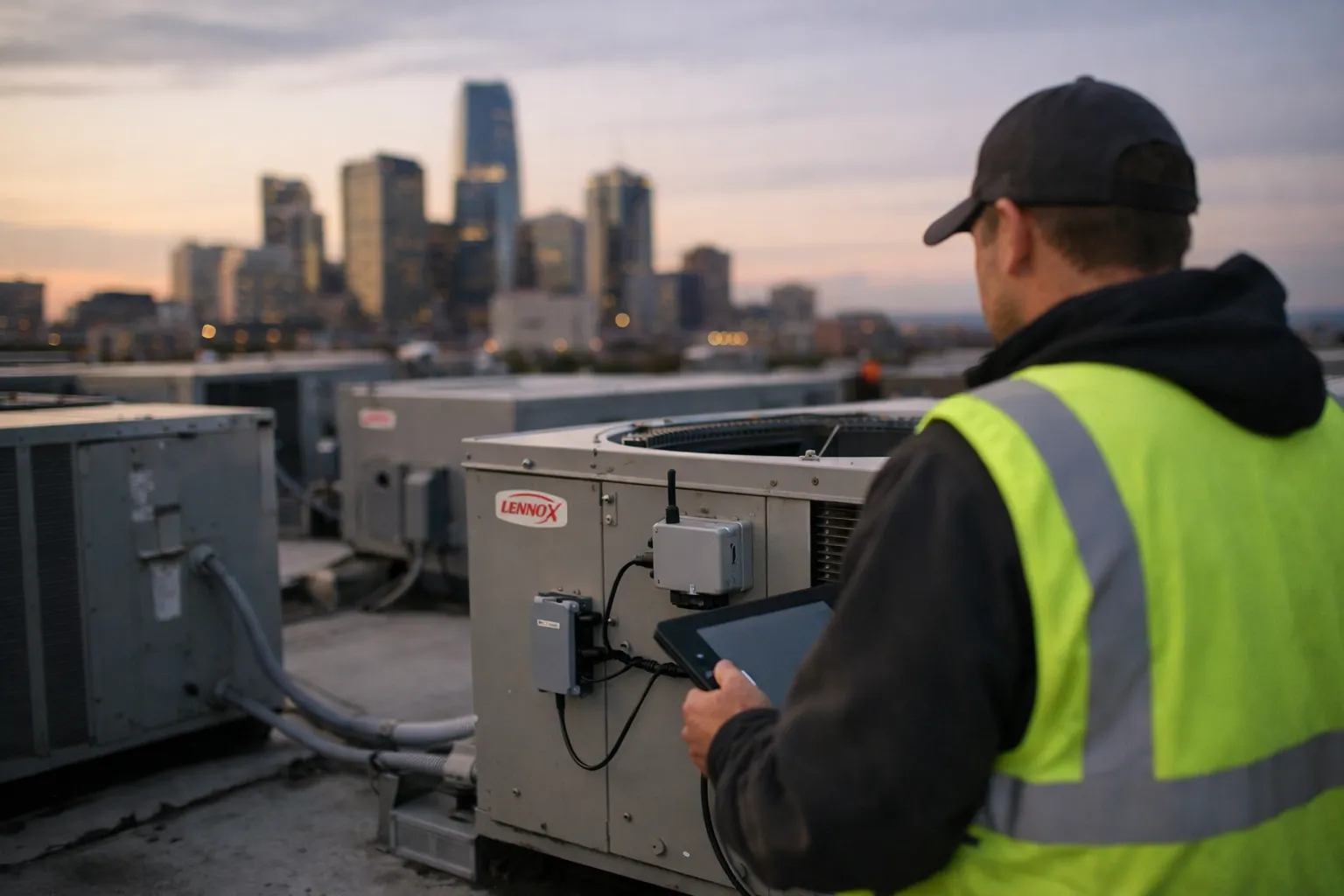
Who, what, when, where, why: On May 28, 2026, the U.S. Department of Energy (DOE) published an interim draft specification and lab verification protocol for its voluntary grid‑interactive commercial HVAC pilot, opening a 60‑day public comment window. The draft refines the agency’s March announcement by adding concrete telemetry definitions, lab test cases and reporting templates aimed at rooftop units (RTUs) and packaged systems between 3 and 25 tons. DOE says the interim material is intended to make it easier for building owners, utilities and aggregators to enroll commercial HVAC assets in demand response (DR) and time‑of‑use programs while preserving occupant comfort and cybersecurity.
Why this matters now
Standardization has been the single largest barrier to large‑scale participation of commercial HVAC in grid programs. Through May and June 2026, several dynamics have made a specification urgent: increasing frequency of summer peak events, growing state mandates for building electrification, and utilities drafting capacity procurement requirements that ask for device‑level telemetry and secure communications. The interim DOE draft provides the first concrete bridge between device manufacturers and market operators by defining not just what data should be visible, but how it should be tested.
What’s new in the May 28 interim draft
- Refined minimum telemetry set: The draft narrows the telemetry list to a prioritized set: instantaneous power (W), compressor/fan runtime (min), supply/return air temps (°F), compressor stage or inverter frequency (Hz or rpm equivalent), outdoor air temp, a standardized fault code map and thermal storage state‑of‑charge where applicable. The draft includes point‑naming conventions to reduce per‑vendor mapping work.
- Expanded control primitives: The earlier concept list is formalized into machine‑readable commands with defined timing and rollback behavior: curtail (% of capacity), temperature setpoint shift (with hysteresis rules), staged derate and two classes of load‑shed (time‑limited and persistent, with operator override semantics).
- Open protocol requirements: The draft asks for at least one open protocol implementation (BACnet/SC or BACnet/IP with secure transport, and/or SEP 2.0/IEEE 2030.5) and specifies an OpenADR gateway profile for utility dispatch. It also includes simple JSON‑over‑HTTPS wrappers for cloud‑to‑cloud integrations.
- Cybersecurity baseline: The draft aligns device requirements with NIST SP 800‑213 IoT guidance and DOE device security best practices, specifying certificate‑based authentication, mandatory encrypted telemetry, and minimum firmware update mechanisms.
- Verification and lab test cases: DOE published 12 lab test scenarios — including two‑hour event curtailment, rapid ramp‑down, and multi‑event sequencing — and measurable pass/fail criteria tied to load reduction and thermal comfort metrics.
Early field experience and data
DOE’s field demonstration tranche, which began enrolling buildings in April 2026, has reached initial milestones. As of June 1, 2026, project reports show 120 buildings enrolled across four climate zones; 42 facilities have completed the first round of DR events. Aggregated results to date indicate an average peak reduction of 10–14% per conditioned floor area during dispatched events, with median occupant temperature drift under 1°F when controls follow the draft’s rollback and hysteresis rules. Independent verification labs — including teams from Lawrence Berkeley National Laboratory (LBNL) and Pacific Northwest National Laboratory (PNNL) — are running the lab cases and publishing summary data as part of the public docket.
Industry reaction and participation
OEMs, controls vendors and utilities have moved from conceptual support to active engagement. Several large manufacturers and controls integrators have submitted technical comments to DOE’s docket requesting clarification on specific point mappings and certificate‑lifecycle requirements. Utilities in California and the Northeast have signaled they will reference the DOE verification protocol when updating DR enrollment and telemetry rules later this year. Trade groups including ASHRAE and the Air‑Conditioning, Heating and Refrigeration Institute (AHRI) provided joint technical feedback focused on commissioning procedures and interoperability test harnesses.
Implications for contractors, OEMs and owners
The interim draft doesn’t change the end goals from March — but it crystallizes near‑term actions.
- OEMs: Those who conform to the draft format gain faster utility qualification because the protocol includes a clear gateway and lab test path. Expect firmware development cycles focused on certificate management, secure boot and OTA update mechanics.
- Controls contractors: Standardized point names and control primitives reduce bespoke mapping work, but contractors must now include certificate lifecycle management, secure commissioning and scripted rollback procedures in service packages.
- Building owners/operators: Early participants in field demos are already seeing program payments and reduced peak bills. Owners should inventory RTU controllers now, map points to the draft telemetry set and plan for gateway or software bridge deployments rather than wholesale equipment replacement.
What to watch next
DOE’s 60‑day comment period closes July 27, 2026. After comments, DOE expects to issue a revised draft and a final verification protocol in late 2026. Utilities will be the immediate adopters: several investor‑owned utilities have indicated they will pilot procurement pilots that preferentially compensate DOE‑verified grid‑interactive equipment in 2027 capacity solicitations. Contractors should watch state incentive program updates in California, New York and Massachusetts — those states have already begun drafting language that references device‑level telemetry and secure communications.
Practical steps for HVAC professionals — updated
- Download DOE’s May 28, 2026 interim draft and compare its point list to your most common OEM controllers. Prioritize mapping for instantaneous power and supply/return air temps.
- Build or procure gateway solutions that translate vendor points into the DOE point naming convention and support BACnet/SC or SEP 2.0/IEEE 2030.5 if possible.
- Implement certificate lifecycle management now: include certificate provisioning, scheduled rotation and revocation procedures in service contracts.
- Update commissioning checklists to include the DOE test cases (short curtail, two‑hour shed, staged derate) and log thermal comfort metrics during each DR event.
- Engage with local utilities and aggregators to confirm enrollment requirements and available incentives tied to DOE verification.
Frequently asked questions
Will certified grid‑interactive RTUs require replacing existing equipment?
No. The DOE interim draft is explicitly device‑level and supports retrofit via gateways or firmware updates. In many cases, translation gateways or controller firmware upgrades will be sufficient — full‑unit replacement is only likely when an RTU lacks modern control hardware or secure update capability.
How strict are the cybersecurity requirements?
DOE’s interim draft aligns with NIST SP 800‑213 and requires certificate‑based authentication, encrypted telemetry and a documented firmware update path. Practically, that means contractors must support secure commissioning, certificate provisioning and periodic rotations as part of routine maintenance.
Will utilities pay for participation, and how much?
Several utilities are already piloting payments tied to verified performance. Early field data suggest program payments can materially offset operating costs; however, payment levels vary by market. Expect per‑event compensation or capacity payments that are contingent on verified load reduction and telemetry reporting.
When will the specification become a de‑facto industry standard?
DOE intends to keep certification voluntary, but widespread adoption in utility procurement and incentive programs could make the verification protocol the practical standard. Watch late‑2026 finalization and 2027 utility program updates for broader market adoption signals.
For HVAC professionals, the DOE interim draft turns a long‑standing interoperability conversation into concrete technical work. The next six months — comment resolution, lab runs and utility pilot rules — will determine how quickly RTUs move from passive loads to reliable grid assets.