
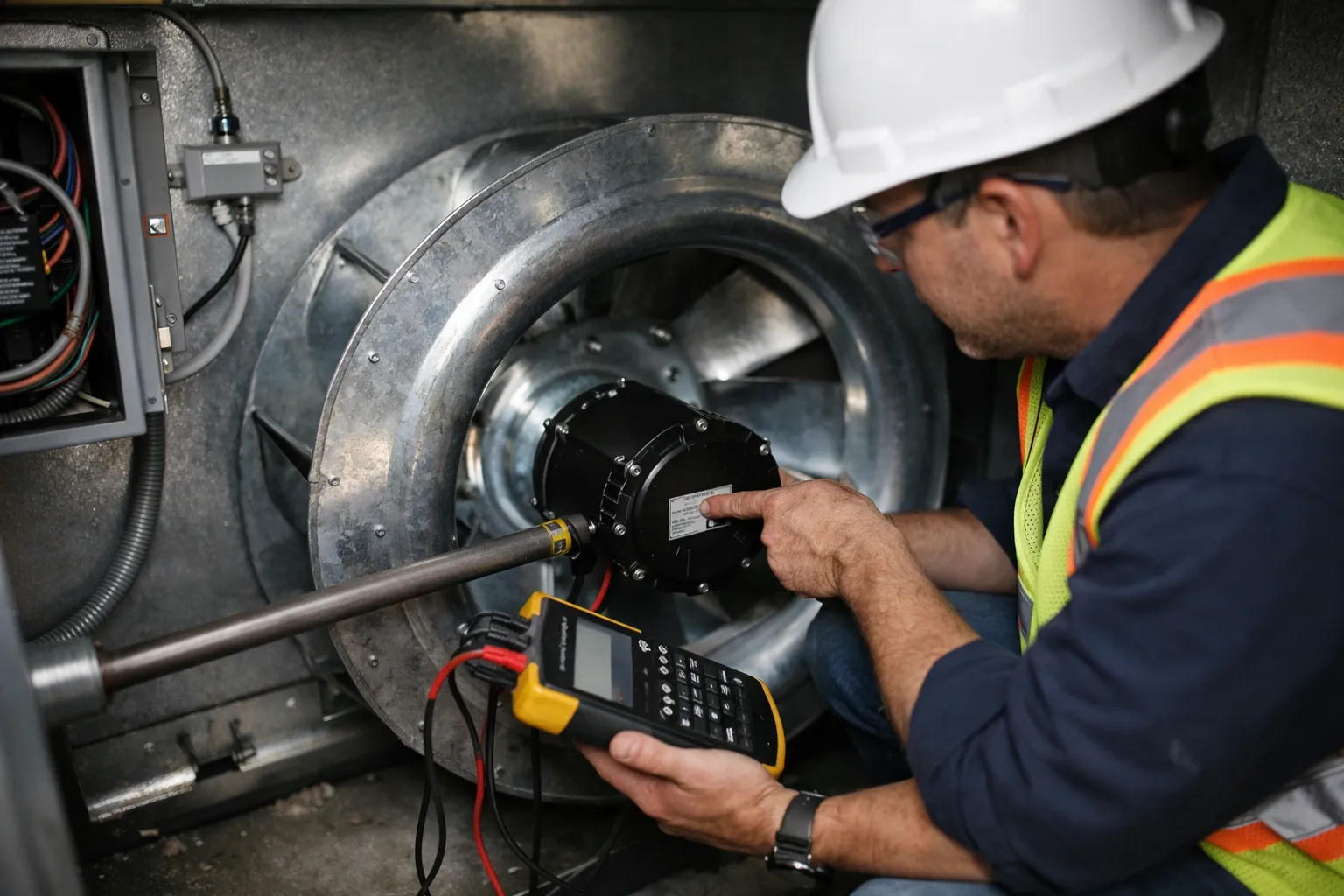
Introduction — What you'll learn and who this is for
This August 2026 update walks HVAC practitioners, facility managers and hands‑on enthusiasts through retrofitting constant‑volume commercial air handlers (AHUs) with electronically commutated motors (ECMs) and a robust static‑pressure reset. We cover what’s changed since mid‑2026 — wider ECM power bands, controller advances (AFE/SiC front ends), stricter utility M&V rules, and clearer cybersecurity expectations — and give the step‑by‑step procurement, installation and commissioning guidance you need to deliver verified savings without surprises.
This guide is for people who manage packaged AHUs, rooftop units or central air handlers and want dependable energy savings with realistic payback timelines. We assume you will be hands‑on with measurements and commissioning or working closely with a contractor who is.
Prerequisites and context — what you should know before you start
Before buying or locking out a single circuit, make sure you have:
- A measured baseline: power logging (kW, kVAR), static pressures and at least one airflow verification method documented.
- A BAS or integration plan that supports 0–10 V, Modbus/BACnet MS/TP or IP; many 2026–2026 ECMs offer BACnet/Modbus over TCP and secure web APIs.
- Clear rebate/incentive rules and pre‑approval processes from your utility/state — many programs now require pre‑approval plus post‑installation measured results.
- An electrical review for harmonic risk and short‑circuit capacity; larger ECM clusters may need AFE or filters to meet IEEE 519 limits.
- A plan for device lifecycle: firmware update policy, vendor support SLAs and spare parts or rollback strategy for critical AHUs.
Why this still matters in August 2026: ECM technology has kept improving. Manufacturers expanded torque‑capable products into higher horsepower bands and integrated Active Front End (AFE) options and Silicon Carbide (SiC) power stages that reduce losses and lower harmonic distortion. Utilities and energy managers now expect M&V-quality data and documented commissioning. That raises the bar for correct installation — and for those who do it right, shortens paybacks.
Step 1 — Baseline assessment (do this first and do it well)
Accurate baseline data is the foundation of measured savings, incentive paperwork and future troubleshooting. Don’t skimp.
- Document motor nameplate (HP, kW, voltage, frame), fan wheel type, drive type (belt vs direct) and service factor.
- Install a power logger on the motor circuit and collect 7–14 days of occupied/unoccupied cycles where feasible. Capture kW, kVAR, voltage and harmonics if your logger supports it. If pursuing a utility rebate, collect whatever interval the program requires (often 5–15 minutes).
- Measure static pressure upstream and downstream of the fan with a calibrated transducer (Pa or in. W.C.). Place taps in low‑turbulence locations and note duct geometry for future sensor placement.
- Verify airflow via traverse, balometer, or fan curve method at one or two representative operating points; record test method and uncertainty.
- Record operating schedule (hours/day, days/week), typical zone control behavior (VAV counts, damper positions) and any special operating modes (free cooling, night purge).
- Photograph motor mounts, coupling, sheaves, belt routes, controller terminals and the motor control center; these images speed procurement and avoid ordering mistakes.
Baseline example (August 2026)
Example AHU: 10 HP nameplate (≈7.46 kW). Measured average running power during occupied hours = 6.6 kW over a logged week. Annual run hours = 3,000 → baseline energy = 6.6 × 3,000 = 19,800 kWh/year. Use local commercial rates (2026–2026 ranges typically $0.12–$0.20/kWh) and include demand charges if applicable. Log and keep the raw files — many incentive programs will request them.
Step 2 — Which approach: direct ECM swap vs VFD + induction motor?
The choice remains practical, but product advances in 2026 shift some thresholds and make hybrid solutions more attractive.
- ECM direct swap: Best for low‑to‑medium HP fans where torque at reduced speed is adequate. Vendors now supply ECMs and permanent‑magnet/PMAC motors in AHU packages up to ~20–30 HP for defined duty points. ECMs excel at part‑load efficiency and compact integration; many include integrated communications, temperature sensing and simple diagnostics.
- VFD + induction motor: Still the preferred choice for larger systems, hot‑swap serviceability and when the motor must stay in place during commissioning. Modern VFDs often include AFE options that limit harmonics for multi‑motor installations.
- Hybrid: Run smaller recirculation or supply fans with ECMs and central return/exhaust fans with VFDs. This balances capital cost, maintainability and harmonic control.
Practical decision steps:
- Obtain a vendor duty‑point analysis showing torque vs speed and expected kW at your static pressure/airflow across the intended reset range.
- Confirm starting torque, stall margin and any transient loads (e.g., dampers snapping closed at startup).
- Check enclosure ratings (NEMA/IP), ambient limits and whether the controller supports AFE or has an available filter accessory if you’re near harmonic limits.
Step 3 — Controls strategy and static‑pressure reset (updated recommendations)
Static‑pressure reset is still your most reliable control strategy for VAV systems. In 2026 the focus is on stability, data fidelity and cybersecurity.
- Sensor location: Place the static sensor in the main supply duct downstream of the fan and upstream of branch takeoffs. Use dual‑point averaging or a short averaging tube in long trunks to reduce noise and false resets.
- Reset logic: Use a two‑tier approach — primary reset via zone feedback (VAV damper counts or average damper position) and a supervisory BAS check to prevent underpressurization. Implement deadbands and soft limits to avoid hunting; modern ECM controllers can accept deadband inputs natively.
- Signal integration: Prefer BACnet/IP or Modbus TCP for lower latency and richer diagnostics than analog links. Ensure the ECM exposes kW, faults, firmware version, runtime counters, and an error log as BAS points.
- Cybersecurity: Treat networked ECMs like other IoT devices. Segment them on a BAS VLAN, require strong passwords and certificate‑based TLS (1.2/1.3). Insist on vendor vulnerability disclosure policies and a documented patch/update cadence — include these in purchase orders.
- M&V readiness: Configure BAS to log kW, static pressure setpoint, actual pressure and key alarms at 5–15 minute intervals for at least 90 days if pursuing incentives. Keep raw CSV or SQL exports; many programs require uploaded files.
Step 4 — Mechanical and electrical installation checklist (expanded)
- Lockout/tagout per OSHA; verify zero energy state and post‑work safe restart procedure with site operations.
- Inspect and, if needed, refurbish the fan wheel, bearings and shaft before swapping the motor — a new motor on a damaged wheel is wasted money.
- If you change drive type (belt ↔ direct), update sheaves, alignment and balance; document mechanical changes with photos and alignment readings.
- Grounding: ensure a dedicated earth ground to the ECM controller; follow manufacturer torque specs on ground lugs and test continuity.
- Separate control wiring from power runs. Use shielded twisted pair for analog signals and maintain proper conduit separation to reduce EMI risks.
- Install static pressure transducer with accessible test/zero points and a short sampling tube to a straight run of duct; provide a test manifold or quick‑disconnect for field calibration.
- Label all cables, controllers and BAS points; configure remote diagnostics (AMS) if offered and verify vendor cloud connections meet your cybersecurity policy.
Step 5 — Commissioning, verification and M&V
Commissioning is now central to incentives and performance. Expect utilities to request IPMVP‑quality evidence and don’t treat commissioning as a checkbox.
- Initial checks: rotation, vibration, motor current, airflow direction and safety interlocks. Verify controller firmware and follow vendor commissioning checklist.
- Power verification: measure kW, kVAR and harmonics at minimum, typical and maximum operating points. Capture commissioning trend files and repeat after 30 days to verify stability.
- Control stability: step the static setpoint through the reset range and verify that pressure, speed and airflow respond smoothly. Tune PI gains and add feedforward where appropriate to prevent hunting.
- Airflow verification: perform a traverse or fan curve verification at design and reduced setpoints; document method per ASHRAE test procedures and report uncertainties.
- M&V reporting: prepare IPMVP Option B (system metering) or C (whole‑building) reports depending on scope. Include baseline days, weather normalization (if relevant), and uncertainty estimates. Keep raw trend files accessible for utility auditors.
- Power quality: for multiple ECMs or larger electronic loads, check harmonic distortion versus IEEE 519 and install passive filters or select controllers with AFE if needed.
Records to keep: serial numbers, measured kW and volts at key speeds, static pressures, airflow numbers, BAS point map, firmware versions and acceptance sign‑offs. If the project uses utility incentives, retain those records for the full audit window (often 3–5 years).
Performance math — August 2026 example with updated assumptions
Using our baseline (6.6 kW average, 3,000 hours → 19,800 kWh):
- Field experience across 2025–2026 shows conservative retrofit savings of 40–55% when ECMs are paired with an effective static reset and properly commissioned controls. Assume a conservative 50% reduction to 3.3 kW average. New annual = 3.3 × 3,000 = 9,900 kWh.
- Annual energy saved = 9,900 kWh. At a representative August 2026 commercial rate of $0.16/kWh, energy savings = $1,584/year. If demand charges apply, be sure to model coincident peak impacts — reducing fan kW often reduces demand bills as well, but verify.
- Installed cost for a 10 HP AHU in 2026 has stabilized but depends on options (AFE, communications, commissioning scope). Typical installed ranges: $6,000–$9,000. Assuming $7,500 installed and a midrange utility rebate of $1,500 (many utilities offer prescriptive or custom incentives), net cost = $6,000 → simple payback ≈ 3.8 years.
Note: your ROI depends on run hours, tariff structure, incentive specifics and how aggressively you can reset without affecting occupant comfort. Pilot one unit to validate assumptions before campus rollout.
Common mistakes and how to avoid them
- Buying the wrong horsepower/torque: Always request vendor torque curves across the full reset range and validate against measured static pressure/airflow. Confirm stall margin and transient capability.
- Bad sensor placement: Avoid turbulent tap locations and long, unanchored sample tubing. Noisy pressure readings mean control hunting and lost savings.
- Skipping M&V planning: Many utilities require pre‑approval and measured post‑installation data. File the paperwork before ordering when required.
- Ignoring firmware and cybersecurity: Networked ECMs require lifecycle management. Include patch schedules, vulnerability disclosure and support terms in procurement documents.
- No rollback plan for critical AHUs: For mission‑critical units, ensure spare parts or a rollback path (e.g., temporary induction motor) in case of controller failure.
Pro tips — getting better results and lower risk
- Start with a pilot: retrofit one AHU, measure results, refine control logic and commissioning scripts, then scale.
- Prefer controllers that expose detailed points (kW, torque, RPM, temperature, fault history) to the BAS — it makes troubleshooting and M&V easier.
- Negotiate firmware update windows and security terms into your contract. Demand an onboard clock, NTP support and signed firmware images where available.
- Use AFE or SiC‑based controllers when installing many ECMs on a single service to avoid costly harmonic mitigation later.
- Log baseline and post‑retrofit kW at 5–15 minute intervals and retain trend windows of at least 90 days in case auditors request raw data.
Resources and standards
- ASHRAE guidance on fans and VAV control (consult the latest official publications and application guides)
- DOE fan system resources and the Fan System Assessment Tool (FSAT)
- IEEE 519 — recommended practice for harmonic control in electrical systems
- IPMVP — Measurement & Verification for energy efficiency projects
- NIST and CISA publications for IoT/OT device cybersecurity — use them as procurement checklists
- Local utility program technical requirements — always read qualification and pre‑approval steps carefully
Project‑ready checklist (one page)
- Baseline logging: power, static pressure, airflow — complete
- ECM vs VFD decision documented with vendor duty‑point analysis
- M&V and incentive pre‑approval submitted (if required)
- Sensor and wiring routes identified; BAS integration plan ready
- Installation & LOTO plan approved; spare parts identified
- Commissioning plan with kW, static pressure and airflow acceptance criteria
- Maintenance & firmware patch schedule defined
Why retrofit now (August 2026)?
ECM hardware and controls continued to mature into 2026, with wider power bands, better onboard diagnostics and AFE/SiC options that reduce harmonics. Utilities and owners demand measurable results; documented commissioning and M&V shorten post‑project disputes and increase rebate capture. If you do the groundwork — baseline, proper controls, commissioning and cybersecurity — an ECM retrofit is one of the most cost‑effective steps toward lower operating costs and decarbonization.
FAQ
Are ECMs safe to put on any existing fan?
Not always. Verify torque at your duty point, mechanical clearances and starting requirements. Inspect the fan wheel and bearings first — an ECM on a damaged wheel will underperform. If the motor is inaccessible, the system needs hot‑swap capability, or the duty requires high transient torque, a VFD + induction motor may be the better choice.
Do I need to worry about harmonics with ECMs?
Yes. Single ECMs on small AHUs rarely trigger utility action, but multiple ECMs or larger installations can increase total harmonic distortion (THD). Measure THD during commissioning and compare to IEEE 519. For larger installs, specify controllers with AFE or plan for passive/active filtering to avoid penalties or nuisance trips.
How strict are 2026 utility rebate requirements?
Many 2026 programs require pre‑approval, specified test procedures and post‑installation measurement (IPMVP Option B or C). Prescriptive rebates exist for simple swaps, but custom programs increasingly require metered results and weather normalization. Always confirm program rules before ordering equipment.
What about cybersecurity for networked ECMs?
Treat ECM controllers like any networked device: put them on a segmented BAS VLAN, enforce strong credentials, use encrypted protocols (TLS 1.2/1.3) where available, and require vendor support/patch schedules in your contract. Maintain an inventory of firmware versions and apply updates during scheduled maintenance windows.
How often should I re‑verify performance after retrofit?
Check BAS trends quarterly for the first year and perform a full verification (kW, airflow, static) at 30–90 days post‑commissioning. Annual inspections should include bearing checks, vibration analysis and firmware review. Keep trend data for the full audit window specified by your incentive program (often 3–5 years).