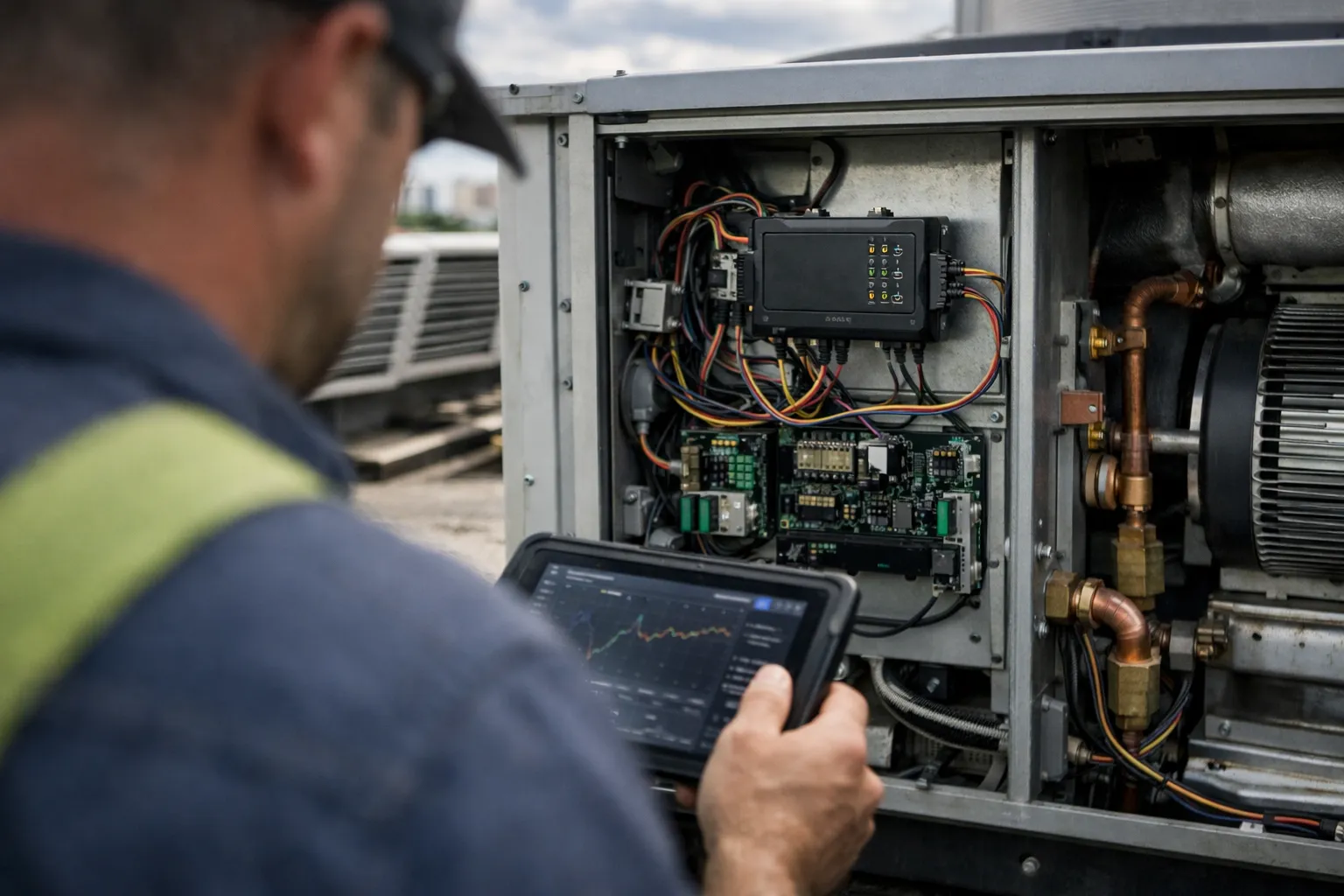
Introduction — What you’ll learn and who this is for
This refreshed guide updates our July 2026 how-to for implementing edge-based Fault Detection and Diagnostics (FDD) for commercial air-handling units (AHUs). It’s written for HVAC system enthusiasts, controls engineers, and facilities teams planning a pilot or scaling an existing edge-FDD program. You’ll get an end-to-end, practical playbook that reflects recent technology, security, and operational trends through September 2026 — including updated hardware recommendations, protocol advances, model lifecycle practices, and real-world integration tips so you can deploy reliable edge FDD today.
Prerequisites / Context
Before you start, confirm these basics:
- Building Automation System (BAS) access: read-only and write access levels defined for the gateway and commissioning engineers.
- Network policy and VLAN availability for management/operational segregation.
- Budget for a small pilot: sensor gaps, gateway hardware, commissioning time and 3–6 months of support.
- An owner/maintenance champion with agreed SLAs for responding to FDD alerts.
Why this matters now: In 2024–2026 the industry consolidated around hybrid edge/cloud FDD patterns, hardware with built-in secure elements became standard in commercial gateways, and toolchains for managing edge ML matured — meaning pilots can produce diagnosable, actionable alerts faster than before. The emphasis is now on repeatable model lifecycle, trustable security, and clear technician workflows.
Step 1: Define scope and success metrics
- Choose a focused pilot of 3–10 AHUs representing the portfolio diversity (VAV vs constant-volume, economizer types, rooftop vs. indoor units).
- Define measurable KPIs. Use concrete targets such as: detection coverage for a prioritized fault set, target true positive rate (e.g., ≥70–80% after validation), MTTR reduction target (e.g., 20–50%), and expected energy savings range for the pilot.
- Agree on data retention window for local logs (common is 30–90 days) and what event-level data will be forwarded to the cloud.
Why: Clear, measurable goals drive data collection, validation design, and vendor selection. With modern toolchains, plan for at least one formal validation cycle (baseline → injection/verification → parallel run) before trusting autonomous actions.
Step 2: Inventory AHU assets and sensors (updated)
- Create a granular inventory: make/model, sequence of operations, available control points and units, communication protocol and firmware versions.
- Prioritize sensors that materially impact diagnostics: filter differential pressure, motor current (or VFD kW), damper position feedback, mixed/return/supply temps, static pressure, CO₂, and humidity.
- Record sampling cost (bandwidth, storage) per point so you can make informed down-sampling choices during commissioning.
New reality in 2026: Low-cost, certified sensor kits and wireless DP sensors are more mature and interoperable; retrofitting filter DP and motor-current monitoring is often the highest ROI step. Also document firmware revisions of VFDs and controllers — control-sequence changes remain a top cause of false positives.
Step 3: Choose an FDD architecture (edge-only, hybrid, cloud-first)
Current best practice (2026): hybrid architectures dominate for commercial AHUs. Implement real-time inference and rule-based logic on-site for immediate detection and automated advisories, with model training, versioning, long-term analytics and model governance in the cloud. Hybrid reduces WAN load while enabling centralized model lifecycle management and cross-site learning.
Why: By 2026, vendors and open-source frameworks offer standardized model deployment pipelines and remote rollback, which makes hybrid approaches operationally manageable and safer for production environments.
Step 4: Select hardware, protocols, and security (updated)
- Hardware class: choose edge compute with secure element/TPM support, 4–8 GB RAM minimum, SSD (NVMe preferred) and industrial I/O if rooftop. Options range from industrial SBCs and ruggedized Intel/AMD NUC variants to ARM-based systems (NVIDIA Jetson Orin Nano class if on-device vision or heavier ML needed).
- Gateways: industrial gateways (Advantech, Moxa and equivalents) remain good choices for serial/BACnet MS/TP integration and durable rooftop deployment.
- Protocols: continue to support BACnet/IP, BACnet MS/TP (serial gateway), Modbus, OPC UA and MQTT. Notable 2026 shifts: OPC UA adoption in BAS has accelerated and companion specifications for HVAC make OPC UA a viable northbound option. MQTT v5 features (shared subscriptions, enhanced properties) are widely used for eventing; MQTT over WebSockets/QUIC appears in newer deployments.
- Security: hardware-backed identity (TPM or secure enclave), X.509 certificates, TLS 1.2/1.3, and network segmentation are baseline requirements. NIST IoT guidance and supply-chain attestation practices (device certificates issued via secure provisioning) are now commonly required by enterprise IT teams. Plan for secure firmware updates (signed images) and remote attestation telemetry.
Why: Edge devices with secure elements dramatically reduce the operational risk of credential theft and help satisfy corporate IT security requirements for on-prem endpoints.
Step 5: Data mapping, sampling strategy and quality checks (updated)
- Build a point mapping spreadsheet including device ID, controller firmware, BACnet object, units, nominal range, sample rate, and an owner field.
- Updated sampling guidance: 5–15 second samples for dynamic control points where you need sequence-level detection; 30–60 seconds is often acceptable for fan speed and damper position in many AHUs. Energy counters and utility meters can be 1–15 minute granularity.
- Implement ingestion rules: range checks, delta checks, monotonic checks for counters and stale-point alarms. Log raw samples locally for at least 30 days; push summarized features and event windows to the cloud for training.
Why: Lower-cost NVMe storage enables longer local windows and richer local debugging. However, balance sample rate vs. CPU and storage when running on constrained devices.
Step 6: Choose detection approaches and models (what’s new in 2026)
Layered approach remains best. What’s new in 2026:
- Explainable edge ML: lightweight explainability (SHAP-lite, on-device feature attributions) is increasingly used to produce technician-friendly evidence with each alert.
- Federated learning pilots: organizations with privacy constraints are experimenting with federated approaches to share model improvements across sites without moving raw telemetry to a central cloud.
- Model runtimes: ONNX Runtime, TensorFlow Lite 2.x, and small-footprint runtimes for ARM/NEON are reliable options. ONNX’s edge ecosystem continued to expand, easing cross-vendor model portability.
Practical recommendations:
- Begin with rule-based signatures and physics-based sequence checks to get immediate wins and generate labeled events for ML.
- For supervised ML, prioritize interpretable models (tree-based ensembles) during initial rollouts, then add lightweight neural sequence models if needed.
- Use synthetic fault injection and replay (in a sandbox) to augment labeled data; many teams now maintain a 'fault library' for reproducible validation.
Step 7: Common AHU fault signatures (practical examples — updated)
- Stuck outside-air damper: commanded damper position diverges from measured, outdoor-air fraction inconsistent with mixed-air temperature during economizer mode. Augment detection by correlating CO₂ trends in the served zone.
- Clogged filter: rising fan current and static pressure differential while VFD speed or commanded VFD % is steady. Newer detections correlate motor-efficiency drift (kW vs VFD %) to isolate motor degradation vs filter loading.
- Reheat valve or coil issue: discharge temp variations inconsistent with valve position and entering water temperature; look for step changes after control sequence changes or heating plant issues.
- Sensor drift/failure: persistent offset relative to colocated references, improbable jumps, or reporting cadence anomalies flagged by ingest quality rules.
Why: Combining multiple correlated signals (e.g., motor current, VFD commands, static pressure) reduces false positives and improves technician confidence.
Step 8: Integration with BAS, CMMS and technician workflows
- Push actionable alerts (not raw telemetry) to BAS alarm lists and CMMS with prioritized severities and suggested corrective actions.
- Package evidence: include 24–48 hour trend windows, feature attributions, and a one-line recommended action. In 2026, on-device explainability became a differentiator for technician adoption.
- Enable a two-way workflow: technicians can mark alerts as resolved or 'false' and provide notes; use these labels to retrain supervised models.
Why: Alert-to-action is the most important ROI link. Without clear remediation steps and easy feedback, alert fatigue undermines FDD value.
Step 9: Commissioning, validation and model governance
- Baseline collection: capture at least 2–6 weeks of representative operation across modes. Longer baselines help when AHU schedules vary seasonally.
- Validation: use safe, controlled injections where practical, plus historical replay and sandbox synthetic faults. Maintain a versioned test suite for each model.
- Parallel run: operate FDD in advisory-only mode for 4–8 weeks, collect technician feedback, and measure TPR/FPR before enabling automated actions.
- Model governance: maintain a model registry, versioning, rollback capability and documented retraining triggers (seasonal drift, control-sequence change, dataset growth).
Why: Mature model lifecycle and governance reduce the risk of model drift causing false alerts and eroding trust.
Step 10: KPIs, ROI and outcomes (practical framing)
Outcomes continue to vary by portfolio, but practical expectations for a well-executed pilot in 2026 are:
- Early wins from rule-based detections (correctable control faults) that produce immediate energy and comfort improvements.
- Measured MTTR reductions as technician triage time shrinks because alerts include contextual evidence (often 20–50% improvement in validated pilots).
- Energy savings and payback remain site-specific; use pilot data to refine assumptions and include labor savings and avoided failures in ROI calculations.
Why: Reliable metrics require a disciplined validation program and explicit accounting for labor impacts, not only energy.
Step 11: Operationalize and lifecycle management (updated)
- Define alert ownership, SLAs and an escalation matrix.
- Track edge health metrics centrally and automate remediation (container restart, disk cleanup alerts) where possible.
- Schedule retraining cadence: at minimum quarterly for portfolios with seasonal behavior; trigger retraining after control logic updates or significant equipment change.
- Build a feedback pipeline: technician confirmations and CMMS outcomes should flow back into the training dataset.
Common mistakes and how to avoid them
- Poor data quality — mitigate with ingestion checks, realistic sample rates and sensor maintenance plans.
- Over-automation too soon — use advisory mode and parallel validation before permitting autonomous control changes.
- Ignoring governance — adopt model registries, traceable data lineage and rollback paths to reduce operational risk.
- Alert fatigue — consolidate related alerts, tune severities, and include actionable next steps on each alert.
Pro tips
- Start with what you can measure well: filter DP and motor current are often the fastest ROI sensors to add.
- Keep the edge lightweight: compute-intensive retraining belongs in cloud/sandbox, not on constrained devices.
- Maintain a fault library and catalog synthetic injections used for validation so you can reproduce results across sites.
- Use explainability on alerts — technicians adopt systems faster when they see “why” an alert fired.
Quick commissioning checklist (updated)
- Complete point inventory and mapping
- Install/verify key sensors (filter DP, motor current, damper feedback)
- Provision gateways with hardware-backed identity and enroll in device management
- Deploy rule-based detectors; enable edge logging and local retention (30–90 days)
- Validate via controlled injections, replay and parallel runs
- Integrate alerts into CMMS and train technicians on evidence packages
FAQ
Do I need expensive hardware to run edge FDD in 2026?
No. You can run effective rule-based and many ML models on moderately priced industrial SBCs or ruggedized small-form-factor PCs with 4–8 GB RAM and an SSD, provided the device supports secure provisioning (TPM/secure element) and your detection models are sized for the device. Reserve higher-end devices (NVIDIA Orin-class or equivalent) for vision or very large sequence models.
How should I handle model retraining without sending raw data to the cloud?
Options in 2026 include: (1) federated learning experiments to aggregate gradients or model updates without moving raw telemetry; (2) local feature summarization that sends engineered features instead of raw samples; or (3) selective upload of anonymized event windows. The right choice depends on privacy requirements and the fidelity needed for training.
What’s the single biggest operational risk for edge FDD projects?
Alert fatigue and loss of trust. This usually stems from poor data quality, missing sensor coverage, or insufficient validation. Mitigate with conservative advisory modes, clear evidence on alerts, and a structured validation program that measures TPR and FPR before enabling automation.
Are BACnet/SC and OPC UA mandatory for a new deployment?
No, but they are increasingly favored. BACnet/SC and OPC UA provide stronger security and modern interoperability compared with legacy BACnet/IP or plain Modbus. If enterprise IT mandates higher assurance, plan for gateways that support these protocols or for protocol translation with secure tunneling.
How quickly should a pilot show results?
Meaningful detection of common, clear rule-based faults can happen within weeks after sensor upgrades and mapping. Robust, validated ML-based detections typically require 2–6 months for baseline collection, validation, and tuning. Use early rule-based wins to build momentum and collect labeled data for ML.
Final recommendations
Start small and practical: use rule-based and physics checks to deliver quick wins while building your labeled dataset and model governance. Prioritize secure provisioning and evidence-rich alerts to win technician trust. In 2026 the available toolchains and hardened edge hardware make hybrid edge/cloud FDD a practical and repeatable approach for commercial AHUs — but the difference between a successful pilot and wasted effort is disciplined validation, governance, and technician workflows.