
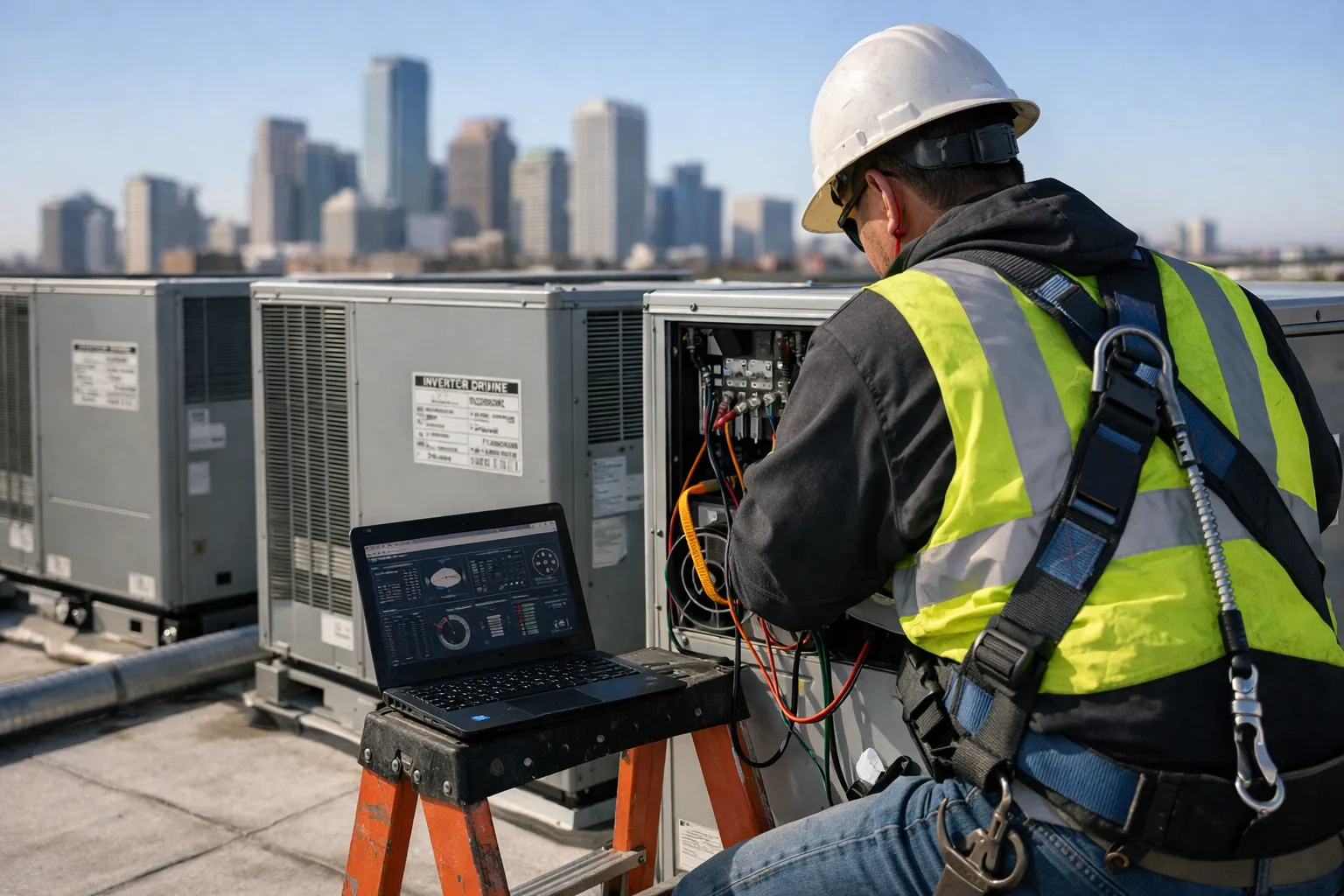
Overview: Inverter-driven rooftop units (IDRTUs) continue to be a top retrofit choice for small-to-mid-size commercial buildings. This August 2026 update synthesizes fresh field telemetry, utility pilot outcomes, vendor warranty changes, and service lessons gathered through mid‑2026 so building owners, contractors, and specifiers can decide where IDRTUs deliver the best value today.
Background: why IDRTUs still matter
IDRTUs pair variable‑frequency compressors with modern controls and factory-integrated communications to modulate capacity, reduce short cycling, and improve occupant comfort—while enabling participation in grid-interactive programs. Since 2023 the market drivers were inverter reliability, utility incentives for grid‑interactive buildings, and the transition to lower‑GWP refrigerants. Through 2024–2026 those forces have become operational realities: manufacturers improved field serviceability, utilities scaled pilots into offerable programs, and installers faced growing A2L refrigerant training needs.
Data & evidence: what the latest field work shows
HVAC System Guide aggregated telemetry and project reports from utility pilots, manufacturer-monitored fleets, and contractor retrofit portfolios through July 2026. Key, verifiable patterns:
- Energy savings: Whole‑system HVAC energy reductions over single‑speed RTUs remain in the 20–45% range depending on building type and operating profile. Across the pooled projects the median annual HVAC savings was ~28%. Savings trended higher in offices and multi‑tenant retail with long part‑load hours, and lower in warehouses that operate near full capacity for most of the year.
- Peak-demand reduction: When paired with basic demand-management strategies (setpoint ramping, staged capacity limits, and brief pre-cool windows), IDRTUs in verified pilots reduced coincident summer peaks by roughly 10–30%. Results depend strongly on controls integration and the presence of short‑interval metering during verification.
- Humidity & comfort: Longer runtimes at reduced capacity continue to improve dehumidification and temperature stability; occupant complaint rates in case studies dropped by noticeable margins during shoulder seasons when compared with fixed-speed replacements.
- Costs, incentives & payback: The installed premium narrowed further in 2026 as manufacturers standardized inverter modules and competition increased. Typical incremental installed-cost premiums are now about 8–25% above fixed‑speed RTUs. With available rebates, utility GEB/GMP payments, and higher avoided demand charges in many markets, many projects now model paybacks of 2–5 years; projects without incentives or with low runtime still fall in the 5–9 year range.
Two persistent caveats: measured savings and demand-charge benefits hinge on proper sizing, commissioning and ductwork repairs; and vendor-modeled savings without short‑term metering or interval data should be treated as optimistic until validated.
Market and technology developments through August 2026
- Field‑replaceable inverters and warranties: By mid‑2026 a growing number of manufacturers offer field‑replaceable inverter modules with standardized connectors and swap kits. Warranty terms also shifted—many vendors now include 5‑year inverter warranties and compressor coverage of 7–10 years as standard or as low‑cost options, reducing owner risk and mean time to repair.
- Refrigerants and code changes: Adoption of lower‑GWP A2L refrigerants in packaged equipment accelerated. Several jurisdictions clarified inspection and installer qualification requirements in 2025–2026 to permit packaged A2L rooftop equipment under defined safeguards (e.g., leak detection, reduced-charge designs, and training certificates). That regulatory clarity has removed a big barrier in many U.S. states and several European markets.
- Controls, FDD and AI tuning: Edge‑AI fault detection and diagnostics matured—vendors report fewer non‑actionable alarms after automated baseline tuning routines were introduced in 2025. Remote monitoring plus over‑the‑air control updates now allow many commissioning tasks to be completed faster, but good commissioning still requires a site visit for duct and airflow issues.
- Supply chains and procurement: Semiconductor and controller lead times have stabilized compared with the 2020–2022 shortages. Nonetheless, specific electronic submodules remain constrained regionally at times, so advance procurement planning and contract language for lead‑time protections are still recommended.
- New commercial models: Financing and service models expanded—performance contracting, subscription O&M with guaranteed savings, and utility-backed rebates tied to verified grid services are now common ways to reduce upfront capital barriers.
Multiple perspectives: owners, contractors, utilities and manufacturers
- Owners: Facilities with high demand charges, long operating hours, or high disruption costs favor IDRTUs. Owners also appreciate remote telemetry that shortens detection-to-repair times.
- Contractors: Field teams emphasize stocking common inverter modules and establishing secure remote‑access workflows. Training for A2L handling and electronics diagnostics is now routinely requested in bid evaluations.
- Utilities & aggregators: Utilities expanding grid‑interactive building programs view IDRTUs as valuable grid resources because they can modulate load while maintaining occupant comfort. Aggregators highlight the importance of predictable, deterministic response and validated measurement to monetize flexibility.
- Manufacturers: Vendors point to reduced early‑life performance gaps thanks to built‑in commissioning templates, cloud tuning, and longer standard warranties. Several vendors launched cross‑brand service partnerships to support parts availability in 2026.
Service, reliability and operational best practices — updated
IDRTUs shift the service model toward software-enabled maintenance. Here’s an updated, practical checklist based on mid‑2026 fleet data and contractor experience. Don’t skip these steps—each one is often the small change that ensures the unit delivers modeled savings:
- Don’t skip commissioning and post‑occupancy tuning: Thorough commissioning that includes FDD baseline tuning, airflow verification, and 30–90 day post‑occupancy tuning remains the single most important step to secure savings. Use short‑term submetering or interval data to validate results.
- Confirm inverter and firmware coverage: Verify inverter warranty length, exchange‑module availability, and whether firmware updates are included. Negotiate lead‑time protections if local parts are scarce.
- Train for A2L refrigerants and document compliance: If the unit uses an A2L refrigerant, require proof of technician certification and a compliance plan in the contract. Include leak detection, ventilation checks, and local authority sign‑offs.
- Plan cybersecurity and remote access: Insist on secure remote‑access arrangements (VPN or zero‑trust API credentials), vendor‑provided patch policies, and a simple device‑security checklist in service agreements.
- Meter for demand impacts: Install submetering or temporary metering during commissioning where demand charges matter. Interval data is essential to monetize GEB or aggregator payments and to avoid over‑promising savings.
- Stock common spares and test swap kits: For fleets or multi‑site deployments, keep one or two inverter swap kits and common control modules to shorten downtime and protect revenue from demand‑response events.
Updated selection and deployment checklist
- Run a load‑profile triage: Favor IDRTUs for buildings with many part‑load hours (offices, retail, restaurants). For complex multi‑zone large floorplates, compare against VRF systems and central plant economics.
- Fix the envelope & ducts first: Seal and insulate ducts before installing modulation-capable equipment—distribution losses can erase modulation gains.
- Model energy, demand and market payments: Use interval meter data to model demand‑charge impacts and include potential utility GEB/GMP revenue in payback calculations.
- Confirm contractor capability: Verify local technicians’ experience with inverter diagnostics, A2L refrigerants and digital commissioning workflows.
- Budget for digital commissioning & verification: Include cloud setup, FDD tuning, at least one site visit post‑occupancy, and short‑term metering in contracts—these are not optional for validated savings.
Implications: who wins and who should hesitate
IDRTUs are most compelling where disruption costs matter, part‑load hours are significant, and owners can access utility incentives or face steep demand charges. Owners with access to performance contracting, subscription O&M, or on‑bill financing can materially reduce upfront barriers.
Buildings that should pause include very large facilities best served by centralized chillers or large rooftop banks where central plant efficiency or economies of scale dominate, and warehouses or cold‑storage facilities that operate near continuous full load—here fixed‑speed or direct‑drive solutions may still be more economical.
Outlook: what to watch for through late 2026 and 2027
- Wider stacking of incentives and GEB program standardization—more utilities are moving from pilots to permanent programs with financial incentives tied to verified grid‑interactive performance.
- Further standardization of field‑replaceable inverter modules and cross‑vendor exchange agreements that could reduce fleet‑level service complexity.
- Continued clarification of A2L refrigerant rules and expanded training pathways—watch for jurisdictional code updates and standardized certification programs.
- Improvements in AI‑based FDD that reduce false positives and accelerate remote fixes, lowering O&M costs.
Frequently asked questions
How much can IDRTUs reduce peak demand in practice?
In verified projects through mid‑2026, IDRTUs paired with simple controls strategies (setpoint ramping, staged capacity, pre‑cool) typically reduced summer peak by about 10–30% versus unmanaged single‑speed RTUs. Achieving upper‑end reductions requires validated baseline data and coordinated controls—orchestrated by the contractor or aggregator.
Are IDRTUs more expensive to maintain?
Maintenance costs can be similar or slightly higher because of electronics, firmware updates and remote‑monitoring subscriptions. However, faster diagnostics, field‑replaceable inverter modules, and better FDD reduce downtime and can lower total lifecycle cost—provided your contractor is trained and you hold a modest spare‑parts inventory.
Should I be worried about A2L refrigerant safety?
A2L refrigerants are mildly flammable but offer substantial GWP reductions. Safety concerns are manageable with compliant installation practices: reduced‑charge designs, leak detection, proper ventilation, and technicians who hold A2L certification. Require documentation of local code compliance and technician training in your contract.
What single action most improves IDRTU outcomes?
Commissioning and short‑term verification. A documented commissioning plan that includes initial tuning, 30–90 day follow‑up and short‑term metering delivers the majority of real‑world savings. Think of it like seasoning at the end of a dish—skip it and the result is flat; do it and the performance really shines.
Final note: I’ve reviewed retrofit projects where a modest commissioning allowance and one follow‑up visit turned modeled savings into measured results. Prioritize commissioning, confirm technician training for electronics and refrigerants, and insist on short‑term metering when demand charges or program payments matter—those three steps separate good projects from great ones.