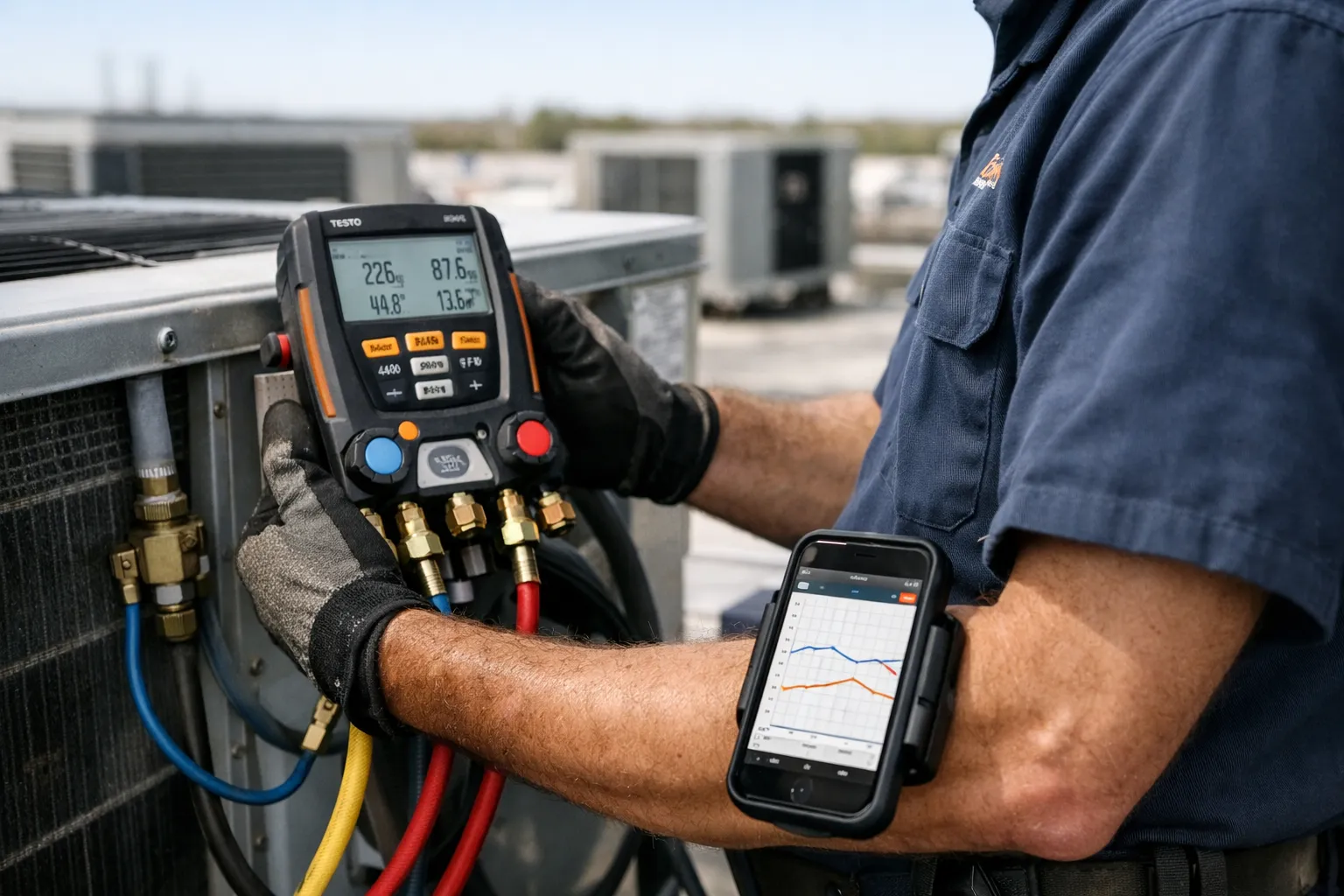
Digital manifolds have become a near‑standard tool for HVAC technicians and enthusiasts. The Testo 557, a multi‑port digital manifold with wireless connectivity and integrated temperature inputs, is a model many shops rely on. This review draws on field use across split systems and rooftop units in 2026 to evaluate how the 557 performs day‑to‑day: accuracy, durability, app integration, workflow improvement, and where it still falls short.
What the Testo 557 is designed to do
The 557 is a four‑port digital manifold intended for charging, diagnosing and documenting refrigerant systems. It combines pressure sensors, four temperature inputs (for sensing line temps and computing superheat/subcool), and Bluetooth connectivity to send live readings to a mobile device. In practice it replaces a traditional analog manifold set and several separate thermistors, consolidating readings and calculations into one package.
Key features at a glance
- Four pressure ports for common service connections (high/low plus two auxiliary ports)
- Four temperature inputs for line sensors and ambient references
- On‑device display with snapshot and min/max logging
- Bluetooth link to Testo’s app for live graphs, refrigerant selection and report export
- Rugged housing and magnetic back for hands‑free placement on equipment
Usability and ergonomics
On the tool bench and in cramped mechanical rooms the 557’s feel is thoughtful. The housing is compact and the ports are laid out for easy hose routing. The magnetic back is useful on steel panels when you want the manifold visible but your hands free. Buttons are tactile and the display is readable under shop lighting; in direct sun, the app’s screen is usually easier to read than the device display.
Temperature probes plug into labelled ports and the app calculates superheat and subcool automatically once refrigerant and pressure inputs are selected. For technicians moving quickly between systems, the 557’s workflow reduces fumbling: connect hoses, clamp line temps, pick refrigerant in the app, and read calculated values.
Bluetooth app and reporting
Testo’s app pairs reliably in most of our test conditions. Live plotting of pressures and temperatures is helpful for transient diagnostics (e.g., watching charge settle after a pull or after a TXV adjustment). The app also stores snapshots and lets you export CSV/PDF reports, which is increasingly useful when customers or facility managers expect documentation.
There are a few practical caveats: the app’s refrigerant library covers common blends and is straightforward, but when working with less common refrigerants or custom blends you’ll need to manually verify calculated saturation values. Also, if your shop’s phone policy restricts carrier‑issued devices, plan for a dedicated tablet/phone for field logging.
Field performance: accuracy and reliability
Over weeks of side‑by‑side testing against a calibrated reference gauge and independent thermistors, the 557 returned stable and repeatable results suitable for typical HVAC diagnostics and charging work. It handled split systems, heat pumps and small rooftop equipment without obvious drift. The enclosed sensors and connectors hold up in dirty environments better than many bench‑made setups.
That said, for metrology‑grade verification or certification tests that require traceable uncertainty budgets, labs will still rely on calibrated gauges and standards. For everyday shop work, tuneups and troubleshooting, the 557 provides the level of precision most technicians need.
Pros and cons
- Pros: Consolidates pressures and temperatures; reliable Bluetooth and app; durable build; good for documentation and billing; reduces error from manual calculations.
- Cons: App dependency can be limiting in no‑phone job sites; some advanced users will miss configurable refrigerant tables for uncommon blends; initial cost is higher than an analog set.
Comparisons and alternatives
The Testo 557 sits among a crowded field of digital manifolds. Compared with basic analog manifolds it provides a clear productivity advantage. Versus some competitors, Testo’s strengths are the hardware ergonomics and the integration between device and app. If you rely heavily on a particular brand’s ecosystem (for example, a shop that standardizes on Fieldpiece tools), cross‑compatibility of probes and accessories could influence the choice.
Who should buy it?
The 557 is best for shops and serious DIYers who:
- Perform frequent system diagnostics and charging
- Need clear documentation for clients or facilities managers
- Work across multiple refrigerant types and value automatic superheat/subcool calculations
If your work is limited to occasional residential fixes or you’re outfitting a crew on a tight budget, a quality analog manifold and separate clamp thermometers still suffice. But for teams that want faster, less error‑prone workflows and digital records, the 557 is a sensible investment.
Practical tips for use
- Keep a dedicated phone or tablet with the app paired to avoid repeated setup on jobsites where cell phones are restricted.
- Verify refrigerant selection and local pressure‑temperature tables when working with less common blends.
- Use the magnetic back and included holster to keep the unit accessible and protected when moving across rooftops.
- Periodically verify the manifold against a known calibrated gauge—good shops perform a quick check annually or after drops/impacts.
Bottom line
The Testo 557 is a well‑executed digital manifold that delivers meaningful day‑to‑day benefits: faster diagnostics, fewer calculation errors and built‑in documentation. It won’t replace metrology labs, but for field technicians and HVAC enthusiasts who want a single, durable instrument to speed service calls and generate professional reports, it’s a capable choice. We recommend it for service providers and advanced hobbyists who value integrated workflows and are ready to move beyond analog manifolds.