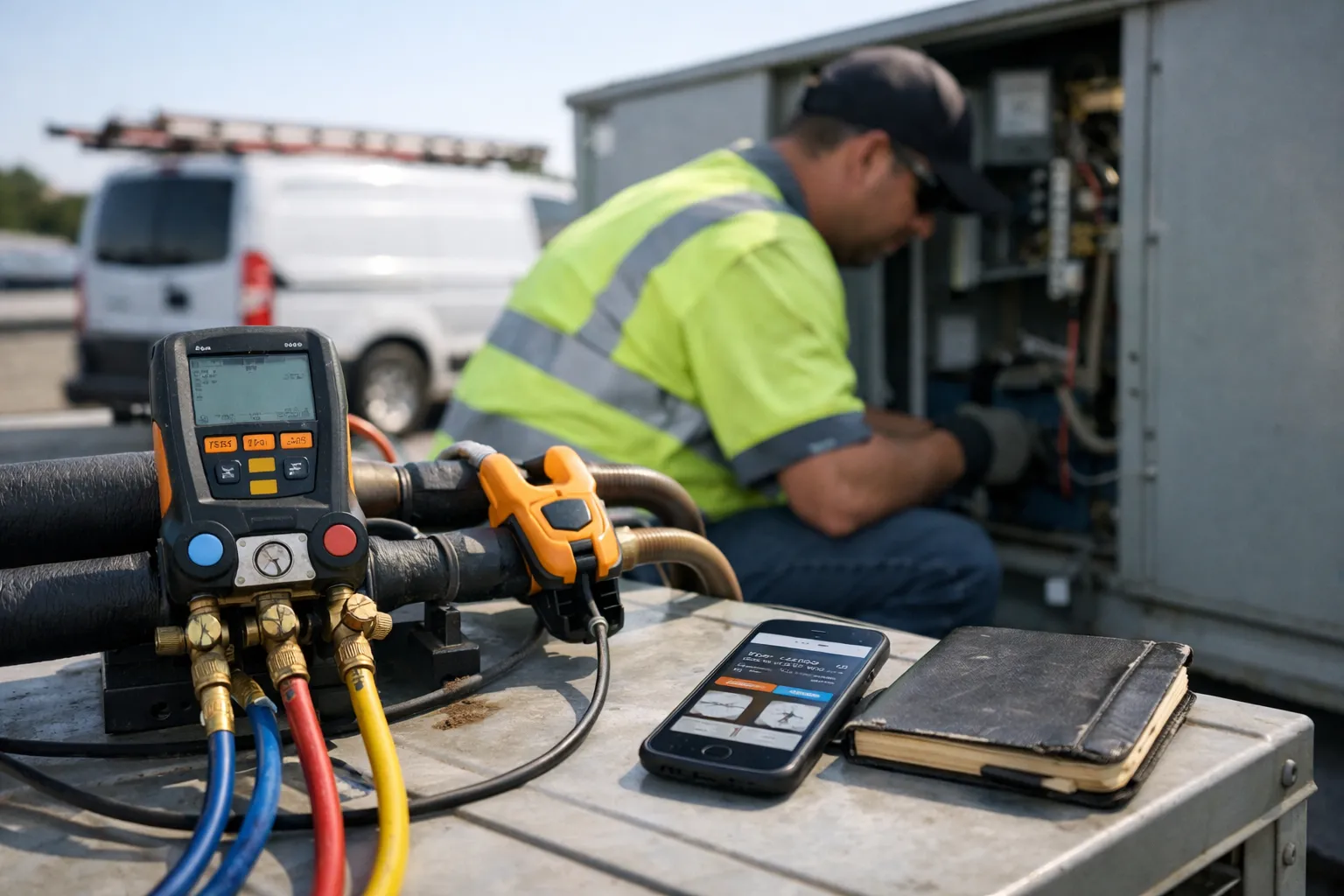
Digital manifolds and wireless probe ecosystems have become standard tools for HVAC technicians. In this review I evaluate the Testo 557 digital manifold and the broader Testo Smart Probes ecosystem in real-world field settings (rooftop RTUs, split systems and commercial refrigeration) to assess whether it delivers on speed, accuracy, and workflow improvements that will matter to HVAC enthusiasts and service pros in 2026.
What I tested
The core of this review is the Testo 557 digital manifold used with Testo Smart Probes (temperature clamps and thermistors) and the Testo Smart Probe mobile app on Android and iOS. Testing was done across:
- Medium-capacity rooftop units (packaged RTUs) on commercial rooftops
- Split-system heat pumps (variable-speed compressor) in light-commercial settings
- Walk-in refrigeration evaporator and condensing units
Key capabilities and workflow
The Testo 557 is a Bluetooth-enabled digital manifold that reads high and low side pressures and supports temperature inputs for superheat and subcooling calculations. In practice the standard workflow is:
- Connect test hoses to service ports and attach temperature sensors to suction and liquid lines.
- Select refrigerant in the app or on device; the manifold calculates target values and displays measured superheat/subcooling.
- Use the app to log readings, create PDFs, and store job data for handoff or compliance records.
Performance features I tested include the manifold display readability in sun, Bluetooth pairing stability at typical rooftop distances, app calculation accuracy against independent references, and the speed of producing field reports.
What worked well
- Clear, fast readings. The onboard display gives immediate pressure and temperature values; the app consolidates multiple inputs for clear superheat/subcooling readouts. This speeds diagnosis compared with juggling analog gauges and separate thermometers.
- App-driven documentation. The Smart Probe app makes it straightforward to capture a session, add notes and export a PDF or CSV. For service companies that need quick job records, this removes an extra step and reduces transcription errors.
- Robust Bluetooth behavior. Pairing remained steady in typical field distances (phone on ladder, manifold at service valves). Reconnects were reliable after short disconnects common when moving around a unit.
- Smart Probes ecosystem. Using Testo temperature clamps and thermistor probes provided rapid line temperature measurement and consistent contact methods. Interoperability across probes simplifies inventory and training.
- Battery and build. The unit’s housing felt rugged for field work; rechargeable battery endurance handled multi-job days in typical use patterns.
Limitations and tradeoffs
- Price vs analog. The convenience and data features come at a premium. For small shops that rarely document jobs, the ROI is marginal compared with traditional gauges.
- App dependence. While the manifold functions standalone for immediate reads, the most valuable features—data logging, PDF reports and long-term storage—require the app. Shops with locked-down mobile policies should plan deployment accordingly.
- Learning curve for multi-step diagnostics. Technicians used to analog gauges need a short period to internalize the app-driven workflow and to trust the auto-calculations under unusual conditions (e.g., long line sets, off-nominal subcooling due to TXV behavior).
- Accessory costs. High-quality thermistor clamps and additional probes are sold separately. Building a full kit to cover all HVAC and refrigeration workflows increases the upfront investment.
Accuracy and reliability — practical findings
I cross-checked pressure and temperature readings from the Testo 557 against calibrated reference gauges and lab-grade thermistors. Results showed tight agreement for typical field tolerances: the manifold consistently returned stable, repeatable pressures and the app-calculated superheat/subcooling matched manually derived values within what most service decisions require.
Two practical caveats emerged. First, calculated targets depend on correct refrigerant selection and accurate line temperature readings; poor sensor contact or selecting the wrong refrigerant in the app produced incorrect guidance (a user-error risk, not a device error). Second, for very long line-sets and microchannel condensers where manufacturer's start-point adjustments matter, the app’s generic target tables may need manual override—Testo provides the ability to enter custom data but that requires the technician to know the system nuances.
Who should buy it?
The Testo 557 and Smart Probes ecosystem suit three buyer profiles:
- Service shops that bill for documentation. If you need quick PDFs, time-stamped logs and clean reports for customers and compliance, the system pays back through saved admin time.
- Technicians focused on diagnostics and troubleshooting. The combination of rapid line temperatures and pressure readings reduces time-to-diagnosis on heat-pump charge and expansion-device problems.
- Training programs and enthusiasts. HVAC trainers and advanced hobbyists will appreciate the instant feedback loop for teaching superheat/subcooling concepts and for validating hands-on adjustments.
It is less compelling for sole-proprietors doing occasional basic maintenance where analog gauges and a clamp meter already suffice and capital is limited.
Verdict — practical scorecard
- Usability: High — app and display streamline common tasks.
- Accuracy: Solid for field diagnostics when used with good sensor technique.
- Durability: Field-ready build; recommended to use an equipment case for transport.
- Value: Good for pros who need documentation and speed; marginal for occasional users.
Bottom line
The Testo 557 digital manifold paired with Testo Smart Probes is a mature, well-engineered choice for technicians who prioritize speed, documentation and consistent measurements. In 2026, when service workflows increasingly demand digital records and traceability, the 557 moves beyond "nice-to-have" into "enabler" territory for medium and larger service operations. For individual technicians weighing cost against frequency of use, assess whether the time saved on diagnostics and reporting covers the initial investment.
For HVAC enthusiasts who enjoy testing gear, the 557 is also rewarding: the combination of immediate feedback, reliable Bluetooth operation, and straightforward reporting makes experimentation and learning more efficient without sacrificing professional rigor.