
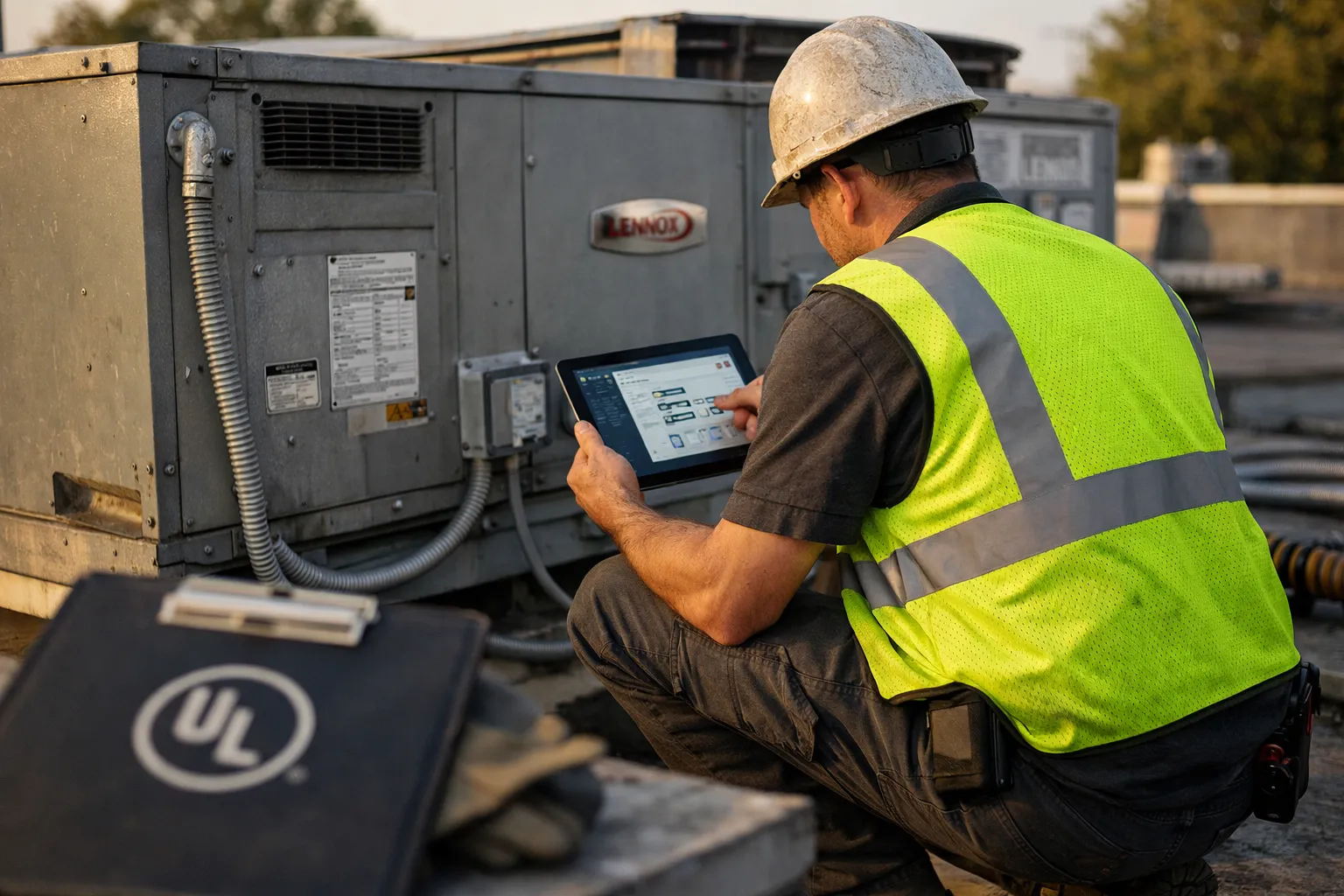
Who, what, when, where, why: Underwriters Laboratories (UL) expanded its connected‑HVAC cybersecurity pilot through July–August 2026. The program—launched in February 2026 to rate device‑level security controls on thermostats, rooftop controllers, VRF (variable refrigerant flow) systems and building gateways—now influences procurement language and service models across North American commercial portfolios. For contractors, controls integrators and facility owners this is no longer a curiosity: it affects bids, commissioning checklists and long‑term firmware governance.
Why this matters now
Put simply: buyers are treating cybersecurity labels as part of the technical spec. Connected HVAC gear remains an attractive entry point for attackers because controllers often sit on the edge of corporate networks, run long-lived firmware, and historically ship with weak defaults. Since the pilot began, a string of disclosed building automation incidents and tighter insurance questionnaires have converted vendor claims into documentation buyers expect to see during procurement.
Think of the UL label as a security nutrition label: it doesn't harden a system by itself, but it standardizes the ingredients list. That allows owners and integrators to make apples‑to‑apples comparisons during procurement and to assign operational responsibilities up front.
What changed between May and August 2026
- Vendor breadth increased: UL reports the pilot now includes participation from more legacy OEMs, two large controls houses, and several gateway/cloud integrators. That broader coverage matters because labeled parts are showing up in mainstream product lines rather than only premium SKUs.
- Draft test method published: In July 2026 UL released a draft test method for public comment that tightens requirements around firmware signing, secure boot where applicable, and multi‑factor authentication (MFA) for administrative cloud portals. The public comment period was scheduled through late August 2026.
- Procurement traction accelerated: Multiple large public and institutional buyers included UL pilot participation or an equivalent device‑security statement in RFP addenda during summer 2026, shifting vendor responses from "we can comply" to "how fast and at what price."
- Insurance and underwriting attention: Two mid‑sized commercial insurers have begun requesting label status on renewal questionnaires, and brokers are asking for documented update SLAs. Expect underwriting language to become more prescriptive in 2027 if pilot adoption keeps growing.
- Price signal and OEM strategies: Market checks in Q2–Q3 2026 show labeled models carry a small premium—still generally single‑digit percentage points—but more vendors are absorbing test costs into standard SKUs or offering labeled firmware options to remove sticker shock.
What the pilot evaluates now (practical summary)
The pilot continues to focus on device‑level controls contractors can verify at commissioning and owners can require in bids. Key checkpoints:
- Firmware integrity: Signed firmware binaries, documented secure‑boot behavior where supported, and rollback protections are tested.
- Secure update pathways: Encrypted over‑the‑air (OTA) updates with documented vendor governance, update provenance, and an update SLA describing cadence and crisis‑patch procedures.
- Authentication and access control: No hardcoded credentials, unique admin credentials, support for role‑based access control (RBAC), and MFA for cloud‑admin portals when a cloud service is a management plane.
- Network protections and documentation: TLS for comms where relevant, plus vendor guidance for network hardening, segmentation and DNS controls suitable for integrators to implement during commissioning.
- Transparency: A published vulnerability‑disclosure channel, a software bill of materials (SBOM) or equivalent, and a patching/policy statement describing supported lifecycle and end‑of‑life timelines.
Concrete implications for contractors and technicians
If you install, integrate or manage HVAC controls, expect these practical changes on jobsites:
- RFP preparation and bids: Always ask for the UL pilot statement of compliance and the vendor’s update SLA in RFIs. Budget for any onboarding, MFA enrollment or cloud connector fees—some vendors are charging setup fees that used to be bundled.
- Commissioning discipline: Labeled devices arrive with better defaults, but installers still must change initial admin accounts, enroll units in the owner's update service (or a managed‑service provider), enable MFA, and verify TLS certificates. Add these tasks to your commissioning checklist.
- Longer update conversations: The label guarantees mechanisms, not perpetual patching. Define who owns firmware management—owner, vendor or managed‑service integrator—and codify SLAs, rollback plans and verification steps in service agreements.
- System‑level validation: A labeled thermostat doesn’t secure a legacy building automation system (BAS) gateway. Integrators must validate end‑to‑end segmentation, logging to a central SIEM or log collector, and intrusion detection where budgets allow.
- Handover documentation: Capture SBOM excerpts, vendor vulnerability contacts, update cadence, and any pen‑test summaries in the as‑built package. These documents are already showing up on audit checklists for owners and insurers.
Costs, remaining gaps and operational hurdles
Two practical realities persist. First, smaller OEMs are still balancing engineering/testing costs; some delay participation or release labeled features only on premium SKUs. Second, the label remains device‑centric: network design, gateway security and integrator practices still determine system safety.
Another practical gap is timeline enforcement. The label requires a documented update policy but cannot force vendors to honor rapid patch timelines across millions of fielded devices. That means contracts and procurement must include remedies—warranty extensions, price holds, or managed‑service commitments—when timely remediation matters to owners.
Updated practical checklist — what to do this month (August 2026)
- In bids and RFIs, require the UL pilot statement and an explicit firmware‑update SLA (include cadence, emergency patch window and rollback process).
- Update commissioning checklists to verify MFA enrollment, unique admin accounts, TLS certificate validity, and receipt of SBOM excerpts.
- Define firmware‑management ownership in service agreements and require change‑control logs for applied updates.
- Coordinate with IT to enforce VLAN segmentation, DNS filtering and forward BAS logs to a central monitor or SIEM; document these controls in turnover packages.
- Ask vendors for recent penetration‑test summaries (redacted as needed) and a minimum security‑support timeline—three years is a practical baseline for major commercial systems.
Reactions from the field
"We're already seeing RFP language change," said an RFP manager at a mid‑Atlantic university I spoke with in July 2026. "The label helps procurement compare options, but we still require end‑to‑end testing before acceptance."
What to watch next (next 6–18 months)
Key signals to monitor:
- Whether UL finalizes a test method and files it as an ANSI (American National Standards Institute) standard; the draft comment period closed August 2026.
- Whether major public buyers and state procurement offices formally require the UL label or an equivalent statement in 2027 RFP templates.
- Whether insurers and brokers translate label status into premium reductions or underwriting credits in renewal cycles for 2027–2028.
FAQ: Common questions HVAC pros are asking
Does a UL label mean I can skip system‑level security?
No. The label verifies device‑level controls. You still need network segmentation, gateway hardening, centralized logging and secure commissioning practices to protect the whole system.
Who should own firmware updates?
Assign ownership in the contract. For many campus owners a managed‑service provider or systems integrator will handle updates; smaller owners may accept vendor cloud management. Put SLAs, rollback plans and verification steps in writing.
Will labeled equipment cost more?
Expect a modest premium initially—often low single‑digit percentages. Some vendors are absorbing costs into standard SKUs or offering labeled firmware as a no‑charge option to win business; always check the SKU and quoting details.
What documentation should I demand at purchase?
Ask for the UL pilot statement of compliance, a vulnerability‑disclosure contact, an SBOM or software inventory, a firmware‑update SLA (including emergency patch windows), and a summary of any third‑party pen tests or audits.
How long should vendors support security updates?
Three years is a practical minimum for major systems; five years is preferable for long‑lived infrastructure. Require explicit end‑of‑support notifications and transition plans in contracts.
Bottom line: The UL HVAC cybersecurity pilot has moved from experiment to procurement signal. Contractors who bake labeled equipment into disciplined commissioning, clarify update ownership in contracts, and maintain system‑level protections will be the ones spared surprise change orders—and possibly insurance headaches—over the next procurement cycle.