
Overview: What we’re updating and why it matters
Variable‑speed (inverter) heat pumps remain the aspirational standard for residential climate control: refined acoustics, tighter temperature and humidity control, and better seasonal efficiency than single‑stage equipment. Since the June 2026 update, three forces have shifted the ownership calculus for discerning buyers and owners: broader A2L adoption with improved permitting workflows, maturation of over‑the‑air (OTA) firmware management, and the emergence of coordinated spare‑parts strategies among contractors and distributors. This November 2026 briefing reconciles new field evidence and offers an actionable checklist for owners who want luxury comfort without disproportionate exposure to downtime or repair cost.
Background: What changed since June 2026
The foundational technology—variable compressor and fan speeds to closely match load—hasn’t changed. What has evolved is the operational ecosystem:
- A2L refrigerants moved from exception to expectation. Through late 2026, most leading OEMs have shipping platforms designed for low‑GWP A2L blends; permitting still varies by jurisdiction, but inspector training programs and manufacturer pre‑submittal packets have narrowed administrative delays compared with spring 2026.
- Firmware and connectivity practices professionalized. Vendors and top contractors now treat OTA as a managed service: staged rollouts, automatic rollback triggers and documented incident response are increasingly standard in premium contracts.
- Parts availability normalized in metros, stratified in rural areas. Distributor consortia and some manufacturers are co‑stocking inverter modules and communication boards in regional hubs, reducing lead times for many high‑end projects—but SKU specificity still produces multi‑week waits in less served areas.
- Grid‑interactive HVAC (GIV) became monetizable. More utilities now offer recurring credits, seasonal incentives and automated load‑management payments for modulating HVAC assets, shifting the conversation from theoretical demand response to tangible household economics.
Data & evidence: Comfort, efficiency and the changing failure profile
Efficiency: real gains, conditional on commissioning
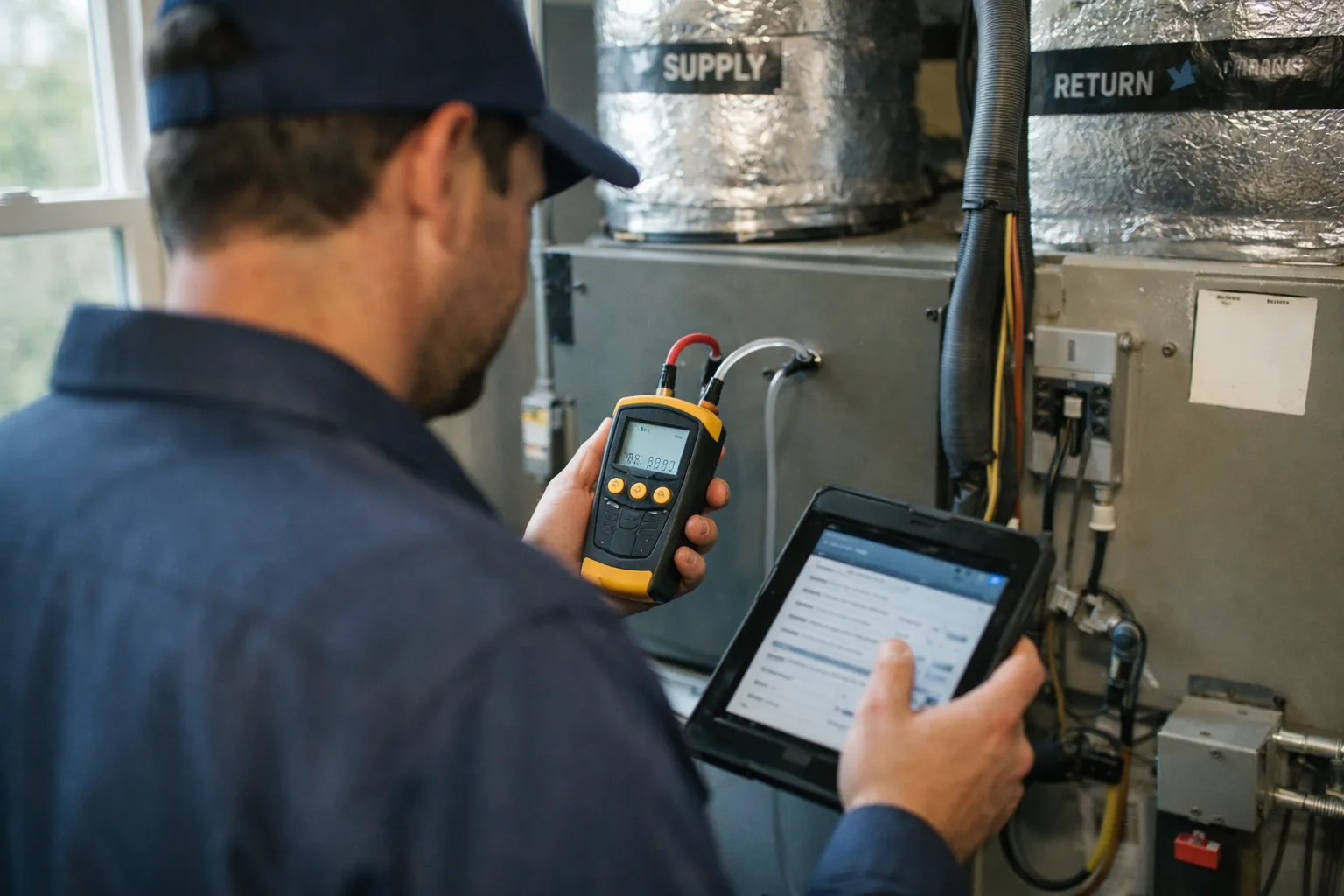
Independent field monitoring through 2025 and industry reporting into 2026 continue to show that properly commissioned variable‑speed systems produce materially better seasonal performance than single‑stage or basic two‑stage units—often in the doubledigit percent range for part‑load dominated climates. The critical caveat remains: real‑world performance tracks lab SEER2/HSPF2 only when three commissioning anchors are met—correct refrigerant charge, verified airflow, and duct tightness. Owners who skip thorough commissioning will not capture the expected efficiency premium.
Comfort and acoustics: why luxury buyers still choose inverter
The sensory return remains the primary driver in luxury homes. Variable‑speed machines run long and slow, creating a steady “climate layer”: minimal swing in room temperature, suppressed compressor cycling noise and better latent (humidity) control. These benefits are most pronounced in tightly sealed, well‑insulated homes and in open‑plan spaces where transient noise becomes perceptible.
Reliability and repair risk: electronics dominate the risk calculus
Field intelligence through November 2026 keeps electronics at the center of the failure landscape. The most consequential repair items are:
- Inverter/drive modules and their power electronics — sensitive to voltage transients and thermal stress.
- Proprietary communication/control boards — often model‑specific and, in some cases, dependent on OEM cloud authentication to function after replacement.
- ECM blowers and matched indoor modules — higher‑cost items and, where telemetry is required for warranty, tied to proactive service regimes.
However, two mitigation trends have reduced consumer pain points this year: (1) regional spare‑parts hubs have cut lead times for common boards in many metropolitan areas, and (2) improved OTA rollouts have reduced firmware‑induced lockouts by enabling safe rollback and staged deployments. That said, remote dependency has created new risk vectors—cybersecurity and network availability are now part of the uptime equation.
Multiple perspectives: contractors, manufacturers and owners in Nov 2026
Contractors: service packaging wins the high end
Top contractors now sell three deliverables as a package on premium installs: a commissioning dossier (Manual J/Manual D evidence, duct static and airflow verification, refrigerant charge report), a firmware governance contract (OTA schedule, rollback policy, incident SLA), and a parts strategy (which spares are pre‑positioned and MTTR guarantees). Firms that bundle these items command higher fees but materially reduce owner callbacks and replacement accommodation costs.
Manufacturers: ecosystems, subscriptions and A2L readiness
Manufacturers have doubled down on ecosystem arguments. Beyond hardware, many now offer subscription services: enhanced OTA support, prioritized parts dispatch, and cloud diagnostics accessible to approved contractors. This model helps OEMs ensure feature parity (advanced defrost logic, humidity‑first control) while shifting part of the service burden from installers to manufacturer support centers. For buyers, the trade‑off is a small recurring fee in exchange for prioritized support and faster firmware remediation.
Owners: premium buyers demand predictable uptime and data transparency
Affluent homeowners treat HVAC like the drivetrain of a luxury car: refinement matters, but so does predictable service. The segment that purchases variable‑speed units expects written MTTR commitments, clear data‑privacy terms for telemetry, and documented parts lead‑time assurances. Where contractors can’t provide that level of certainty, buyers increasingly choose high‑quality two‑stage alternatives with elevated commissioning to lower electronic exposure while achieving similar perceived comfort.
Implications: Updated checklist for November 2026 buyers and owners
1) Vet A2L readiness early
Ask your installer for two recent local A2L permits and the names of inspectors who have signed off on similar installs. Confirm any witnessed testing requirements and who pays for them. If your jurisdiction still treats A2L as special‑handling, build extra time into the schedule.
2) Require commissioning plus a Firmware Governance Addendum
Commissioning is now baseline. Add a Firmware Governance Addendum that specifies: who controls OTA updates, a staged rollout protocol, rollback triggers, notification cadence, and an emergency remediation SLA. Require that logs from initial commissioning be preserved for at least 12 months and available to you on request.
3) Lock a parts and MTTR strategy into the contract
Obtain an explicit list of critical‑spare SKUs for the selected platform (inverter module, outdoor control board, indoor control board, ECM blower), typical local lead times, and whether the contractor stocks any of them. For luxury properties, negotiate an option to pre‑purchase a spare inverter module or to include a parts‑pool subscription that guarantees next‑business‑day dispatch within a defined radius.
4) Insist on cybersecurity and data‑privacy clauses
With remote diagnostics now common, require encryption standards for telemetry (TLS 1.2+), a limited data‑retention policy, and an explicit statement on who can access OEM cloud logs. If the contractor uses third‑party integrators, require SOC‑2 or equivalent assurances where available.
5) Consider hybrid resiliency for critical properties
For primary residences where comfort uptime is non‑negotiable, consider hybrid strategies: dual‑compressor zoning, integrated backup heat with automated switchover, or paired two‑stage indoor units to reduce single‑point electronic exposure. These approaches increase capital cost but reduce downtime risk where operator or parts access is uncertain.
Outlook: What to watch for through 2027–2028
- A2L normalization: inspector training and manufacturer pre‑submittal toolkits will continue to reduce permitting variability into 2027, easing administrative friction for most homeowners.
- GIV monetization: utilities will refine payment structures for modulating HVAC assets; homeowners who secure competent commissioning and control integration can expect recurring seasonal credits in many regions.
- Service stratification: the market will further bifurcate—contractors who invest in commissioning, firmware governance and spare‑parts pools will dominate the luxury segment, while price‑focused firms will compete on first‑cost alone.
- Insurance and extended warranty innovation: expect insurers and OEMs to roll out uptime products and parts‑replacement insurance for smart HVAC assets by 2027, reducing some of the owner’s financial exposure to long lead times.
FAQ
Do variable‑speed heat pumps require different contracting language?
Yes. For inverter systems insist on a commissioning dossier, a Firmware Governance Addendum (OTA policy with rollback provisions), and explicit parts/MTTR commitments. These elements materially affect long‑term uptime and ownership experience.
Is A2L refrigerant adoption increasing homeowner risk?
Not when the installer and local authorities are experienced. A2L refrigerants are mildly flammable and require specific handling and permitting, but trained contractors and familiar inspectors complete installations safely. The primary remaining risk is administrative—delays where jurisdictions are still building inspection capacity.
Can OTA firmware updates cause system failures?
Occasionally, if updates are poorly staged. The risk is reduced by staged rollouts, automated rollback triggers and clear SLAs. Require these protections in writing and ensure your contractor documents every update during the first 12 months after install.
What critical spare parts should luxury buyers consider pre‑securing?
At minimum, confirm local availability for the outdoor inverter/drive module, outdoor control board, indoor control board, and the matched ECM blower. For high‑value properties, negotiate a parts‑pool subscription or the option to pre‑purchase a spare inverter module to minimize MTTR.
How should owners weigh efficiency gains against repair exposure?
Evaluate total cost of ownership: projected energy savings, comfort value, expected maintenance, and downtime risk. If you can secure strong commissioning, firmware governance and a parts strategy, variable‑speed systems typically justify their premium. If local service support is thin, prioritize duct and distribution improvements or a high‑quality two‑stage alternative.