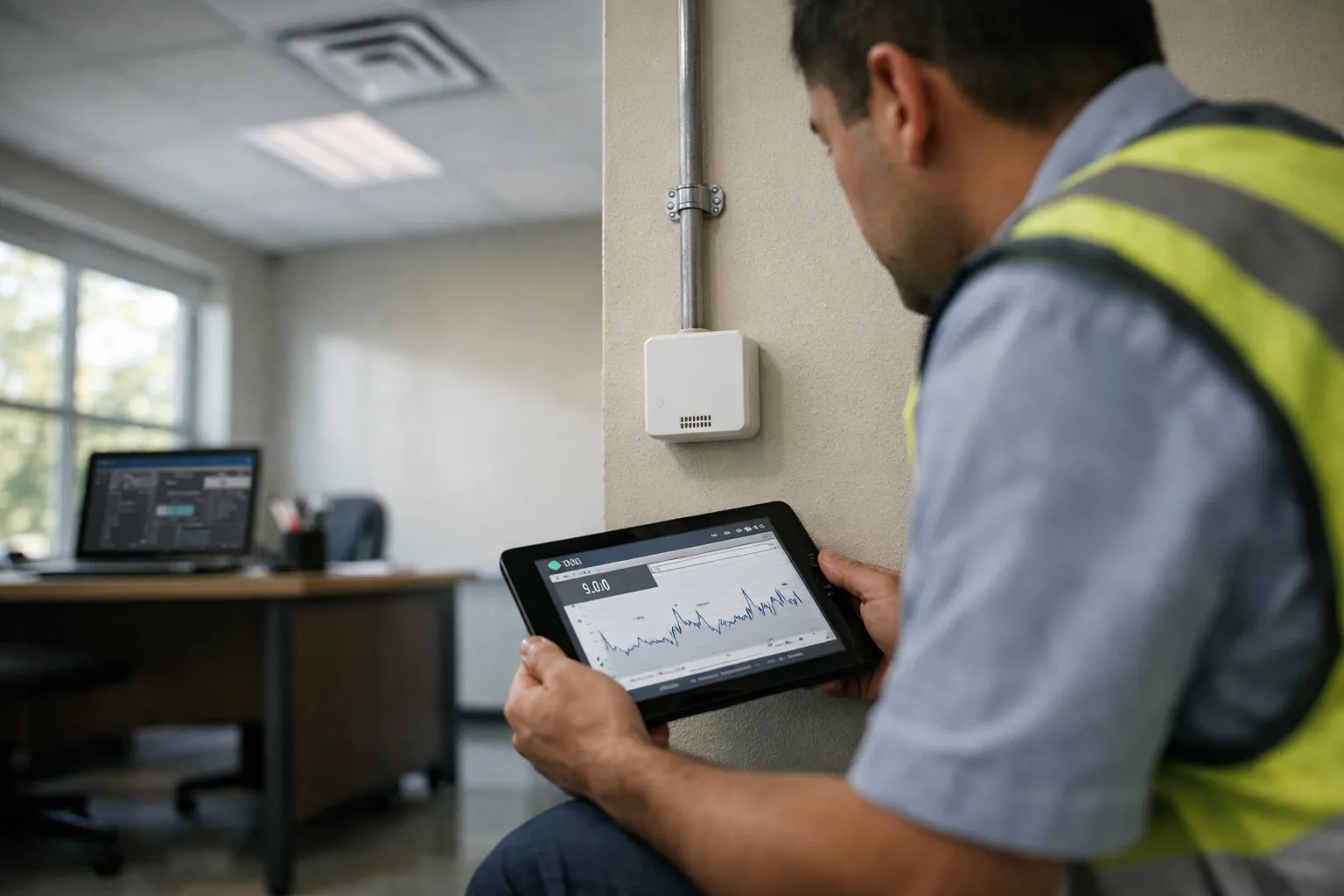
This updated guide gives HVAC enthusiasts and technicians a practical, field-ready workflow for implementing CO2-based demand-controlled ventilation (DCV) in classrooms in July 2026. You will get current sensor guidance, secure integration best practices, updated control sequences, commissioning tests that reflect modern analytics, and troubleshooting tips that reflect the field lessons and technology shifts since 2024. This is intended for controls engineers, commissioning agents, facilities managers and experienced technicians who implement or maintain classroom DCV.
Why CO2-based DCV for classrooms (and what's changed by 2026)?
CO2-based DCV remains one of the highest-impact measures to reduce HVAC energy while maintaining acceptable indoor air quality in classrooms. The fundamentals are unchanged: CO2 is a reliable proxy for human occupancy and for the build-up of bioeffluent under typical classroom conditions. When correctly implemented, DCV:
- Reduces heating and cooling energy by lowering outdoor air (OA) intake when rooms are under-occupied;
- Helps maintain occupant comfort and supports cognitive performance by limiting CO2 exposure during lessons;
- Integrates with modern BMS and packaged-unit controls, including new secure protocols and edge controllers.
What’s new in 2026:
- Outdoor baseline CO2 is higher than a decade ago; plan for an external baseline around 420–425 ppm in 2026 when setting low-end control points.
- Sensor hardware and on-device filtering have improved: mid-range NDIR modules now commonly advertise stability and lower drift (e.g., ±(30 ppm + 3%) in field specs), and many sensors include temperature, RH and VOC channels for multi-parameter IAQ strategies.
- Secure building-control protocols such as BACnet/SC and TLS-protected MQTT are more widely available and recommended for sensor networks and cloud analytics.
- Edge analytics and sensor fusion (CO2 + PIR + door switches) are practical at low cost—useful for compensating limited sensor coverage without giving up accuracy.
- Public funding and district-level IAQ programs since 2021 accelerated deployments; many K‑12 clients expect monitoring data and ongoing KPI reporting as part of delivery.
Prerequisites and context
Before you begin, confirm these project basics:
- Reference ventilation requirements: ASHRAE 62.1 or local code still govern required per-person and per-area OA. DCV is an optimization layer, not a replacement for code compliance.
- System boundaries: identify if classrooms are single-zone (dedicated RTU/packaged unit) or part of a multi-zone AHU/DOAS. Control authority determines whether DCV is implemented at zone, AHU or edge controller.
- Network and cybersecurity: ascertain available protocols (BACnet/IP, BACnet MS/TP, BACnet/SC, Modbus TCP, Modbus RTU, analog 0–10 V). Prefer secure variants (BACnet/SC, TLS) for new installations or retrofit sensor networks that send telemetry to cloud analytics.
- Operational expectations: agree with facility managers on performance KPIs—typical are (1) %occupied time CO2 is below setpoint, (2) average OA reduction vs. constant ventilation, and (3) alarm handling and maintenance cadence.
Step 1 — Planning and system boundaries (updated)
- Record zone mapping: classroom sizes, typical occupancy, schedule patterns, and any irregular uses (club meetings, after-hours).
- Document existing OA modulation method: OA damper, VAV reheat boxes, DOAS with energy recovery, dedicated ERV, VFD-controlled fans, or packaged units. Note actuator response times and communication endpoints.
- Decide control authority early. For single-classroom packaged units, local zone-level DCV usually minimizes latency and network complexity. For multi-room AHUs, plan BMS-level aggregation with a clear sensor-to-AHU mapping and weighting rules.
- Plan for fallback and cybersecurity: require OA_min fallback on sensor loss; use VLANs, device authentication and encrypted channels where telemetry leaves the local network.
Step 2 — Selecting CO2 sensors (2026 guidance)
NDIR remains the field standard. Since 2024–2026 the market shifted toward higher-performing, lower-cost NDIR modules, but selection still matters.
- Technology: Choose true NDIR with temperature and RH compensation. Avoid CO2 proxies (e.g., metal-oxide VOC-based estimators) for control loops.
- Accuracy: Aim for devices rated at ±(30 ppm + 3% of reading) when budget allows. ±50 ppm remains acceptable for many DCV applications, but expect better mid-range options in 2026.
- Drift and calibration: Prefer sensors that document drift (ppm/year) and offer manual span or forced outdoor baseline calibration. Auto-baseline correction (ABC) is common—understand how it works: ABC assumes sensors see outdoor air periodically; it can miscalibrate in continuously occupied or sealed spaces.
- Outputs: Use native BACnet/IP, BACnet MS/TP or Modbus when connecting to a BMS; prefer secure transport (BACnet/SC or TLS-encrypted MQTT) if available. For simple packaged units, 0–10 V analog outputs are still acceptable.
- Additional sensors: Devices with integrated PIR, temperature, humidity and TVOC channels unlock sensor-fusion strategies that reduce false positives and improve occupancy inference.
- Firmware & lifecycle: Choose manufacturers that publish firmware updates and support secure OTA updates. Track serial numbers and maintain calibration logs for 3–7 year lifecycle planning.
Practical recommendation
For BMS-connected classrooms: wall-mounted NDIR with BACnet/IP or BACnet MS/TP output and specified accuracy ±(30 ppm + 3%) is a current best choice. For standalone packaged units: 0–10 V NDIR with local display, local logging and documented calibration procedures remains reliable. Avoid low-cost, Wi‑Fi-only CO2 toys for control applications unless they meet stated accuracy and security requirements.
Step 3 — Placement and mounting (no excuses)
Poor placement still causes most field failures. Apply these updated placement rules:
- Mount at breathing zone height: ~1.2 m (4 ft) on an interior wall, away from supply diffusers, returns, doors and windows.
- Keep at least 1–2 m from supply diffusers or return grilles to avoid biased readings. For radiantly heated ceilings or rooms with upward stratification (tall rooms), locate sensors where occupants breathe.
- For large or irregular rooms (>1,000 ft²) or spaces with sub-zoning, use two sensors and implement averaging or maximum-of-zones logic at the controller.
- Avoid placing sensors next to CO2 sources (e.g., staff kitchens, labs) and avoid mounting near exterior walls subject to drafts.
Step 4 — Control sequence design (modernized)
Design DCV as a simple, predictable loop with fail-safe behavior and secure telemetry. Use proportional control where hardware supports it and staged control where not.
Updated baseline and setpoints
Given higher outdoor CO2, set your control low point relative to measured outdoor baseline (measure site-specific outdoor CO2 during commissioning). Typical values in 2026:
- CO2_min ≈ outdoor_baseline + 30–50 ppm (usually ~450–475 ppm in 2026)
- CO2_set (target) = 800–900 ppm for general classroom use; tighter (700–800 ppm) for sensitive populations or where recommended by stakeholders
- CO2_max (escalation) = 1,100–1,300 ppm as alarm/upper bound depending on system capacity
Proportional control (recommended)
Map CO2 to OA% proportionally between OA_min and OA_max with clamping and integrator time constants:
- CO2 = CO2_min: OA = OA_min (must meet code)
- CO2 >= CO2_max: OA = OA_max (system capacity)
- If CO2 between CO2_min and CO2_max: OA% = OA_min + (OA_max − OA_min) * ((CO2 − CO2_min) / (CO2_set − CO2_min)), clamped at OA_max
Use a 2–5 minute low-pass filter on the CO2 value and include hysteresis of 40–60 ppm to prevent hunting. Where PID controllers are used, reduce integral action and use slower integral times to avoid overshoot during class transitions.
Staged control (simple systems)
For systems without modulating actuators, use 3 stages: OA_min, OA_mid (+25–40%) and OA_max. Trigger stages at ~850 ppm and ~1,050 ppm with 40–60 ppm hysteresis.
Zone aggregation strategies
When multiple classrooms are served by one AHU, decide aggregation rule:
- Max-of-zones: ensures the most occupied classroom gets ventilation but may over-vent others.
- Weighted average: weights zone CO2 by floor area or occupancy; reduces OA waste but risks leaving some rooms under-ventilated if weights are wrong.
- Hybrid: use max-of-zones during high-occupancy hours and weighted average during transitional periods. Document the logic and obtain stakeholder signoff.
Step 5 — Implementing the controls (security & data)
- Program fallback behavior: loss of sensor data or communication must revert to OA_min and raise a visible alarm to maintenance.
- Telemeter key points: CO2, OA damper position, supply fan speed, zone temperature and occupancy flag. Log at 1–5 minute intervals; 1-minute sampling is recommended if storage and bandwidth permit.
- Use secure transport: prefer BACnet/SC, BACnet/IP over VPN, or TLS-encrypted MQTT for cloud telemetry. Apply device authentication and least-privilege access controls.
- Implement firmware management: test and apply vendor firmware updates on a staging device before fleet rollouts; preserve calibration offsets during updates.
Step 6 — Commissioning tests (updated for 2026)
Commission both the physical system and the data pipeline. Below are practical acceptance tests and modern analytics checks.
- Baseline outdoor check: Measure outdoor CO2 for 30–60 minutes near outdoor intake at times representative of occupancy. Record the mean (expect ~420–425 ppm in 2026 depending on location).
- Baseline interior check: With the classroom empty and HVAC at OA_min, log CO2 for 30 minutes. Expect readings close to outdoor baseline + 30–50 ppm; investigate if >500 ppm.
- Sensor cross-check: Use a calibrated portable NDIR reference to spot-check wall sensors in at least three positions (center, near occupancy, near return). Differences should be within the installed sensor accuracy (±30–50 ppm).
- Full-occupancy stabilization: Simulate a class at full expected occupancy for 45–60 minutes. Confirm CO2 rises and OA responds per sequence. Verify CO2 stabilizes near CO2_set when OA_max is available.
-
Decay (ventilation rate) test with analytics: After occupancy, vacate the room and record CO2 decay. Compute ACH via the standard decay formula:
n = -ln[(C(t) − C_out)/(C0 − C_out)] / t
Run this test at least twice and compare measured ACH to design ACH. Also compare decay-derived ACH to the expected OA when OA_min is commanded.
- Actuator response and timing: Step OA from min to max and back; verify damper position and VFD speed follow commands and settle within expected times (typically 3 minutes per step). Log timestamps for control audit trail.
- Network and failover: Simulate sensor communication loss and confirm fallback to OA_min and that alarms propagate to the maintenance dashboard. Verify remote analytics still display last-known-good readings and that control reverts locally.
- Data quality and KPI check: After 30–90 days, run analytics to compute: percent of occupied hours where CO2 > CO2_set, average OA reduction versus constant baseline, and energy delta (if BAS energy meters exist). Use these KPIs for tuning.
Example calculation (2026)
For a 900 ft² (84 m²) classroom with 30 students, using Rp = 5 cfm/person and Ra = 0.12 cfm/ft²:
- OA required = (5 cfm × 30) + (0.12 cfm/ft² × 900 ft²) = 150 + 108 = 258 cfm (≈122 L/s)
Set OA_min = 258 cfm to meet code baseline. If AHU capacity is 600 cfm, map CO2 range (CO2_min ≈ 450 ppm to CO2_set = 900 ppm) to OA 258–600 cfm per your proportional mapping formula.
Troubleshooting common issues (with 2026 fixes)
- Drifting sensors: If CO2 slowly trends upward without occupancy change, verify sensor firmware, clean sensor inlet, and check ABC behavior. If ABC is active in a continuously occupied room, schedule periodic manual outdoor-span calibrations.
- Control oscillation: Add a 2–5 minute low-pass filter to the CO2 input and increase hysteresis. If using PID, lengthen integral time and lower gain.
- Insufficient ventilation: If OA_max cannot hold CO2 below setpoint during full occupancy, verify occupancy assumptions, consider occupancy limits, or provide supplemental ventilation (portable HEPA units with known CADR). Document any occupancy changes for liability reasons.
- False low readings: Relocate sensors away from returns, or add another sensor and use max-of-sensors logic.
- Network or OTA failures: Maintain a local control fallback on the unit controller. Keep a local display for quick field verification and require firmware change approvals.
Maintenance and long-term verification
- Clean sensors quarterly and inspect for dust, paint overspray, or insect ingress.
- Check calibration annually; many sites now keep a rolling factory recalibration schedule every 3–5 years depending on observed drift.
- Monitor KPI dashboards monthly: %occupied hours below setpoint, alarm frequency, and energy impact.
- Maintain firmware/version control and proof of testing for each update. Retain logs for at least 1 year for trend analysis and stakeholder reporting.
Final tips and real-world considerations
- Be conservative with setpoints where capacity is marginal—protect occupant health and performance over aggressive energy savings.
- Where multiple classrooms share AHUs, coordinate controls to avoid one room monopolizing OA—use hybrid aggregation (max-of-zones during peaks, weighted average otherwise).
- Engage teachers and facility staff during commissioning; simple behaviors (opening windows) affect control outcomes and must be documented in occupant guidance.
- Document everything: sensor serials, calibration dates, control logic, archived logs, and commissioning evidence. Districts increasingly require this documentation for funding compliance.
Common mistakes to avoid
- Relying on default ABC settings without understanding occupancy patterns.
- Mounting sensors directly above diffusers or returns.
- Failing to secure sensor networks—unsecured telemetry is an attack vector for building systems.
- Neglecting to log and review data—DCV requires data to verify savings and IAQ outcomes.
Pro tips
- Use sensor fusion: combine CO2, PIR and door contacts to detect sudden occupancy changes (e.g., short training sessions) and avoid OA overshoot.
- Log at 1-minute intervals during commissioning; drop to 5-minute steady-state logging later to save storage if needed.
- When replacing sensors, preserve previous calibration offsets and run a 7‑day side-by-side comparison before switching to new data sources.
- In districts with central analytics, standardize sensor models and firmware to simplify fleet management and reduce support costs.
FAQ
Is CO2 a direct measure of all indoor air quality concerns?
No. CO2 is an occupancy proxy that correlates with human bioeffluent and exhaled aerosols but does not measure VOCs, particulates (PM2.5), or radon. Use additional sensors (TVOC, PM) if those contaminants are a concern.
How often should CO2 sensors be calibrated or checked?
Field checks annually are recommended. Many modern NDIR sensors will remain within tolerance for 3–5 years, but verify drift annually and perform factory recalibration according to the manufacturer or observed drift. Be cautious with auto-baseline correction in continuously occupied spaces.
What setpoint should I use for classrooms in 2026?
Common practice is to target 800–900 ppm for general classrooms, with CO2_min set relative to the outdoor baseline (usually outdoor +30–50 ppm). For sensitive populations or stakeholders that request stricter IAQ, target 700–800 ppm if the mechanical system can support it.
How should I handle cybersecurity for sensor networks and telemetry?
Use secure transport (BACnet/SC, TLS-based MQTT) where available, authenticate devices, separate IoT sensors on VLANs with firewall rules, and require firmware change control. Ensure the BMS and cloud analytics enforce least-privilege access for users.
What KPIs prove DCV success?
Track: (1) percent of occupied hours where CO2 ≤ setpoint, (2) average CO2 during occupied periods, (3) energy savings vs. a constant-ventilation baseline, and (4) alarm and sensor-failure rates. Use 30–90 day rolling reports for tuning and stakeholder reporting.
CO2-based DCV remains a mature, cost-effective measure for classrooms in 2026, but the implementation bar has risen: better sensors, secure networks, and analytics are expected. Follow the steps above, adopt conservative controls where capacity is constrained, and maintain a disciplined commissioning and maintenance program to sustain IAQ and energy benefits.