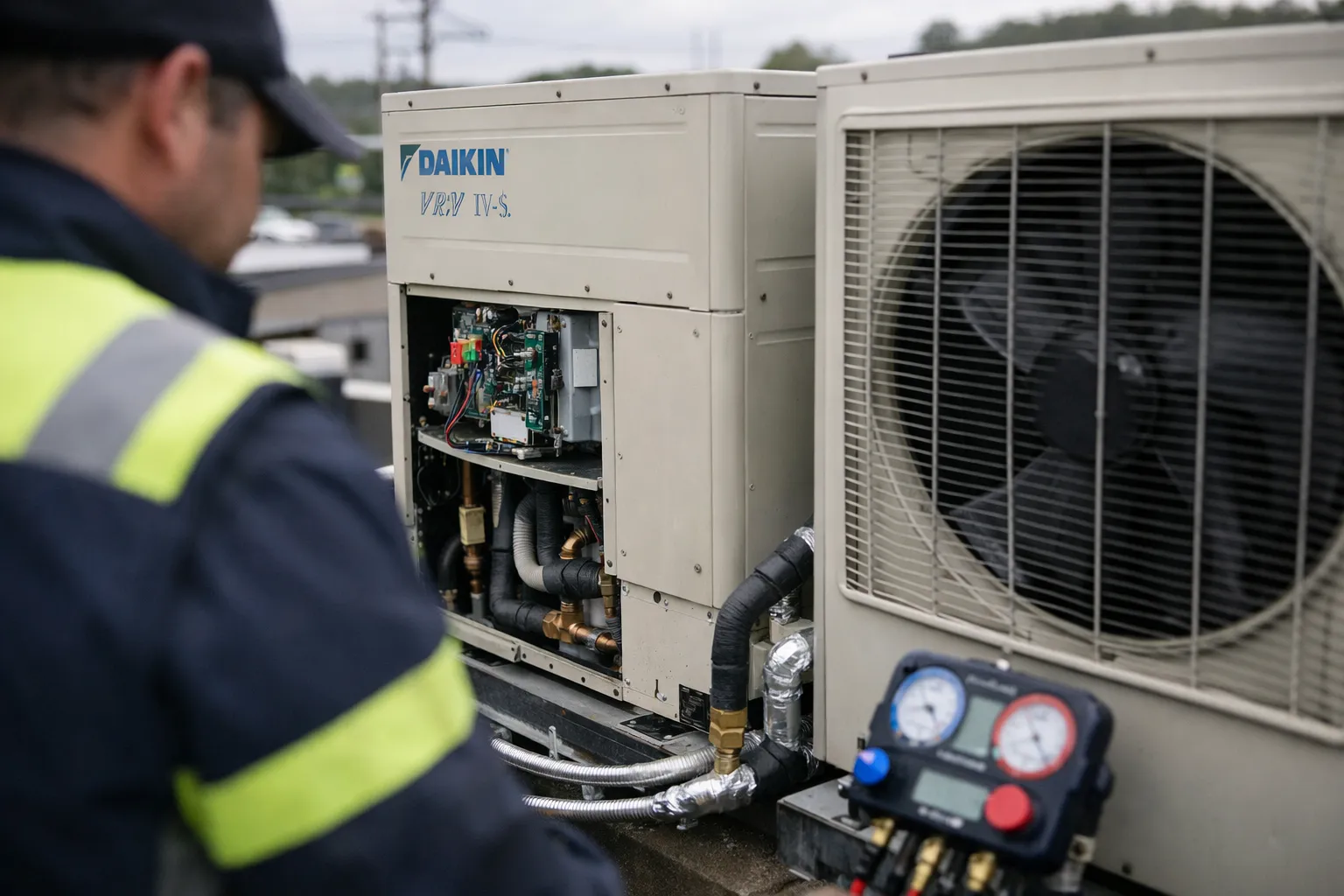
Daikin’s VRV family has long been a benchmark for variable‑refrigerant‑flow (VRF) HVAC in commercial buildings. The VRV IV‑S — commonly specified in projects that need compact outdoor footprints, extensive zoning and simultaneous heating/cooling — is now widely installed with R‑32 refrigerant. This review evaluates the IV‑S as deployed in 2026: its engineering strengths, operational tradeoffs, service and safety implications of R‑32 (an mildly flammable A2L), and where it best fits in today’s small‑to‑mid commercial market.
What the IV‑S brings to the table
- Heat‑recovery VRF: Individual indoor units can simultaneously heat and cool different zones by transferring refrigerant between branches, improving thermal control in mixed‑use spaces such as hotels, offices, or multifamily buildings.
- R‑32 refrigerant: Lower GWP than R‑410A (R‑32 GWP ~675 vs R‑410A ~2088), reducing carbon‑equivalent charge and future regulatory exposure. R‑32 is A2L (mildly flammable), which affects installation practice and code compliance.
- Compact outdoor modules: Space‑efficient outdoor units and modular multi‑compressor architecture simplify rooftop or ground installations where footprint and weight matter.
- Integrated controls and connectivity: Native unit controllers with compatibility for BACnet/Modbus and Daikin’s building management integrations enable central monitoring and scheduling; onboard fault diagnostics assist commissioning and service.
- Wide modulation range: Inverter compressors and electronic expansion valves provide fine capacity control and part‑load efficiency — crucial for variable occupancy buildings.
Performance and efficiency
In practical installations the IV‑S demonstrates the typical VRF advantage: high seasonal efficiency in part‑load operation and tight zone temperature control. Because the system can reject and absorb heat across zones, overall energy use is often lower than separate packaged rooftop units when significant simultaneous heating/cooling occurs.
Key performance notes for owners and specifiers:
- Seasonal COPs and SEER/IEER ratings depend heavily on system zoning, outdoor unit selection and refrigerant piping layout; expect best results where terminals are grouped by similar thermal loads and coil matches are optimized.
- Heat‑recovery saves energy in mixed‑use buildings (e.g., meeting rooms and perimeter offices) but delivers less benefit in mono‑mode buildings that only require cooling or heating.
- Controls integration with building automation pays off: coordinated scheduling, demand limiting and optimal start/stop reduce runtime on low‑load days.
Installation, commissioning, and serviceability
VRF systems require careful design and commissioning to achieve advertised efficiency. For the IV‑S this means:
- Piping discipline: Long refrigerant lines and vertical risers are possible, but pressure drops, oil return and charge must be calculated for the specific layout.
- A2L handling: R‑32 requires A2L‑aware installation practices: reduced refrigerant charge per room where codes require, ventilation and leak‑detection planning for enclosed mechanical spaces, and updated hot‑work and brazing protocols. Local code acceptance varies — check jurisdictional allowances and inspection expectations early.
- Commissioning focus: Verify EEV operation, superheat across indoor units, branch‑selector operation (if used), and heat‑recovery mode transitions. Expect longer commissioning time versus rooftop units; budget for it.
- Service access & spares: Daikin’s dealer network generally stocks common replacement modules and control boards, but specialized compressors or boards can have lead times; plan spare‑parts strategy for critical sites.
Safety, regulation, and A2L implications in 2026
By 2026, adoption of lower‑GWP refrigerants like R‑32 has accelerated, but A2L status continues to shape design decisions. Real constraints to keep in mind:
- Some local mechanical codes and inspectors still impose volume or room‑size limits for A2L refrigerant charge in indoor spaces; designers frequently use outdoor‑only refrigerant rooms, minimized indoor risers or secondary‑loop approaches where codes are restrictive.
- Insurance and landlord approval sometimes require documented leak‑detection and ventilation strategies for mechanical rooms handling refrigerant risers or 2‑inch double walls.
- Training: contractors and technicians must be trained and credentialed for A2L service practices (brazing procedures, gas detectors, emergency protocols).
Pros and cons — succinct summary
- Pros: Excellent zoning and thermal comfort, strong part‑load efficiency, compact outdoor footprint, effective for mixed‑use buildings, lower GWP refrigerant reduces carbon exposure.
- Cons: A2L refrigerant handling increases installation complexity and administrative overhead; higher upfront cost and longer commissioning; refrigerant leaks greater operational risk than water‑based central plants if not managed.
Who should choose the IV‑S?
The VRV IV‑S is a solid fit for:
- Small‑to‑mid commercial buildings requiring many independent zones (boutique hotels, multi‑tenant offices, condominium‑class multifamily).
- Sites with limited rooftop or mechanical‑room footprint where modular outdoor units help packaging.
- Owners prioritizing fast tenant comfort control and lower operational energy where simultaneous heating/cooling is common.
Consider alternatives if you need: large central chilled‑water capacity for process loads, extremely low‑cost first costs for speculative retail where tenants control HVAC, or sites with restrictive A2L rules that make refrigerant containment impractical.
Practical recommendations for specifiers and owners
- Engage an experienced VRF designer early. Design decisions on piping topology, branch selector placement and control integration materially affect energy and serviceability.
- Confirm jurisdictional acceptance of R‑32 and document compliance strategy with AHJ before bidding.
- Specify contractor training and A2L service credentials in the bid. Require a commissioning plan and acceptance tests tied to performance targets (IEC/ASHRAE test points).
- Design leak‑detection and ventilation for refrigerant‑exposed spaces, and consider refrigerant‑containment features where occupants occupy below‑grade or tight spaces.
- Factor total lifecycle cost: durability, service network, and potential refrigerant retrofits vs short‑term capital cost.
Bottom line
Daikin’s VRV IV‑S with R‑32 offers a compelling combination of zoning precision and reduced global‑warming potential that suits many small‑to‑mid commercial projects. The technology delivers clear operational benefits where simultaneous heating and cooling and part‑load efficiency matter. However, A2L refrigerant handling and higher upfront complexity mean owners must budget for higher design, commissioning and trained‑technician costs. For teams that plan accordingly, the IV‑S is a forward‑leaning, practical VRF choice in 2026.