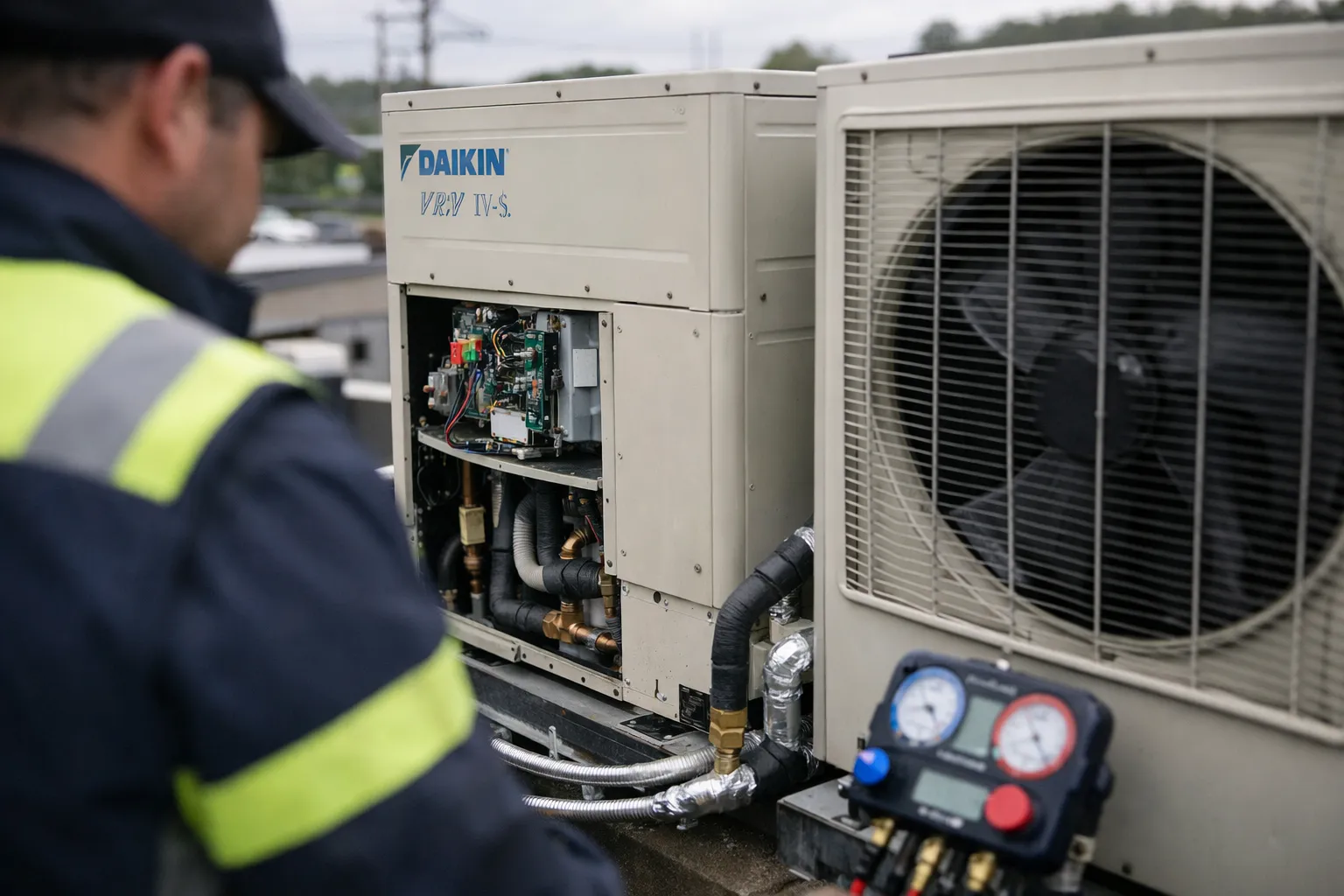
Daikin’s VRV IV‑S remains a compact, heat‑recovery VRF option for small‑to‑mid commercial buildings. This September 2026 update revisits the IV‑S as deployed with R‑32 (GWP ≈675, A2L mildly flammable) and adds the latest real‑world lessons, market trends, commissioning best practices and cost guidance that matter to specifiers today.
Overview — What we’re reviewing
- Product: Daikin VRV IV‑S heat‑recovery VRF family (R‑32 refrigerant configuration)
- Key specs at a glance: Heat‑recovery capability, inverter compressors, electronic expansion valves, modular outdoor footprint, BACnet/Modbus compatibility, multi‑compressor outdoor modules (model ranges vary by capacity).
- Primary differentiator: Compact outdoor packaging plus branch heat recovery for simultaneous heating and cooling in many zones.
Background — who makes it and the market context
Daikin remains one of the largest global VRF manufacturers; the IV‑S targets small‑to‑mid commercial projects that need many independently controlled zones, limited outdoor space and the ability to recover heat between zones (hot rooms cooling while core spaces need heating). By 2026, the VRF market has moved decisively toward lower‑GWP refrigerants—R‑32 in many markets—so the IV‑S’s R‑32 offering is now mainstream in Europe, Asia and many U.S. projects where AHJs accept A2L refrigerants.
Features analysis — what’s new or different in 2026
- Wider A2L acceptance but local variance: Through 2024–2026, many jurisdictions updated mechanical rules or published guidance that allows R‑32 systems with mitigation (charge limits, ventilation, leak detection). Still: acceptance and permit detail vary—confirm AHJ early.
- Improved digital diagnostics: Daikin’s native controls and cloud integrations now commonly include fault‑trend logging and remote analytics services (dealer/cloud dashboards) that cut diagnostic time during warranty period. These tools materially reduce service calls for common alarms.
- Practical field optimizations: Specifier workflows increasingly favor grouping indoor units by thermal profile, using branch selector manifolds intentionally and limiting long, mixed‑load runs to preserve oil return and capacity modulation.
- Lifecycle and refrigerant strategy: Owners are factoring refrigerant‑GWP exposure and potential future retrofits into lifecycle models. R‑32 reduces carbon‑equivalent charge versus R‑410A but introduces A2L handling and insurance considerations.
Performance & efficiency — what to expect now
Operationally the IV‑S still delivers the core VRF advantages: high part‑load efficiency, fine zone control and useful heat‑recovery gains in mixed‑use buildings. Two practical updates:
- Real installations in 2025–2026 show the largest efficiency gains when indoor units are grouped by similar load profiles and controls are integrated with BAS for sequencing, optimal start and demand limiting.
- Measured seasonal performance depends strongly on piping topology and branch selector sizing—poor layout erodes IEER/SEER gains more than minor differences in outdoor module selection.
Installation, commissioning & serviceability — updated best practices
Specifiers and owners now routinely include the following as standard contract deliverables for R‑32 IV‑S projects:
- AHJ acceptance plan: A written strategy showing refrigerant charge calculations, ventilation strategy and leak detection prior to submittal. Early AHJ engagement shortens permit review.
- A2L competent crew requirement: Require manufacturer‑certified A2L training and documented brazing/hot‑work procedures in the contract. Many owners now mandate a site safety plan and gas‑detector calibration record for the commissioning period.
- Commissioning tests: Verify EEV/Evap superheat at representative loads, branch‑selector and two‑phase piping behavior, oil return indicators and staged compressor transitions. Require a performance‑based acceptance test (kW vs load) rather than only component checks.
- Spare‑parts & remote support: Include a spare parts kit (common PCBs, fuses, filters) and remote diagnostic access in the service contract. Lead times for some VRF compressors remain several weeks in constrained markets—plan for critical sites.
Safety, regulation and A2L implications in Sept 2026
Since mid‑2024, industry guidance and manufacturer material have matured; however, three practical realities remain:
- Local code differences persist—while many AHJs accept R‑32 in rooftop‑mounted outdoor modules and building risers with mitigation, some jurisdictions still limit indoor room charge without secondary loop designs.
- Insurance underwriters increasingly request documentation: leak detection, ventilation calculations and technician certifications. Expect insurers on larger projects to require written refrigerant management plans.
- Contractors without A2L practice perform poorly in service metrics; owners should specify A2L competence and confirm contractor programs for brazing safety, combustible‑gas detection and emergency procedures.
Pricing & value — 2026 guidance
Real costs vary by region, capacity, number of indoor terminals and control scope. Typical range examples (U.S. market, September 2026):
- Equipment only: Single outdoor IV‑S module (3–8 nominal tons) typically ranges $8,000–$22,000 depending on capacity and model; indoor terminal prices vary $600–$2,000 each by type.
- Installed project cost: Small 6–12 ton heat‑recovery systems (outdoor + 6–12 terminals) typically install for roughly $30,000–$80,000 depending on piping complexity, controls and A2L mitigation items (ventilation, detectors). Large variable ranges reflect labor, line‑set lengths and commissioning scope.
- Service & warranties: Standard manufacturer warranty covers compressors and parts for 1–5 years; extended service agreements with remote monitoring cost extra but reduce unexpected downtime on critical sites.
Value proposition: For mixed‑use buildings with simultaneous heating/cooling, the IV‑S typically repays higher upfront cost with operational energy savings, improved tenant comfort and smaller rooftop footprints—if design, commissioning and A2L mitigation are budgeted.
Pros and cons — updated summary
- Pros: Refined digital diagnostics, mainstream R‑32 availability, strong part‑load efficiency, excellent multi‑zone comfort and compact outdoor footprint.
- Cons: A2L handling and documentation still add time and cost; commissioning demands are higher than packaged units; spare‑parts lead times and technician skill variability can affect uptime.
Who should choose the IV‑S?
Good fits:
- Boutique hotels, multi‑tenant offices and multifamily projects that need tight per‑room control and commonly experience simultaneous heating and cooling.
- Sites with constrained rooftop or mechanical‑room space that benefit from compact modular outdoor units.
- Owners who will invest in commissioning and a documented refrigerant management plan.
Consider alternatives where: AHJs prohibit A2L in occupied spaces without secondary loops; project budget cannot absorb commissioning/mitigation costs; or process loads require central chilled‑water systems.
Alternatives
- Mitsubishi Electric CITY MULTI (R‑32): Comparable heat‑recovery VRF with broad dealer network; similar A2L considerations.
- LG Multi V (R‑32): Competes on controls and indoor unit variety; strong remote diagnostics in dealer programs.
- Central water‑cooled heat pumps / chillers: Better when large, centralized cooling and process load economies are required or when owners want to avoid refrigerant throughout the building footprint.
Verdict
As of September 2026 the Daikin VRV IV‑S (R‑32) remains a practical, forward‑leaning choice for small‑to‑mid commercial projects that can budget for A2L‑aware design, commissioning and operations. Its zoning precision and part‑load savings are real—provided you engage experienced VRF designers, document AHJ acceptance early, require A2L‑trained contractors, and include leak‑detection/ventilation in the contract scope. For teams that plan for those requirements, the IV‑S delivers strong operational value and reduced carbon‑equivalent refrigerant exposure versus older R‑410A systems.
Frequently asked questions
Is R‑32 (A2L) safe for occupied commercial buildings?
R‑32 is classified A2L (mildly flammable). Safety is managed through code compliance, charge limits, ventilation and leak detection. Many jurisdictions allow rooftop outdoor units and properly mitigated indoor risers; others require secondary‑loop or refrigerant containment. The safe approach is to follow AHJ guidance, use manufacturer recommendations and require A2L‑trained technicians.
How much extra should I budget for A2L mitigation and commissioning?
Expect additional scope for leak detectors, ventilation calculations, written AHJ submittals and extended commissioning. On small projects this can add a few thousand dollars; on complex sites (enclosed mechanical rooms, long risers) mitigation and commissioning can add several percent to project cost. Get line‑item estimates during design.
Can existing R‑410A VRF systems be retrofitted to R‑32?
Direct retrofit from R‑410A to R‑32 is generally not recommended because of differences in lubricant compatibility, pressure and flammability class. Retrofits, if considered, require manufacturer approval and extensive component changes; replacement is more common.
What contracting language should owners include for IV‑S projects?
Include AHJ acceptance plan, mandatory manufacturer A2L training for technicians, a commissioning plan with performance‑based acceptance tests, spare‑parts kit, remote diagnostics access for the warranty period and leak‑detection/ventilation deliverables.
Where does the IV‑S make the biggest operational difference?
Mixed‑use buildings with simultaneous heating and cooling (e.g., perimeter offices vs interior meeting rooms, small hotels) see the largest energy and comfort benefits from IV‑S heat recovery versus separate rooftop units.