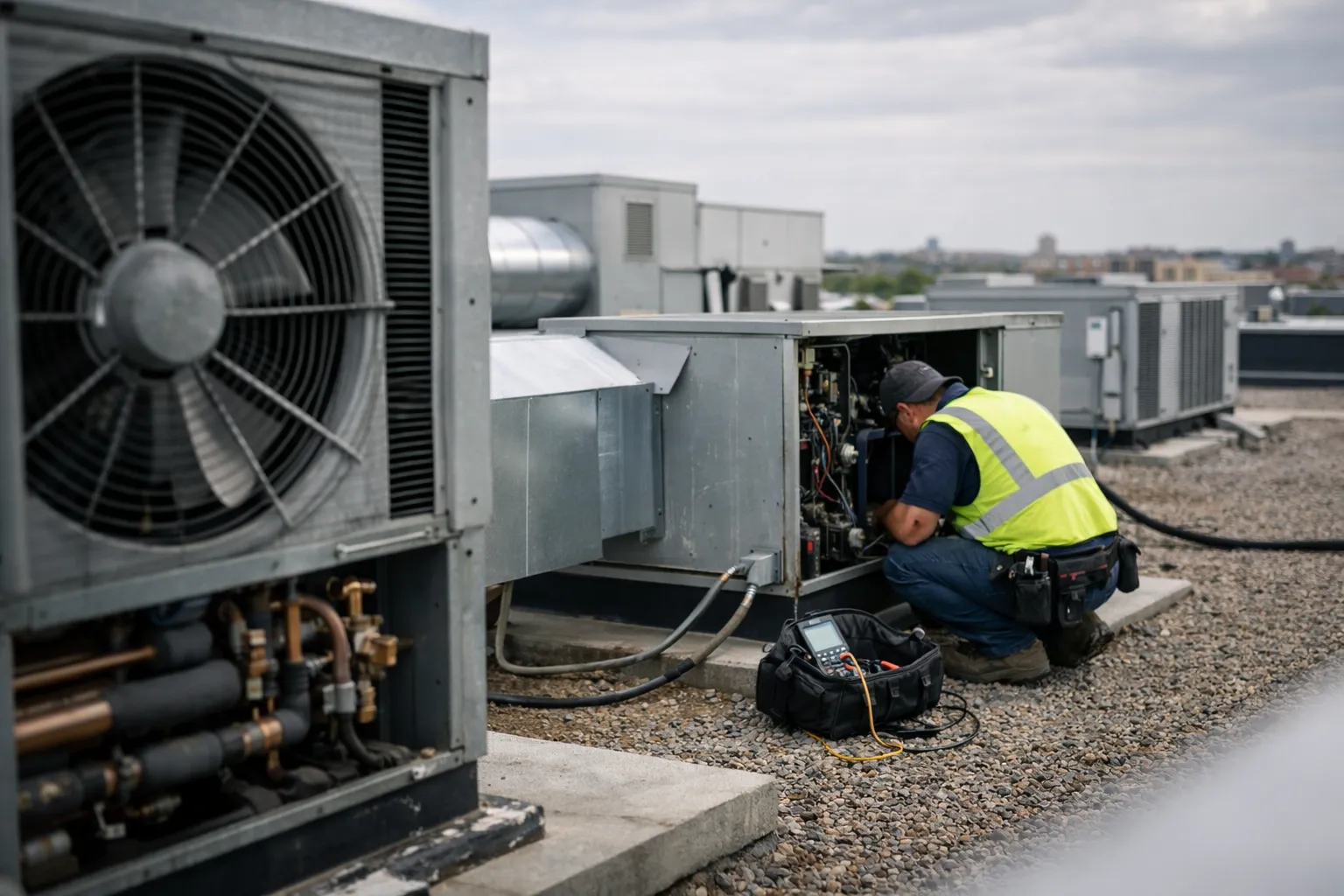
Who: U.S. Department of Energy (DOE). What: a Notice of Proposed Rulemaking (NOPR) to tighten minimum efficiency, set fan‑power limits, and require baseline controls for commercial rooftop units (RTUs). When: NOPR published in July 2026; status updated September 2026. Where: applicable to RTUs sold and installed in the United States. Why: to reduce commercial HVAC energy use, lower peak demand, and cut greenhouse‑gas emissions by aligning rated performance with in‑field operation.
Context — why this still matters
RTUs remain one of the largest single piece‑parts of commercial HVAC stock in the U.S., especially across retail, strip centers, small‑office and light industrial building types. DOE’s July 2026 NOPR builds on decades of federal appliance rulemakings that aim to shift the baseline of deployed equipment toward lower operating cost and lower carbon intensity. The proposal directly targets three persistent gaps in field performance: parasitic fan power from constant‑speed blowers, poor part‑load control that erodes seasonal efficiency, and lack of baseline control capabilities needed for demand response and diagnostics.
What’s new since July 2026
- Regulatory process: DOE published the NOPR in July 2026 and opened a stakeholder comment period. As of September 2026 DOE staff are reviewing technical submissions and modeling updates from manufacturers, utilities and efficiency advocates to refine the regulatory impact analysis.
- Industry positioning: Major OEMs — including Carrier Global, Trane Technologies, Lennox International, Daikin Applied and Johnson Controls — submitted technical comments and prototype data during the comment window demonstrating improved ECM fan and variable‑speed compressor availability across most capacity bands.
- Market trends: Procurement and component data through mid‑2026 indicate ECM fan modules and variable‑speed compressor costs have fallen roughly into the mid‑single digit percentage points compared with early‑2024 prices, driven by larger production runs and more supplier competition. That trend reduces the upfront premium for higher‑efficiency RTUs compared with two years ago.
- Incentives and pilots: Several utility programs and state energy offices announced targeted pilots in August 2026 to accelerate high‑efficiency RTU replacements in small commercial sectors; pilots focus on bundled rebates for ECM fans, controls integration, and commissioning support.
Details of the proposed technical changes (summary)
- Tighter full‑ and part‑load efficiency thresholds: DOE’s NOPR proposed higher minimum steady‑state and part‑load metrics across multiple capacity bands to better reflect seasonal operation.
- Fan‑power limits: new maximum allowable fan power (watts per cfm) for unitary air handlers intended to eliminate wasteful constant‑speed blower designs that dominate smaller RTUs.
- Baseline controls required: mandatory baseline features include basic fault detection & diagnostics (FDD), staged or variable‑speed modulation in larger units, native demand‑response compatibility (e.g., OpenADR‑capable or equivalent), and minimum onboard scheduling and setback controls.
- Updated test procedures: DOE proposed revisions to capture part‑load behavior and fan parasitic losses more accurately and to harmonize where possible with AHRI and ISO test procedures.
Impact — who will feel it and how
Building owners and facility managers: Expect more RTUs in procurement catalogs to ship with ECM fans, variable‑speed compressors and factory‑integrated controls. That lowers operating cost but shifts some upfront capital and project planning considerations toward commissioning and controls management.
Manufacturers and distributors: The manufacturer road map is moving from optional to likely standardization of several higher‑efficiency features. Smaller OEMs have warned of retooling costs; larger OEMs said the change is manageable but requires validation testing and supply‑chain coordination. Distributors will need to expand training and spare‑parts strategies for ECMs and inverters.
Contractors and service techs: Onsite commissioning and controls expertise becomes more central. Projects will likely budget 2–4% of equipment+installation cost for commissioning and initial controls tuning to secure lifecycle savings—an industry best‑practice that the NOPR implicitly makes more valuable.
Utilities and states: Incentives will be a bridge to accelerate adoption. Several utilities plan to align rebate thresholds with DOE’s proposed performance bands to create an early market for certified high‑efficiency RTUs.
Industry reaction — consensus and contention
Responses in the comment docket and at trade events in August and September 2026 fell into predictable camps: pro‑efficiency advocates and large utilities broadly welcomed higher part‑load and fan‑power requirements as a way to deliver verifiable savings; manufacturers supported the goals but flagged practical concerns about packaging, acoustic tradeoffs and small‑capacity model costs; contractors emphasized the need for workforce training.
“We support standards that ensure in‑field savings rather than just lab numbers, but the rule must allow realistic lead times and harmonization with AHRI test methods to avoid market disruption,” said an industry spokesperson for the Air‑Conditioning, Heating, and Refrigeration Institute (AHRI) in a Sept. 2026 statement to HVAC System Guide.
Practical recommendations — what HVAC specifiers and owners should do now
- Start updating procurement specs: require minimum part‑load performance metrics, specify fan‑power (W/cfm) limits, and include factory‑installed FDD and demand‑response compatibility (OpenADR 2.0 or equivalent).
- Include commissioning and controls budgets: allocate 2–4% of the equipment + installation cost for startup tuning, sensor calibration and BMS integration.
- Work with suppliers early: confirm availability, lead times and test data for ECMs and inverter compressors for the specific capacity bands you commonly specify.
- Train staff: invest in line‑item training on variable‑speed drives, inverter compressors, and controls integration; prioritize technical training for service teams now to avoid field shortfalls once the rule is final.
- Watch for utility incentives: align retrofit projects with state/utility rebate cycles and pilots that may cover part of the incremental cost.
What's next — timeline and key things to watch
- DOE review of comments: DOE is analyzing stakeholder submissions and updated test data through fall 2026 to refine cost‑benefit modeling.
- Final rule timing: based on typical DOE rulemaking cadence, stakeholders expect a possible final rule in 2027 with compliance windows staged across 2028–2031 to allow manufacturers inventory turnover and retooling.
- AHRI and standards harmonization: look for AHRI test‑procedure updates and potential revisions to AHRI 340/360 series to align with DOE’s approach.
- Utility alignment: more incentive pilots are likely in Q4 2026–Q1 2027, focused on small commercial RTU replacements with bundled commissioning support.
Questions contractors and specifiers are asking
Will RTU prices spike if the rule is finalized?
Expect a modest upfront premium on the first wave of compliant models, but OEM comments and component‑cost trends through 2026 indicate that premiums are shrinking as ECM and inverter supply scales. Incentives and lifecycle energy savings often outweigh the incremental first costs for owner‑occupied buildings.
What specific control features should I require today?
Require native scheduling, setback/setpoint limits, basic FDD, and demand‑response interoperability (OpenADR 2.0 or equivalent). Specify accessible BACnet/IP or Modbus endpoints for BMS integration and ensure factory commissioning and a verification report are part of the delivery.
How should I budget for commissioning and training?
Plan for commissioning costs equal to roughly 2–4% of equipment plus installation. For training, set aside funds for one or two vendor‑led sessions per year and prioritize controls and variable‑speed drive coursework for field techs.
Are retrofit kits a practical alternative?
For many cases, high‑efficiency retrofit kits (ECM fan modules, advanced controls packages) offer a faster, lower‑capital path to improve existing RTU performance. Evaluate on a case‑by‑case basis using measured baseline performance and payback analysis; utility rebates can improve economics.
For HVAC professionals, the July 2026 NOPR is not just regulatory noise — it signals a system‑level change in how RTUs will be evaluated and procured. Between now and DOE’s final action, the most valuable moves are practical: update specs, secure supplier commitments, budget for commissioning, and take advantage of utility pilots that defray costs of the first compliant equipment in the field.