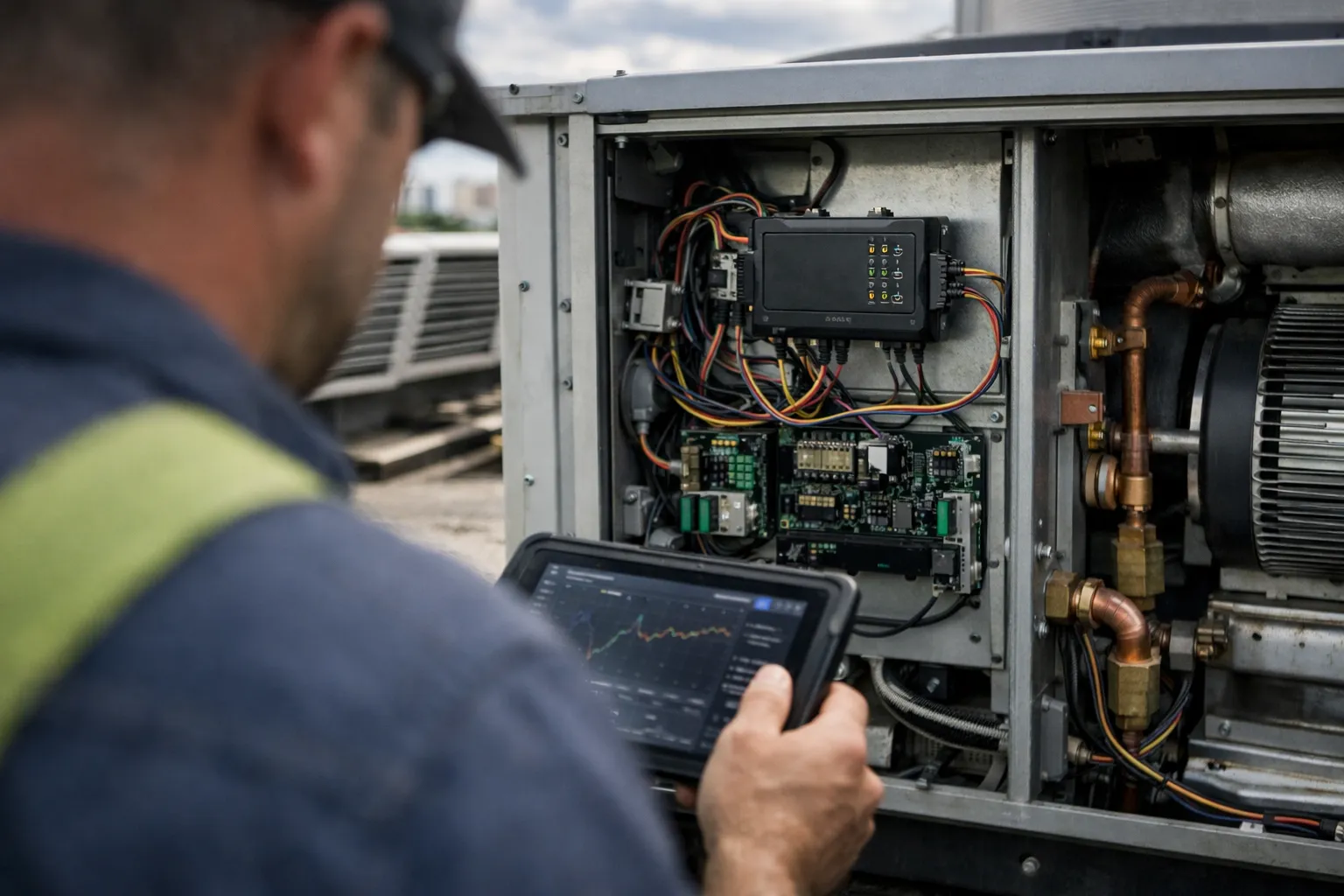
Fault Detection and Diagnostics (FDD) tuned for air-handling units (AHUs) is now moving to the edge. Advances in low-power CPUs, robust IIoT protocols, and light-weight ML runtimes let buildings detect faults close to the equipment — reducing latency, preserving bandwidth, and enabling local automated corrective actions. This guide walks HVAC enthusiasts through a practical, step-by-step process to plan, implement, commission, and maintain an edge-based FDD system for commercial AHUs in 2026.
Why edge-based FDD for AHUs?
Edge FDD places model inference and decision logic on-site — typically on an industrial gateway or a compact compute device — rather than sending all raw telemetry to the cloud. Key advantages for AHUs:
- Lower latency for automated responses (e.g., damper reposition, start/stop auxiliary fans).
- Reduced network usage and cost by transmitting only events and summaries.
- Improved data privacy and resilience: detection continues when WAN is intermittent.
- Enable on-site technicians with real-time diagnostics and contextual data.
Overview of the step-by-step process
- Define scope and success metrics
- Inventory AHU assets and sensors; upgrade where needed
- Choose an FDD architecture (edge vs. hybrid)
- Select hardware, software stack, and protocols
- Map data, standardize naming, and set sample rates
- Develop or select detection models and rules
- Integrate with the BAS and work-order systems
- Commission, validate, and tune
- Operationalize: alerts, workflows, maintenance and model retraining
1. Define scope and success metrics
Start concrete: pick a limited pilot (3–10 AHUs) representing different sizes, control strategies, and spaces (offices, labs, retail). Define measurable KPIs — examples:
- Detection coverage: percentage of targeted fault types detected
- True positive rate / false positive rate
- Average lead time before failure or performance loss
- Energy savings (kWh) and cost savings
- Mean time to repair (MTTR) reduction
Setting KPIs up front guides data collection and evaluation strategy.
2. Inventory AHU assets and sensors
FDD quality depends on data fidelity. For each AHU document:
- Make/model, AHU sequences (economizer, reheat, VAV interface)
- Existing sensors: supply/return temp, mixed air temp, outdoor temp, static pressure, fan status, motor current, damper position, filter differential pressure, CO₂, humidity
- Available control points via BAS (binary and analog points)
- Communication protocols (BACnet/IP, BACnet MS/TP, Modbus, LonWorks)
Common gap: missing filter differential pressure or motor current sensors. Prioritize adding these for high-impact FDD signatures.
3. Choose an FDD architecture
Three main patterns:
- Edge-only: inference on device; cloud used for dashboards & historical analytics.
- Hybrid: lightweight rules & anomaly detection on edge; heavy ML retraining and model management in cloud.
- Cloud-first: raw data streamed to cloud; edge provides forwarding. This increases bandwidth and reduces resilience.
For most commercial AHU pilots, a hybrid approach is optimal: edge inference for real-time detection and the cloud for model lifecycle, orchestration, and long-term analytics.
4. Hardware, protocols and security basics
Hardware choices:
- Compact compute: industrial Raspberry Pi 4-class devices, Intel NUC, or NVIDIA Jetson Nano/Xavier for heavier ML. Choose devices with ample RAM (4GB+), SSD, and industrial temperature range if rooftop.
- Industrial gateways: Advantech, Moxa, or similar for durable I/O, serial ports, and secure provisioning.
Protocols to support: BACnet/IP, BACnet MS/TP (via serial gateway), Modbus TCP/RTU, OPC UA, MQTT for northbound telemetry. Plan for BACnet object mapping and use MQTT/JSON or OPC UA for cloud-forward messaging.
Security essentials:
- Device identity: use certificates (X.509) and TPM where available.
- Encrypted telemetry: TLS for MQTT/HTTP; secure BACnet implementations (BACnet/SC) if supported.
- Least-privilege network segmentation: place gateways in a management VLAN and apply firewall rules.
- Automated patching and secure boot capabilities.
5. Data mapping, sampling strategy and quality checks
Create a point-mapping spreadsheet containing:
- Device ID, point name, BACnet object (or Modbus register), units, expected range, and sample rate.
- Human-readable tags: e.g., Building/Floor/AHU/Point — use a consistent naming convention to support model features and dashboards.
Sampling guidance:
- Control points (temperatures, pressures, damper positions): 10–30 second samples for detection of dynamic faults.
- Slower points (weekly energy counters): 1–15 minute samples.
- Always store time-stamped raw samples locally for a rolling window (e.g., 30 days) to support root cause analysis.
Implement basic data-quality rules at ingestion: range checks, delta checks, and stale-point detection.
6. Choosing detection approaches and models
There is no one-size-fits-all. Use a layered approach:
- Rule-based signatures: simple, interpretable rules for well-known faults (stuck damper, economizer stuck open, sensor offset). Implement these first to get immediate value.
- Physics-based models: control-sequence-aware checks that compare expected vs actual behavior (e.g., expected mixed-air temperature given damper position and coil conditions).
- Data-driven ML: anomaly detection (autoencoders, isolation forest), supervised classifiers for labeled faults (random forest, gradient boosting), and time-series models (LSTM, temporal convolution networks) for sequence anomalies.
Practical tips:
- Start with rule-based and physics checks to create labeled events for later ML training.
- Use simpler ML (scikit-learn) or light runtimes (TensorFlow Lite, ONNX Runtime) for edge inference.
- Address label scarcity with semi-supervised methods, synthetic faults injected in sandbox, or transfer learning from similar AHUs.
7. Common AHU fault signatures (practical examples)
- Stuck outside-air damper: outdoor-air fraction not matching commanded damper position; mixed-air temperature deviates from setpoint during economizer mode.
- Clogged filter: rising fan motor current and static pressure differential while airflow or VFD speed is steady.
- Reheat valve throttling/failure: discharge temp fluctuates; reheat valve position and supply-water temp mismatch expected heat transfer.
- Faulty temperature sensor: persistent offset against nearby reference sensors or improbable short-term jumps.
For each signature, document required points, expected thresholds, and suggested corrective actions.
8. Integration with BAS and workflows
FDD is only valuable if it leads to timely action. Integrate alerts with:
- BAS alarm lists and trend logs (create actionable alarm text and priority levels)
- Maintenance management systems (CMMS) or work-order platforms via REST API or MQTT-to-CMMS bridges
- Technician mobile apps with contextual data links, local graphs, and evidence packaged with each alert
Implement automation carefully: allow edge rules to trigger advisory actions (e.g., increased fan staging) but require technician approval for invasive actions.
9. Commissioning and validation
Commission in phases:
- Baseline collection: capture at least 2–4 weeks of normal operation across operating modes to establish baselines.
- Inject controlled faults where safe and practical (e.g., temporarily restrict return grille) to validate detection logic.
- Run parallel validation: have technicians confirm a subset of alerts for 4–8 weeks to establish true/false positive metrics.
- Tune thresholds and retrain models based on validation results.
Document all changes and keep versioned model artifacts.
10. KPIs, ROI and typical outcomes
Reported energy and O&M benefits from FDD projects vary, but a conservative pilot expectation is:
- 5–15% reduction in HVAC-related energy waste (from correcting control faults and optimization opportunities).
- Reduced reactive maintenance and faster diagnostics: MTTR often decreases 20–50% after implementation.
- Payback period generally ranges from 1–3 years for moderate-sized portfolios, depending on labor rates and energy costs.
Estimate costs by line item: sensor upgrades (per AHU), edge gateway ($500–$4,000 depending on industrial grade), software licensing or cloud services, and commissioning labor. Use pilot results to refine business case for roll-out.
11. Operationalizing and lifecycle management
To keep FDD delivering value:
- Define alert ownership and SLAs with facility teams.
- Schedule model retraining cadence: quarterly for seasonal drift, or triggered retraining after firmware or control-sequence changes.
- Maintain a feedback loop: technicians confirm/correct alerts to create labeled datasets that improve supervised models.
- Track health of edge devices (disk, CPU, memory) and telemetry health metrics.
12. Common pitfalls and how to avoid them
- Poor data quality — implement ingestion validation and simple sanity checks early.
- Unrealistic sampling rates — balance detection needs and storage/network cost.
- Ignoring control-sequence changes — re-baseline after major control updates.
- Alert fatigue — tune severity and group related alerts; include actionable remediation steps.
Quick commissioning checklist
- Inventory and map all AHU points and protocols
- Install/verify key sensors: DP filter, motor current, damper position
- Provision gateway with certificates and network segmentation
- Deploy rule-based detectors first; enable edge logging for 30 days
- Validate 5–10 real faults via safe injection or historical event replay
- Integrate alerting into CMMS and train technicians
Final recommendations
Start small and practical: choose a pilot that can deliver early wins through simple rule-based detections while laying the groundwork for ML-based improvements. Prioritize data quality, secure provisioning, and clear technician workflows. With a measured approach, edge FDD for AHUs can deliver faster troubleshooting, lower operational costs, and measurable energy savings.
For HVAC enthusiasts planning a pilot this year, prepare by auditing your AHU points now, confirming BAS access methods, and lining up a gateway with secure provisioning. Use the pilot to build the labeled dataset that will unlock more advanced ML-driven diagnostics across your portfolio.