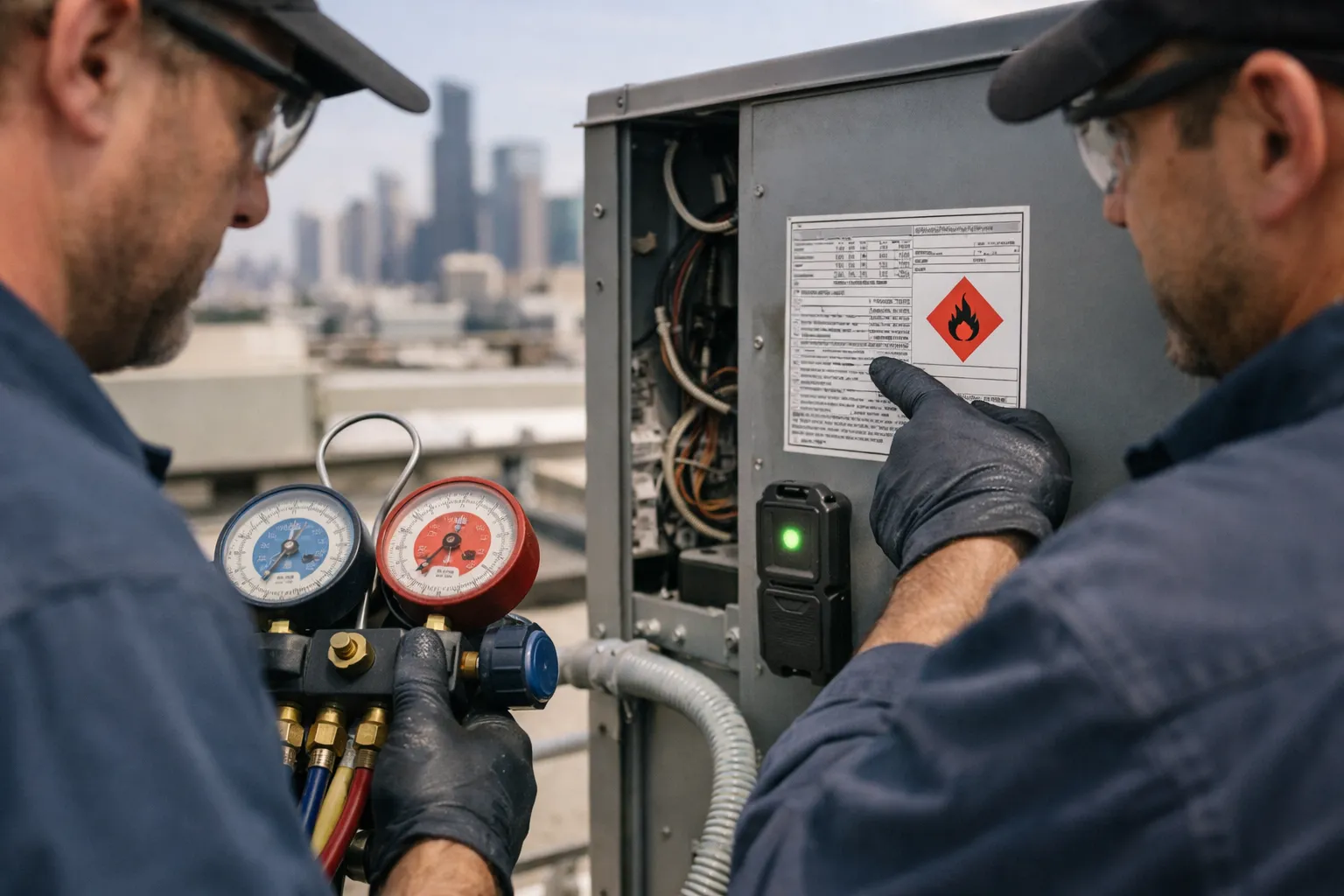
The commercial HVAC sector’s migration to mildly flammable, low‑GWP "A2L" refrigerants — such as R‑454B and R‑452B — is accelerating, but the pace and shape of that transition vary widely across the United States. The result: a patchwork of state and local rules that is complicating product selection, permitting, workforce training and retrofit planning for contractors, building owners and equipment manufacturers.
Why the fragmentation matters
Low‑GWP A2L blends are attractive because they offer significantly lower global warming potential than legacy HFCs and help comply with federal and international phasedowns driven by the AIM Act and the Kigali Amendment. At the same time, A2L refrigerants are classified as mildly flammable under ASHRAE 34, so jurisdictions have moved cautiously when updating plumbing, mechanical and fire codes.
The uneven pace of code adoption and differing interpretations by authorities having jurisdiction (AHJs) create practical obstacles for commercial HVAC projects:
- Equipment availability: manufacturers are certifying A2L versions of rooftop units, packaged heat pumps and chillers, but sales can be limited where local codes still restrict A2L use or require additional AHJ approvals.
- Permitting delays: contractors report longer review times as AHJs request supplemental documentation, risk assessments or proof of technician training before issuing permits for A2L equipment.
- Retrofit constraints: existing rooftop and mechanical room layouts may exceed local charge limits for flammable refrigerants, forcing alternate system choices or expensive reconfigurations.
- Insurance and liability: unclear code status can complicate underwriting and scope-of-work definitions for retrofits that involve flammable refrigerants.
On‑the‑ground consequences for contractors and owners
For contractors, the fragmented regulatory landscape increases project complexity and cost. Pre‑job site surveys must consider not only ductwork and electrical but also refrigerant charge calculations relative to occupancy classification, ventilation and proximity to ignition sources. In jurisdictions that have not explicitly adopted updated A2L‑permitting criteria, contractors must coordinate closely with AHJs to avoid stop‑work orders and rework.
Building owners face choices between postponing retrofits until local rules settle, accepting higher‑GWP alternatives to avoid permitting hurdles, or pursuing more extensive mechanical modifications to meet charge‑limit or ventilation thresholds. Each option carries tradeoffs in up‑front cost, long‑term operating emissions and equipment lifetime.
Training and safety are uneven
Technician training and certification is another pressure point. Handling mildly flammable refrigerants requires safe work practices that go beyond traditional HFC training: specialized leak‑detection protocols, ventilation assessment, hot‑work restrictions, spark‑control measures and updated personal protective equipment. Training programs exist through industry associations and OEMs, but uptake varies regionally, matching the uneven regulatory environment.
How industry stakeholders are responding
Manufacturers, contractors and trade groups are taking several steps to manage the uncertainty and keep projects moving:
- Producing detailed technical packages for AHJs — including charge tables, ventilation calculations and risk assessments — to streamline permitting reviews.
- Offering A2L‑ready and dual‑refrigerant product lines that can be field‑configured to suit jurisdictions with different rules.
- Expanding training resources and documented best practices for safe A2L installation, startup and commissioning.
- Collaborating with insurers and code bodies to clarify acceptance criteria and standardize expectations for commercial installations.
Practical recommendations for HVAC professionals
For HVAC contractors, designers and facility managers planning work with A2L refrigerants, practical on‑the‑ground steps can reduce risk and schedule slippage:
- Engage the AHJ early. Submit manufacturer documentation, proposed safety measures and technician credentials with permit applications to avoid surprises.
- Verify product approvals. Confirm that the OEM’s A2L equipment is certified and that the model is explicitly allowed for the intended application under local interpretations.
- Plan for charge limits. Use refrigerant charge reduction strategies — multiple smaller circuits, secondary loop systems, or remote condensing — if site layout would otherwise exceed allowable limits.
- Prioritize detection and ventilation. Install continuous leak detection and ensure required mechanical ventilation is designed, tested and documented for commissioning records.
- Invest in training. Ensure technicians hold vendor‑ or industry‑recognized A2L handling credentials and that jobsite safety plans reflect flammability mitigation steps.
- Coordinate with insurers. Notify and consult with facility insurance providers early to confirm coverage and any required mitigations for A2L use.
Outlook: toward harmonization, but not overnight
Industry sources view the current fragmentation as a temporary phase. As more OEMs ship A2L‑capable commercial equipment and as more AHJs adopt clarified guidance, permitting and installation workflows should normalize. Harmonization will likely come through a mix of model code updates, clarified AHJ guidance and wider adoption of standards such as ASHRAE 15/34 and relevant UL test procedures for equipment handling A2Ls.
Until then, commercial HVAC stakeholders will need to manage a complex mix of regulatory, safety and logistical variables on a project‑by‑project basis. For contractors and owners, the practical key is due diligence: verify approvals, document safety measures, train staff and communicate with AHJs and insurers before committing to A2L equipment in commercial projects.