Overview
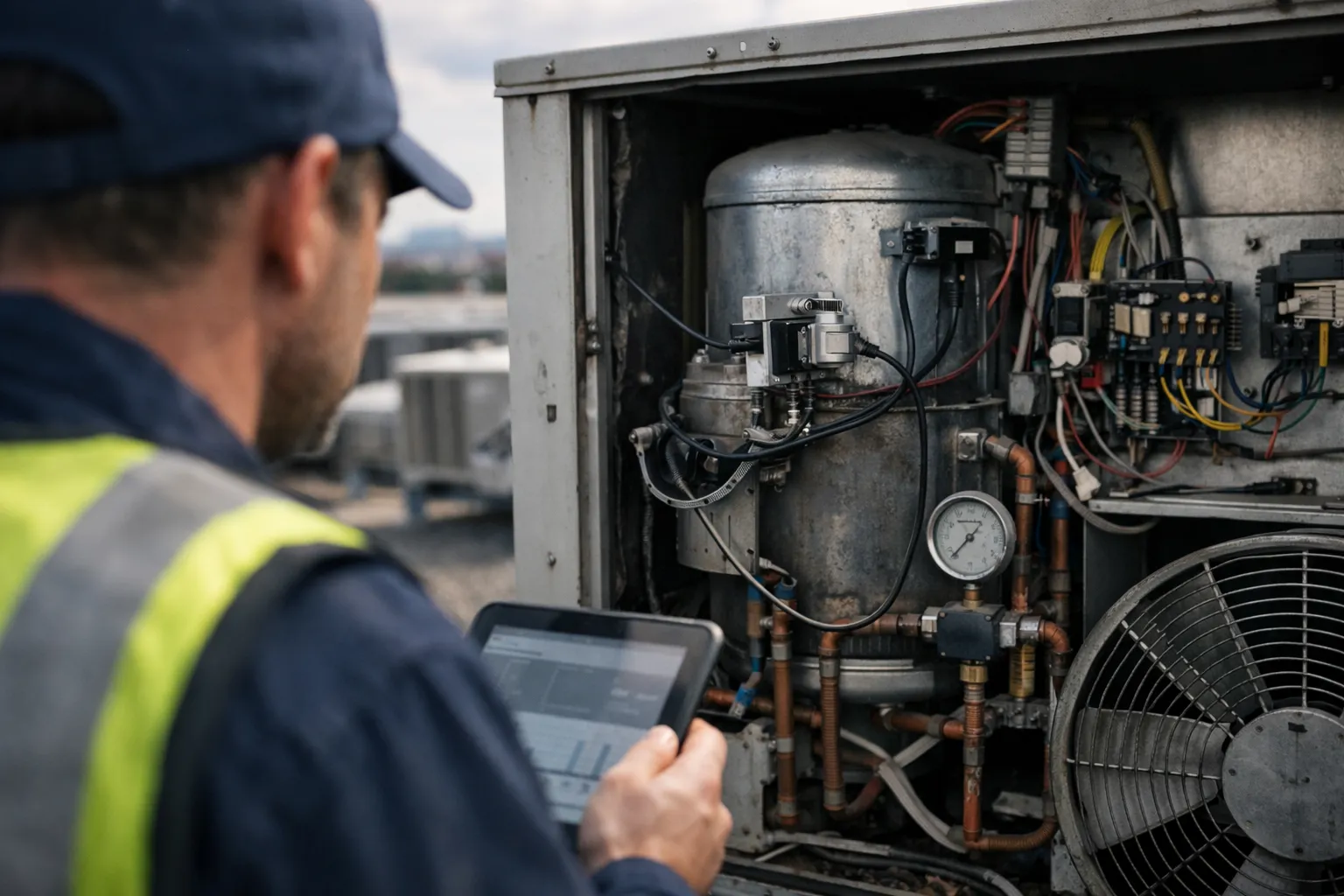
Predictive maintenance (PdM) for rooftop units (RTUs) is now an operational expectation for many building portfolios rather than an experimental add‑on. As of September 2026, the core decision for owners and contractors is no longer “does PdM work?” but “which architecture and commercial model fit my portfolio and risk tolerance?” This update synthesizes the practical architectures, current cost and ROI ranges, new technological developments that matter right now, and concrete steps HVAC teams should take to achieve measurable results.
Background: what changed between 2024 and 2026
From 2024–2026 several incremental shifts made PdM more actionable at scale:
- Lower sensor hardware unit costs and commodity IO reduced per‑unit sensor budgets for basic telematics.
- Federated learning and model‑management tooling emerged as mainstream options to address privacy and scaling of ML across multi‑site portfolios.
- Large language models (LLMs) started being used to translate complex fault chains into step‑by‑step technician guidance—improving field adoption.
- Energy prices and tighter refrigerant regulations increased the monetary value of early fault detection for refrigerant leaks and inverter-driven heat pumps.
- Procurement shifted further toward outcome and shared‑risk contracts, with more customers asking vendors for uptime guarantees or rebates tied to energy and outage reductions.
Three PdM architectures today (and what’s new)
The three architecture categories from prior years remain valid but have evolved in capability and cost profile.
1. Rule‑based telematics (cloud dashboards + rules)
- Description: Simple sensor kits or BAS taps stream time series to a cloud platform where deterministic rules and thresholds generate alerts.
- What’s changed: Vendors increasingly ship standardized point mapping templates and auto‑discovery tools that cut commissioning time. Integration with credentialed APIs and secure MQTT is now common.
- Strengths: Lowest initial engineering, fastest pilots, deterministic and explainable alerts.
- Weaknesses: Still less effective at detecting slow degradation and compound failure chains without additional instrumentation.
- Best fit: Single sites, small portfolios, and owners looking for quick time‑to‑value.
2. Edge machine‑learning (on‑site anomaly detection)
- Description: Lightweight ML runs on gateways or upgraded controllers to detect anomalies; only events or compressed summaries are sent to cloud services.
- What’s changed: Federated learning toolkits and centralized model‑governance dashboards now allow vendors—or in‑house teams—to train global models while keeping raw data local. LLMs are being used to turn anomaly traces into prioritized troubleshooting scripts.
- Strengths: Lower bandwidth, faster local decisioning, better adaptation to site idiosyncrasies, and improved privacy controls.
- Weaknesses: Higher upfront engineering and an operational requirement for periodic re‑validation and edge hardware lifecycle management.
- Best fit: Large campuses, critical facilities, and portfolios with intermittent network reliability or privacy requirements.
3. Physics‑based digital twins (high‑fidelity modeling)
- Description: High‑fidelity equipment and system models combined with operational data to estimate remaining useful life and simulate complex fault propagation.
- What’s changed: Tooling for automated calibration improved, and cloud compute costs for running twin simulations fell modestly—making hybrids (selective digital twins for high‑value sites) more common.
- Strengths: Can prioritize capital, quantify comfort and energy impacts, and model refrigerant or electrification upgrades.
- Weaknesses: Most expensive per site and requires ongoing engineering support and rich sensor sets.
- Best fit: High‑value assets, campuses undergoing electrification, and owners focused on long‑term CAPEX planning.
Updated costs and ROI drivers (Sept 2026)
Three variables still dominate PdM economics: integration/sensor capex, analytics subscription and model‑management fees, and realized savings (energy, labor, deferred capital, avoided outages). Current typical vendor and integrator ranges observed in 2026:
- Rule‑based telematics: $400–$1,000 per RTU installed; $12–$45/RTU/month subscription. Faster pilots with 6–18 month payback in many small portfolios.
- Edge ML: $1,000–$2,200 per RTU for gateways and sensors; $30–$90/RTU/month for analytics and model management.
- Digital twin (selective deployments): $2,500–$9,000 per RTU equivalent for initial build and calibration; $120+/unit/month for continuous engineering support.
Key benefit streams and updated assumptions:
- Energy savings: Vendor reports and independent pilots in 2025–26 commonly cite 3–12% portfolio energy savings when PdM is paired with sequence optimization and recommissioning. With average U.S. commercial rates near $0.13–$0.15/kWh in mid‑2026, the dollar value of these savings has grown relative to 2023.
- Maintenance labor: Mature deployments report 10–45% reductions in reactive truck rolls; savings depend heavily on technician adoption and work‑order automation.
- Capital deferral and avoided outages: Avoided emergency compressor replacements and comfort failures can be the largest single ROI component at critical sites; quantify using site‑specific outage costs.
Example scenario (updated): a 50‑unit retail fleet averaging 10 tons, 4,000 operating hours/year, with PdM delivering 6% energy savings at $0.14/kWh yields annual energy savings ≈ $4,032. Add $1,500/year in maintenance savings and subtract subscription costs (~$21,600/year at $36/unit/month), and an edge ML deployment with $80,000 installed cost returns in roughly 3–6 years depending on avoided outage incidents and capital deferrals. Always model conservative, mid, and optimistic scenarios and include outage avoidance value for critical sites.
Data, security, and contracting considerations (new priorities)
Three operational changes should be part of any procurement in 2026:
- Data ownership and model rights: Contracts should specify who owns raw data, derived features, model weights, and whether models trained on your data can be reused by the vendor elsewhere. Insist on exportable data and model‑explainability clauses.
- Cybersecurity SLAs: Demand network segmentation, signed vulnerability disclosure processes, and alignment to a recognized framework (for example, NIST ICS guidance or equivalent). Vendors must provide firmware signing, patch windows, and incident response commitments.
- Performance and outcomes: Where possible, structure pilots as performance pilots with clear KPIs (energy delta, calls avoided, MTTR) and a path to transition into outcome‑based or shared‑risk contracts if targets are met.
Multiple perspectives: vendors, technicians, owners
Vendors argue that federated learning and LLM‑assisted diagnostics reduce false positives and improve technician efficiency. Field technicians report the strongest gains when PdM outputs are prescriptive—e.g., a prioritized fault with a short checklist and spare‑parts recommendation—rather than raw anomaly flags. Portfolio owners focus on total cost of ownership, citing that savings only materialize when work order processes and spare parts logistics are aligned with PdM outputs.
"PdM only shifts work from firefighting to planned work if you build the operational path—work orders, SLAs and parts flow must change."
Implications: what this means for HVAC teams
Practical implications for contractors and in‑house teams:
- Run a prioritized pilot: choose 10–25 representative RTUs and measure baseline energy, reactive calls, and MTTR. Make pilots short (3–6 months) and instrument for data quality checks from day one.
- Budget for data hygiene and commissioning: point mapping, clock sync, and sensor calibration are non‑negotiable and typically consume 10–20% of deployment effort.
- Insist on technician workflows: alerts must auto‑generate prioritized work orders with decision trees; include technician feedback loops to reduce false positives.
- Plan for model maintenance: allocate annual budget for model re‑training, edge hardware refresh, and cybersecurity updates—often 10–25% of initial capex per year for edge ML systems.
- Use hybrid architectures: many portfolios adopt rule‑based monitoring for low‑value sites, edge ML for core portfolios, and digital twins for a handful of mission‑critical locations.
Outlook: what to watch for through 2027
Near‑term developments likely to affect PdM adoption:
- Broader availability of federated learning toolchains making scalable ML cheaper and more privacy‑friendly.
- Deeper LLM integration that converts fault traces into actionable, evidence‑linked repair steps—improving technician acceptance.
- Insurance and financing products that explicitly value PdM: expect more pilots where insurers offer premium credits and financiers provide favorable terms for portfolios demonstrating PdM maturity.
- Stronger regulatory pressure on refrigerants and HVAC electrification will raise the value of early detection for refrigerant loss and inverter diagnostics.
Practical checklist before you buy
- Define KPIs and measurement windows for pilots (energy, calls avoided, MTTR).
- Specify data, model, and IP ownership in contracts.
- Require cybersecurity SLAs and firmware‑signing commitments.
- Map technician workflows and spare‑parts strategies in advance.
- Budget for ongoing model governance and edge hardware lifecycle.
FAQ
How quickly should I expect to see measurable results from an RTU PdM pilot?
With a well‑scoped pilot—clean BAS points, calibrated sensors, and defined KPIs—many teams see measurable reductions in false alarms and reactive calls within 3–6 months. Energy savings and capital deferral benefits typically require 6–12 months of normalized operating data to quantify reliably.
Is edge ML worth the extra cost versus rule‑based telematics?
Edge ML is worth the extra cost when you have scale (hundreds of units), intermittent connectivity, or critical sites where false positives/negatives carry high costs. For small portfolios or quick pilots, rule‑based telematics often delivers faster time‑to‑value.
What are the top contract items to negotiate with PdM vendors?
Negotiate clauses on data ownership and export, model‑explainability, cybersecurity SLAs (patch windows, vulnerability disclosure), performance KPIs, and a clear path from pilot to production or off‑ramp terms if KPIs aren’t met.
Will PdM reduce the need for skilled technicians?
No. PdM changes the work mix—more planned preventive work and fewer emergency truck rolls—but skilled technicians remain essential for diagnostics, non‑routine repairs and validating complex failures. Invest in training so techs can interpret PdM outputs effectively.
How should I value avoided outages in my ROI model?
Calculate avoided outage value based on lost revenue, tenant SLA penalties, emergency repair premiums, and brand or reputational damages specific to the site. For critical sites, avoided outage costs can dominate the ROI equation and justify higher‑cost PdM architectures.
By September 2026 PdM for RTUs is mature enough that the right architecture — deployed with attention to data hygiene, contracts, and technician workflows — reliably converts alerts into energy savings, fewer emergencies, and smarter capital planning. The immediate opportunity lies in choosing the right hybrid approach for your portfolio and treating PdM as an operational capability, not just a software purchase.