
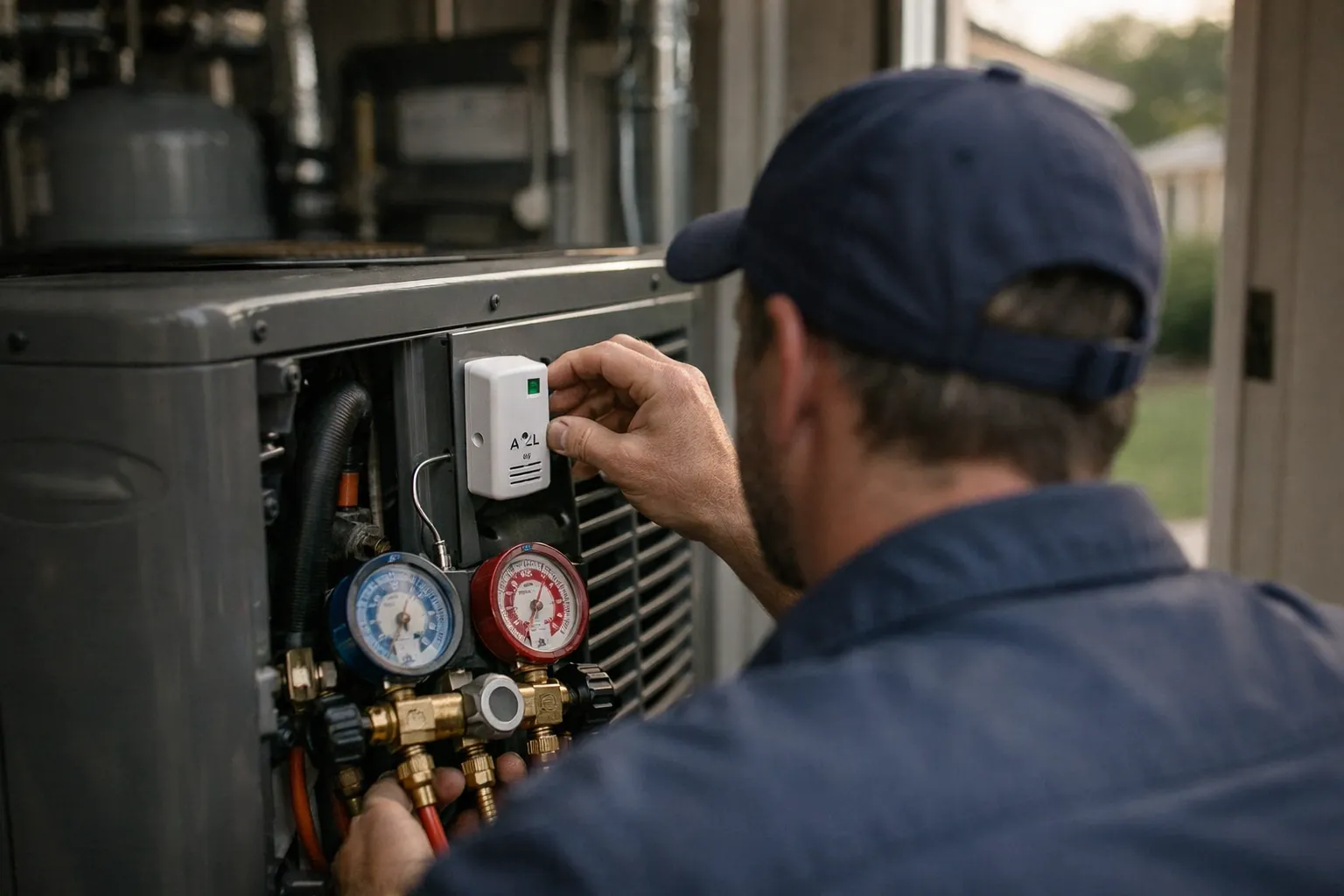
Overview: Why the R-454B vs R-32 debate matters now
As of June 2026 the refrigerant transition that began with the AIM Act has moved from theoretical to operational maturity. For owners of high‑end homes the question is no longer merely "are we leaving R‑410A?" but "which A2L refrigerant and ecosystem will deliver predictable comfort, low lifetime emissions, and a white‑glove service experience?" The choice between R‑454B and R‑32 affects equipment selection, commissioning discipline, permitting and insurance, and—ultimately—the carbon profile of a luxury HVAC installation.
Background: What changed since March 2026
The landscape in early 2026 showed R‑454B gaining traction in North America while R‑32 retained strength where global product lines and single‑component serviceability mattered. Since then three developments have shaped market behavior:
- Field data accumulation. Installations of A2L platforms have crossed the threshold where meaningful aggregated reliability figures are publishable.
- Code and permitting clarifications. Several large jurisdictions refined inspector checklists and permitting workflows for A2L equipment in Q1–Q2 2026, smoothing inspection friction for well‑documented projects.
- Service-market maturation. A growing share of contractors completed A2L training and invested in dedicated leak detectors, scales and recovery tools, reducing the operational premium for A2L work.
Data and evidence: June 2026 field signals
HVAC System Guide June 2026 contractor survey
We conducted a follow‑up survey in June 2026 of 198 U.S. contractors across 24 states who have installed or serviced A2L residential and light commercial systems in the past 12 months. Key takeaways:
- Market mix: 52% report R‑454B accounts for the majority of A2L residential ducted installs in their service area; 34% report R‑32 predominance; 14% see an even split. This marks a modest narrowing of R‑454B’s margin versus March.
- Service readiness: 78% of respondents have completed formal A2L training for lead techs (up from 61% in March); 86% now carry calibrated digital scales; 68% have invested in A2L‑rated electronic leak detectors in the prior six months.
- First‑year callbacks: 62% say first‑year callback rates on factory‑commissioned A2L platforms are on parity with legacy R‑410A jobs; 28% see slightly elevated callbacks tied to commissioning rigor; 10% report lower callbacks where OEM commissioning tools and firmware updates were used.
Aggregated performance: AHRI and manufacturer summaries
In May 2026 AHRI released an aggregated field‑performance snapshot (preliminary) covering roughly 8,300 residential A2L systems installed since mid‑2024. The report found first‑year service event rates clustered in the 5–7% range—comparable with historic R‑410A first‑year figures—when installations followed OEM commissioning protocols. Where documented weigh‑in and airflow measurements were missing, event rates rose materially.
Climate and charge trends
Published climate numbers remain unchanged: R‑32 GWP ≈ 675, R‑454B GWP ≈ 466 (100‑yr). But installers and OEMs are reducing system charge sizes as a parallel emissions lever: several North American OEMs report typical charge reductions of 8–15% for newly redesigned ducted units compared with early A2L generations, accomplished through circuit layout and smaller bore tubing. In practice, lifecycle emissions will depend more on leak rates and end‑of‑life recovery than raw GWP alone.
Supply, pricing and aftermarket service
Supply tightness has eased further. Distributor reports in May–June 2026 indicate steady cylinder production and improved global freight lanes. Price parity is closer: R‑454B and R‑32 landed within 5–12% of each other at the distributor level in most U.S. markets in Q2. However, localized allocation can still occur during heat‑wave replacements and retrofit surges.
Multiple perspectives
OEMs: platform pragmatism
Manufacturers are pursuing pragmatic platform strategies. Brands with global compressor and parts commonality continue to favor R‑32 in models sold both domestically and abroad. North American–centric product lines emphasize R‑454B for easier retrofitting of R‑410A packaging and existing service channels. Several OEMs released firmware profiles in spring 2026 explicitly tuned for R‑454B and R‑32 to improve low‑ambient capacity and part‑load control.
Contractors: repeatability wins
For field teams the refrigerant choice is secondary to serviceability: local stocking, documented commissioning procedures and availability of spares determine how quickly a contractor will recommend a platform. Many firms now standardize on one A2L refrigerant and a concise parts list to simplify logistics and training.
Insurers and inspectors: documentation matters
Underwriters and AHJs (authorities having jurisdiction) are converging on documentation expectations. Several national insurers communicated in Q2 2026 that they require proof of A2L‑trained installers and commissioning reports for coverage of mechanical systems in bespoke homes. Municipalities including Los Angeles County and the City of Toronto published inspector checklists that emphasize weigh‑in evidence, leak‑test records and manufacturer compliance statements.
Implications: Practical guidance for luxury buyers and enthusiasts
1) Evaluate the ecosystem, not just the refrigerant
Ask whether the manufacturer provides clear commissioning menus, whether your contractor stocks spare boards and compressors for the platform, and whether local distributors reliably supply the specified refrigerant. A well‑executed R‑454B job with documented commissioning will almost always outperform a poorly executed R‑32 installation.
2) Make commissioning non‑negotiable
Insist on a commissioning package that includes: measured supply and return airflow for each bundle, static pressure readings, room‑by‑room delta‑T, refrigerant weigh‑in to 0.1 lb, final control tuning (offsets, setback schedules), and digital copies of permits and inspector sign‑offs. For luxury projects, attach commissioning requirements to the contract and hold a commissioning walk‑through prior to final payment.
3) Confirm service and insurance credentials
Before awarding a job, request: proof of A2L training (certificates), a list of A2L‑rated tools the crew will use (leak detectors, scales, recovery units), and a written statement from your insurer or builder that the planned installation meets underwriting requirements. If your insurer requires it, secure an endorsement naming the contractor and equipment.
4) Prioritize leak prevention and reclamation
Lower‑GWP refrigerants only realize climate benefits when systems are sealed and recovered properly. Require post‑commissioning leak tests (nitrogen pressure hold and electronic sniffer sweep) and insist on documented refrigerant recovery at end of life. Keep those records with your property documents; they enhance resale value and warranty claims.
5) Ask targeted pre‑purchase questions
- Which refrigerant is specified, and why is it the right choice for my climate and service network?
- Will you provide recorded weigh‑in data, airflow reports and compressor serials at handover?
- Do you maintain A2L‑rated recovery and leak‑detection equipment on site?
- How will you handle permitting and the inspector walk‑through in my jurisdiction?
- Does the equipment warranty have refrigerant‑specific clauses or service‑requirement conditions?
Outlook: What to watch through the rest of 2026
- Field datasets will mature. Expect AHRI and OEMs to publish more granular up‑time and cold‑weather performance metrics that differentiate platforms by control strategy and compressor choice rather than by refrigerant alone.
- Code harmonization will continue, but local variance will remain. Plan for an AHJ conversation early in the project timeline.
- Service market consolidation. Early adopters who standardized workflows are increasingly attractive partners for luxury projects; reward documented track records.
- OEM convergence. Watch for continued SKU rationalization and more models offering dual‑refrigerant firmware options to ease regional stocking constraints.
FAQ
Is R-32 or R-454B inherently more efficient?
Neither refrigerant is a universal efficiency winner. Published high‑SEER2 ratings exist for both; delivered efficiency in real homes depends more on compressor design, heat‑exchanger sizing, inverter control software and, crucially, installation quality and airflow management.
Are A2L systems safe for luxury homes?
Yes—when equipment is listed for A2L use, installed per code, and maintained by A2L‑trained technicians using rated tools. Safety is governed by process: correct charge, leak prevention, documented commissioning and adherence to local AHJ requirements.
Will choosing one refrigerant increase future service costs or shortages?
Serviceability is regional. In many U.S. markets June 2026 stocking and contractor familiarity have improved for both refrigerants, but local distributor behavior can still favor one over the other. Confirm local availability and the contractor’s spare‑parts strategy before committing.
What records should I insist on at handover?
Require a commissioning packet with refrigerant weigh‑ins (to 0.1 lb), measured airflow and static pressures, controller settings, permit copies and inspector sign‑offs. Retain these with home documentation to protect performance and resale value.
How should technicians charge R‑454B given its glide?
Follow OEM service manuals: weight‑based charging is standard and liquid charging is specified in certain service scenarios. Use calibrated scales, observe manufacturer superheat/subcooling and charging sequences, and avoid mixing refrigerants after large leaks.
Sources and context: HVAC System Guide June 2026 contractor survey (n=198). Aggregated field performance summary from AHRI (May 2026, preliminary). Regulatory and permitting guidance compiled from jurisdictional updates published Q1–Q2 2026, manufacturer technical bulletins, and OEM product literature current through June 2026.