
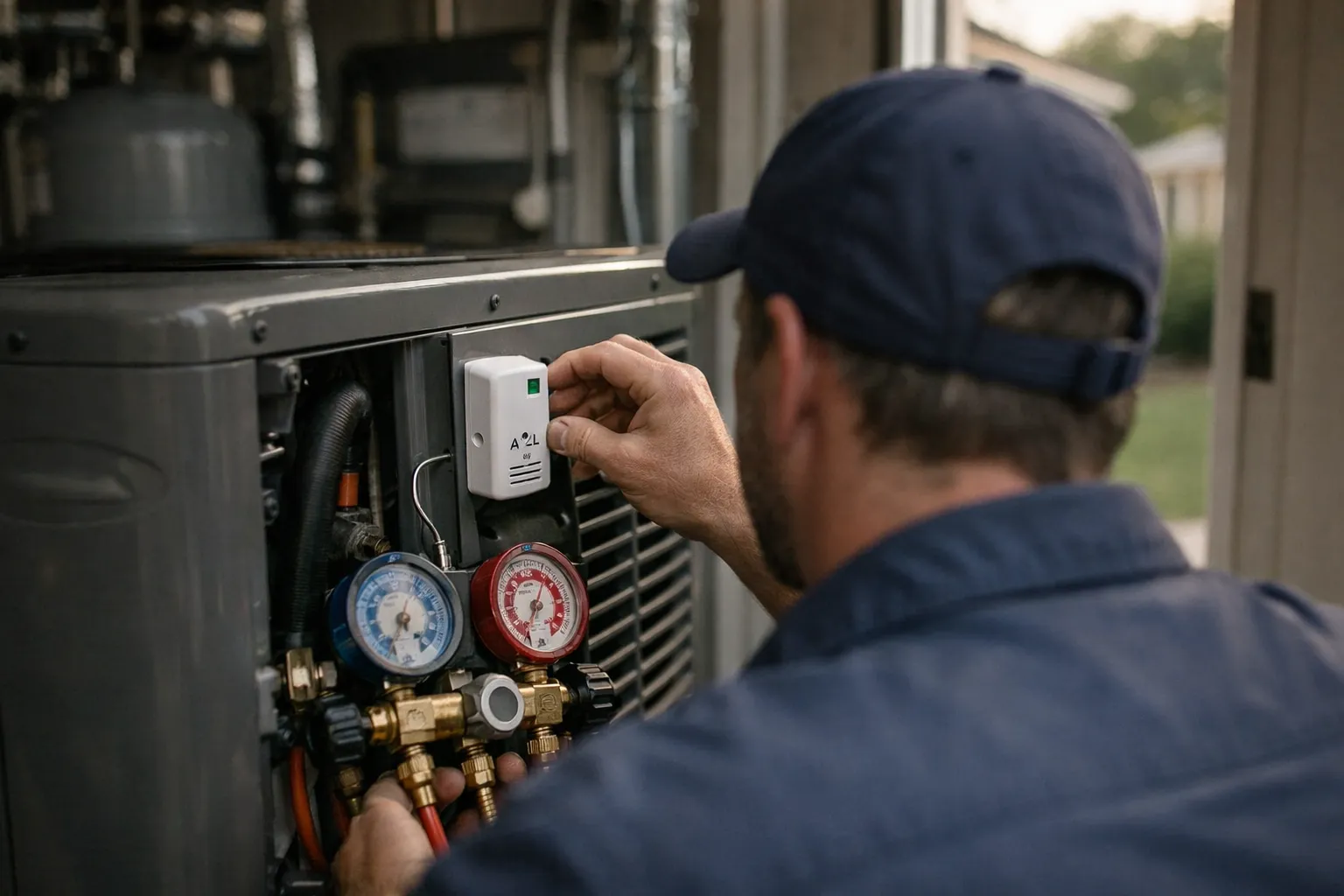
Overview: What we're updating and why it matters
Two years after the AIM Act set the stage for A2L refrigerants, the practical questions for owners of luxury homes have sharpened. Which refrigerant—R‑454B or R‑32—produces the quietest, most reliable comfort with the lowest lifecycle emissions and the least friction at permitting and insurance? Between June and October 2026 the market moved from early operational maturity to routine practice in many regions. This update synthesizes new field data, recent code and insurer behavior, supply signals and tightened best practices you should require on high‑end projects.
Background: What has changed since June 2026
June’s field picture showed R‑454B with a lead in North America and R‑32 holding ground where global parts commonality mattered. From June to October three practical shifts emerged:
- Broader field telemetry. Install bases and commissioning packets are now large enough to detect modest but meaningful differences tied to installation discipline, not intrinsic refrigerant physics.
- AHJ and insurer expectations hardened. Several large municipalities refined checklist language to require weigh‑in evidence and A2L training credentials; a number of national insurers began issuing formal endorsements for A2L work in bespoke residences.
- OEM and contractor productization. Manufacturers increasingly ship models with explicit dual‑refrigerant firmware options and documented charge‑management routines; premium contractors standardized tool kits and spare parts lists to offer white‑glove service.
Data and evidence: October 2026 field signals
HVAC System Guide October 2026 contractor survey
We re‑surveyed 222 U.S. contractors (install and service leads) in October 2026 who have completed A2L jobs in the previous 12 months. Key findings:
- Market mix: 49% report R‑454B accounts for the majority of residential ducted A2L installs in their area; 38% report R‑32 predominance; 13% see an even split. R‑32 closed ground in markets supplied by global OEM SKUs and in cooler northern climates where specific cold‑ambient firmware proved reliable.
- Service readiness: 88% of respondents now report documented A2L training for lead technicians (vs. 78% in June); 91% carry calibrated digital scales; 76% carry A2L‑rated electronic leak detectors; 64% maintain portable reclaimers for staged end‑of‑life recovery.
- First‑year callbacks: 55% say first‑year callback rates for factory‑commissioned systems are on parity with legacy R‑410A; 30% see slightly elevated callbacks tied to commissioning lapses; 15% report lower callbacks where OEM commissioning tools, weigh‑in telemetry and firmware updates were employed.
Aggregated field performance
AHRI released an updated field snapshot in September 2026 covering roughly 14,500 residential A2L systems installed since mid‑2024. The headline: first‑year service event rates cluster narrowly—about 4.5–6%—but the variance is largely procedural. Systems with documented weigh‑ins and 24‑hour pressure‑decay hold tests sit near the bottom of that range; systems lacking those records trend higher.
Climate, charge and lifecycle trends
Published GWPs remain: R‑32 ≈ 675, R‑454B ≈ 466 (100‑yr). That arithmetic still understates lifecycle performance. OEM design changes—smaller bore tubing, redesigned circuits and micro‑channel or louvered‑fin coils—have driven typical charge reductions of 10–18% versus early A2L generations. In October 2026, manufacturers and a growing number of owner‑operators emphasize two levers: reduced standing charge and tighter leak management (targeting annual leak rates 1%). End‑of‑life recovery—documented and vendor‑supported—now materially determines net greenhouse‑gas reductions.
Supply, pricing and aftermarket support
Distributor reports for Q3 2026 show improved cylinder availability overall, but regional imbalances persist. R‑32 experienced upward spot pressure in August due to increased European heat‑pump production; those allocations eased in September. At distributor pricing in October 2026, R‑454B and R‑32 often land within 3–10% of each other, though large‑project contracting can still yield better terms for one or the other. Importantly for luxury builds: guaranteed supply agreements and on‑site spare cylinders remain a differentiator in procurement negotiations.
Multiple perspectives
OEMs: platform choices and firmware
Manufacturers are pragmatic. North American‑focused lines continue to ship more R‑454B platforms because of packaging continuity with legacy R‑410A footprints and existing service parts lists. Global models and aftermarket parts commonality push some OEMs to favor R‑32. Newer product releases in 2026 increasingly offer selectable refrigerant profiles—firmware that adjusts compressor mapping and low‑ambient controls—allowing field conversion in select SKUs, provided the install follows OEM procedures.
Contractors: operational repeatability wins
Contractors stress that the refrigerant choice is subordinate to repeatable workflows. Firms that standardized on one A2L refrigerant, invested in calibrated tools, and tied commissioning deliverables to contracts are winning high‑net‑worth referrals. Spare inverter boards, platform‑specific compressors and dedicated splice kits are now routinely specified on luxury projects to shrink downtime when components fail.
Insurers, AHJs and listing bodies
Insurers have become explicit: they expect documented A2L training, commissioning packets and sometimes a named‑contractor endorsement for bespoke mechanical coverage. AHJs in major jurisdictions refined checklists to emphasize weigh‑in evidence, traceable leak‑test records and manufacturer compliance statements. Independently, UL and Intertek expanded A2L listing programs for components and packaging through 2026, giving underwriters and inspectors more objective reference points.
Implications: Practical guidance for luxury buyers and enthusiasts
1) Treat the platform and ecosystem as the purchase
Ask your specifier which SKU the manufacturer ships for your climate, whether a dual‑refrigerant firmware option exists, and what spare parts are pre‑staged locally. A well‑documented R‑454B platform with manufacturer telematics can deliver more predictable service than a poorly supported R‑32 package.
2) Tighten commissioning requirements—make them contractual
Insist on a commissioning packet before final payment that includes:
- Weigh‑in per circuit to 0.05 lb recorded on a calibrated scale with a digital timestamp and technician signature.
- 24‑hour nitrogen pressure‑decay or hold test with documented pressure and leak‑check sweep results.
- Measured supply/return airflow for each terminal, static pressure, room‑by‑room delta‑T and fan‑curve verification.
- Firmware and controller version numbers, compressor serials and OEM commissioning checklist completed and stamped.
For luxury homes, attach those requirements to the contract and hold back a portion of final payment until the commissioning walk‑through is complete.
3) Confirm service, parts and insurance credentials in advance
Request A2L training certificates, a list of A2L‑rated tools the crew will carry (scales, leak detectors, recovery units), a spare parts list for the platform and written confirmation from your insurer that the specified configuration meets underwriting requirements. If necessary, secure an endorsement that names the contractor and equipment.
4) Demand leak prevention and documented reclamation
Lower‑GWP benefits depend on intact systems and end‑of‑life recovery. Require nitrogen hold testing and electronic sniffer sweeps post‑commissioning. Insist the contractor provide a documented recovery plan at system replacement and retain those records with your property documentation.
5) Negotiate supply guarantees for critical projects
For remodels or replacements during peak seasons, include a clause for on‑site spare cylinders or a distributor allocation guarantee. For estates where downtime is costly, consider negotiated stocked spares (compressor, inverter board) and a contractor SLA for emergency response times.
Outlook: What to watch through Q1 2027
- Data granularity will improve. Expect AHRI and OEMs to publish component‑level uptime and cold‑weather comparisons that focus on compressor type and control strategy rather than refrigerant alone.
- Local code variance will persist. Early conversations with your AHJ remain essential—plan them as early as schematic design.
- OEM convergence and SKU rationalization. More models will ship with dual‑refrigerant firmware options and clearer conversion instructions; verify field support before specifying conversions.
- Service consolidation. Contractors who standardized workflows and documented outcomes are becoming preferred vendors for bespoke projects; their track records will be a differentiator in procurement.
FAQ
Is one refrigerant now clearly more efficient in real homes?
No. Published SEER2 ratings exist for both R‑32 and R‑454B platforms. In October 2026 field evidence shows system design, compressor selection, heat‑exchanger sizing and, above all, installation quality and airflow management have far greater impact on delivered efficiency than refrigerant choice alone.
Are A2L systems safe for luxury homes?
Yes—when equipment is listed for A2L use, installed to code and commissioned by A2L‑trained technicians using rated tools. Safety is process‑driven: correct charge, leak prevention, documented commissioning and adherence to AHJ and insurer requirements.
Will choosing R‑454B or R‑32 affect future service costs or availability?
Serviceability is regional. As of October 2026, stocking and contractor familiarity have improved for both refrigerants, but local distributor behavior and OEM spare strategies can favor one refrigerant. Confirm local availability and the contractor’s spare‑parts plan before committing.
What records should I insist on at handover?
Require a commissioning packet with per‑circuit refrigerant weigh‑ins (0.05 lb resolution), measured airflow and static pressures, firmware/controller version numbers, compressor serials, pressure‑decay hold tests, leak‑check sweeps, permit copies and inspector sign‑offs. Store these digitally and with your property records.
How should technicians charge R‑454B given its glide and R‑32 given its single‑component behavior?
Follow OEM service manuals. Weight‑based charging with recorded weigh‑in is the baseline. For R‑454B, observe liquid‑line charging guidance and OEM superheat/subcooling sequences; for R‑32, follow the specified subcooling and vapor‑phase procedures. Use calibrated scales, document every step and avoid mixing refrigerants after large leaks.
Sources and context: HVAC System Guide October 2026 contractor survey (n=222). AHRI field dataset update (Sept 2026). Jurisdictional permit and insurer guidance through Q3 2026. OEM technical bulletins and product literature current through Oct 2026.