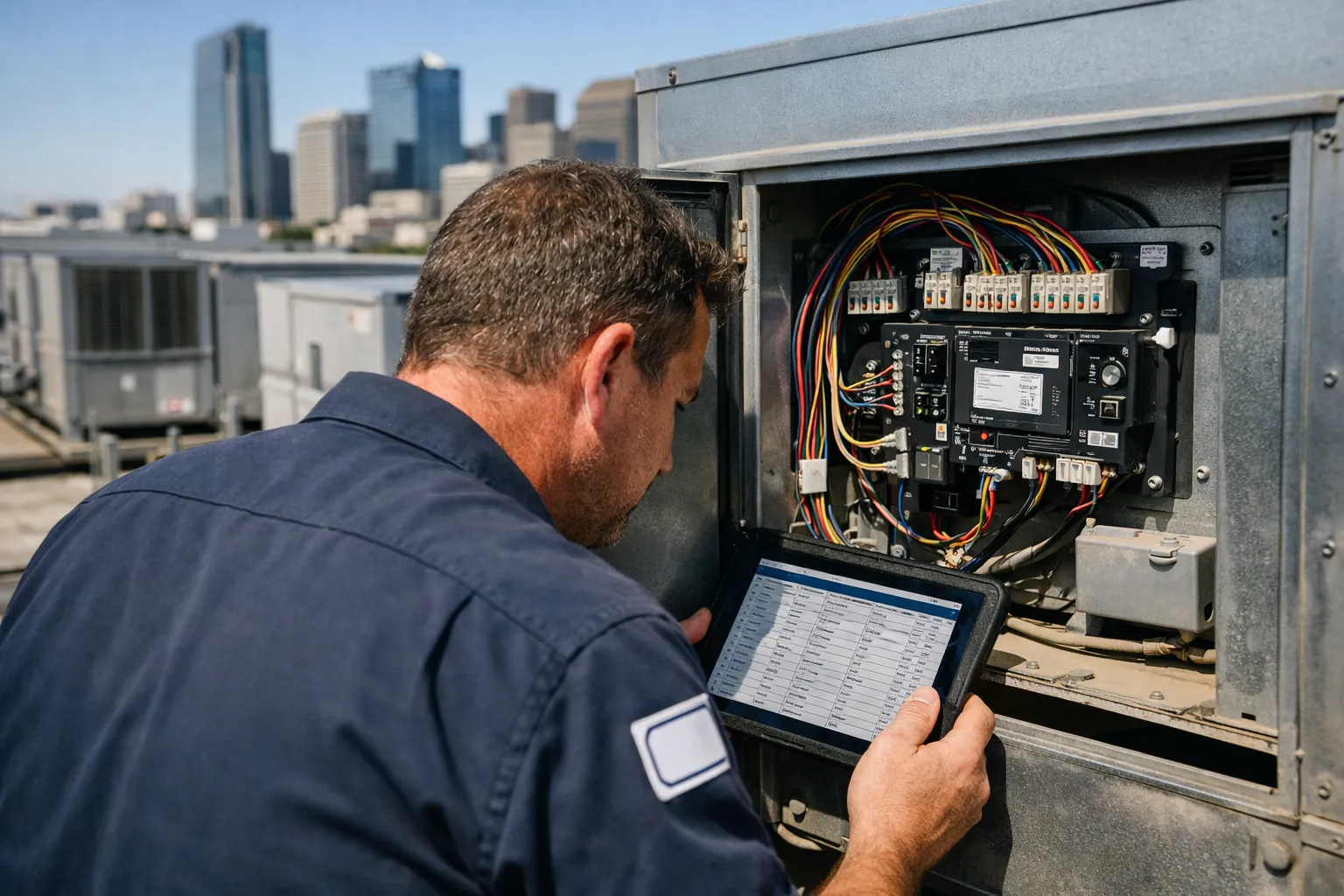
October 2026 — An industry consortium today released OpenRTU, an open specification for rooftop-unit (RTU) control interfaces designed to make factory controllers, third‑party supervisors and building management systems interoperable without custom gateway work. Backed by major controls vendors, independent commissioning firms and several large building owners, OpenRTU addresses a perennial pain point for HVAC installers: integrating new or replacement RTUs with heterogeneous on‑site controls and cloud services.
What OpenRTU is — and why it matters
OpenRTU defines a standard physical and logical interface for packaged rooftop units: a modular communications and I/O layer, a security and onboarding workflow, and a set of semantic data models for common RTU functions (supply fan, economizer, DX coil, compressors, sensors, fault codes). The specification targets both new equipment and retrofit scenarios, where field technicians must often adapt legacy RTUs to modern building automation systems.
In practical terms, OpenRTU aims to let a certified third‑party controller or gateway be connected to an RTU and immediately expose a consistent BACnet/IP, Modbus TCP, and REST/JSON endpoint, complete with standardized point names, units and command semantics. That reduces custom mapping, shortens commissioning cycles, and enables plug‑and‑play fault detection, remote diagnostics and demand‑response participation.
Key technical elements
- Modular hardware profile: a small set of physical connectors and pinouts for power, I/O and network that accommodate both factory controllers and field modules.
- Semantic data model: canonical object definitions for sensors, actuators and alarms so a supply‑fan speed is exposed the same way across manufacturers.
- Secure onboarding: certificate‑based device authentication, signed firmware and a staged commissioning workflow that mirrors field practices.
- Edge capabilities: optional local analytics for short‑cycle fault detection and control fallback when the network is down.
Industry response and scope
The OpenRTU consortium says the specification was developed after a 12‑month pilot across 40 RTUs in civic, retail and education facilities. Participants included controls integrators, third‑party commissioning firms and building owners who cited reduced site‑integration labor and fewer driver‑compatibility issues in pilots. Members plan to publish a certification program for hardware and software, expected to ramp up in the next 9–15 months.
For OEMs, OpenRTU offers a way to keep a factory controller while exposing a defined external interface for third‑party integration, addressing both warranty concerns and the desire to retain value‑added services. For controls contractors and building owners, it lowers the technical risk of replacing legacy controllers or adding cloud services without ripping out entire RTUs.
What installers and technicians should expect
OpenRTU is not a product; it's a spec and a certification pathway. On the ground, installers can expect several changes over the next year that will affect retrofit and service workflows:
- Reduced custom mapping: fewer hours spent mapping points from an OEM driver to a BAS because certified modules will present standardized point names and units.
- Certifiable commissioning steps: a defined onboarding checklist that aligns with existing commissioning best practices, including certificate provisioning and signed firmware verification.
- Modular replacement options: the ability to remove a failing factory controller and plug in a certified field controller to restore operations quickly while preserving newer integrations.
- Improved remote diagnostics: third‑party cloud platforms will be able to access consistent telemetry, enabling quicker first‑touch troubleshooting and fewer truck rolls.
Training and tooling needs
Technicians will need updated training on secure onboarding procedures and on interpreting the standardized semantic model. Tool vendors have signaled plans to add OpenRTU support to popular commissioning and field‑service apps, but early adopters should budget for training and expect a transition period where both proprietary and OpenRTU workflows coexist on job sites.
Benefits — and where to watch for pitfalls
Potential benefits are straightforward: lower integration labor, faster commissioning, better remote performance monitoring and a clearer pathway for adding demand‑response and energy‑optimization services. Facility teams could see faster time‑to‑value when swapping controllers or onboarding cloud analytics.
However, the spec raises real practical questions:
- Legacy equipment: many older RTUs lack the connector or edge compute headroom required by OpenRTU, so retrofit kits will be necessary and may be economically marginal on very old machines.
- Warranties and OEM service models: manufacturers will need to balance open interfaces with service revenue models and warranty protections. The consortium emphasizes certified modules as a mechanism to preserve warranty integrity.
- Fragmentation risk: if multiple certification profiles emerge, the industry could recreate the same driver fragmentation the spec is trying to eliminate. Success depends on strong governance and broad adoption.
Next steps for the market
The consortium plans to publish an OpenRTU conformance test plan and formal certification program within the next year. Controls vendors and integrators in the pilot group have committed to adding certified products and modules progressively through 2027. Facility owners evaluating RTU replacements should ask prospective OEMs and integrators whether the equipment and controls offered will be OpenRTU‑certified or can be paired with a certified module.
For technicians and commissioning agents, now is the time to request vendor roadmaps, budget for training on secure onboarding, and participate in pilot installs where possible. Early adopters in large portfolios stand to reduce long‑term integration costs and accelerate rollout of analytics, but they should also document warranty and support terms explicitly.
Bottom line
OpenRTU tackles one of the practical bottlenecks in modernizing rooftop HVAC: interoperability. By standardizing the interface between RTUs, field controllers and cloud systems, the specification could cut integration labor and enable faster deployment of energy‑saving controls and diagnostics. Adoption will hinge on a robust certification program, OEM participation and effective technician training. For HVAC enthusiasts and professionals, OpenRTU is a development worth tracking closely in 2027 as certified products begin to appear in the field.